Friday, May 16, 2014

Branding iron mystery

Someone walked into the Orange County Archives today with three branding irons he'd acquired from a descendant of Vincente Yorba, Jr. I traced the brands and posted the tracings above. The center one looks like a variation on Bernardo Yorba's original brand from the 1830s/1840s, but it's not exact. Do any of you sharp-eyed readers know the "who" or the "when" of these brands?

I can tell you some places these brands do not appear: They aren't in the "Historic Brands of Orange County" guide in Jim Sleeper's 2nd Orange County Almanac of Historical Oddities. They don't appear in the 1919 California Brand Book (the only edition I have at hand). They also don't appear in the little chart of rancho brands at First American Corp., which is also reproduced in Cindy Tino-Sandoval's Images of America: Yorba Linda. They are also absent from the county's old Brand Book and the other filed brands at the Orange County Archives.

So now the ball is in your court. Please leave your comments in the comments section below. Thanks in advance for any light you can shed.

Tuesday, May 06, 2014

The House of Bernardo Yorba

The historic Bernardo Yorba adobe, when it was still standing - Circa 1900.
The exploration and documentation of the ruins of Bernardo Yorba’s home by Don Meadows in 1919 will be the topic of the next Orange County Historical Society meeting. Historian Phil Brigandi, a longtime friend of Meadows, will tell us about this early adventure in local archaeology. This program will be held Thursday, May 8, 2014, 7:30 p.m., at Trinity Episcopal Church, 2400 N. Canal St., in Orange.

(The previously announced speaker is unable to attend. We knew it was just a matter of time before the dumb guy who schedules OCHS' programs screwed up.)

OCHS also has a small book on this subject, The House of Bernardo Yorba by Don Meadows, available for sale. They should have copies available at the meeting and also sell them through their website.

Monday, April 21, 2014

Upcoming Orange County history events

Dann Gibb at the lower adit, Blue Light Mine, Silverado. Photo by Phil Brigandi.
Today I'm posting a bunch of upcoming local history related events you'll want to know about. (May, in particular, is lousy with 'em!) But everyone loves photos, so I'm also including a few images from the Orange County Historical Society's April 12th "History Hike" to the old Blue Light Mine in Silverado Canyon. Mike Boeck and Phil Brigandi did a great job leading the tour and interpreting the historical sites, (and we thank Karin Klein for pushing us in the right direction to begin with).  I should point out that OCHS had special permission to visit the mine area, and that none of the adits are open anymore. More photos from the trek are posted here. It was a fun day and a fascinating hike! Look for another OCHS History Hike to be announced for this coming fall.

Now,... On with the upcoming events -- right after this photo...
Chris gives a pep talk at the trail head. Photo by Mike Boeck.
First of all, if you haven't see the exhibit, "California Scene Paintings: 1920s-1970s," at the Irvine Museum, you should do so before it closes on May 8. It's great art by great artists, telling the story of California in the 20th Century.

Apr. 27 - Eric Lynxwiler will present "The Birth of Knott's Berry Farm: An Illustrated Presentation" at the historic Egyptian Theatre in Hollywood, at 1pm. It will be followed by Boysenberry pie and two circa 1960 documentary shorts about Knott's: "Come and Get It" and "A Family Builds a Mountain." Tickets at Fandango.com.
May 3 - This weekend will be packed full of events! On Saturday, check out the Costa Mesa Historical Society's "Early California Days" at the Estancia Adobe, or spend the day at the Tustin Area Historical Society's 18th Annual Home & Garden Tour in Old Town Tustin.

May 4 - On Sunday, take the family to the Rancho Days Fiesta, 10am-3pm at Heritage Hill Historical Park in El Toro, a.k.a. Lake Forest. There'll be ropin' and ridin' and all kinds o' old-timey music and dancin' along with crafts, historical tours, and other educational opportunities. I'll be there, tending the O.C. Archives' booth and giving away free wooly mammoths. (Just checking to make sure you were reading.) This is also the last weekend of the Ramona Pageant in Hemet, so this is clearly the weekend to overdose on "the romance of the ranchos." Olé!

May 3 & 4 - Railroad Days will be held at the Fullerton Train Station, 9am-5pm on both Saturday and Sunday. The BNSF Railway will let you clamber around a modern locomotive cab, and Disneyland's Ernest S. Marsh locomotive and Kalamazoo handcar will be on hand, along with countless other rail-related exhibits, displays and activities. This event is sponsored by the Southern California Railway Plaza Association.
Hiking through the woods. Photo by Charles Beal.
May 6 - I'll be speaking on "Tiki and Polynesian Pop in Orange County" (similar to a talk I gave in 2010)  at the Garden Grove Historical Society, 7pm, at the historic Stanley House at 12174 Euclid St. Once again, Hawaiian attire is welcomed, but not mandatory.

May 8 - Jeannine Pedersen of the Cooper Center will discuss "Archaeology in Orange County" at the Orange County Historical Society, 7:30pm, at Trinity Episcopal Church, 2400 N. Canal St., in Orange. (Remember: Archaeologists do not follow maps to buried treasure and X never, ever marks the spot.)

May 10 - Santa Ana Fire Museum will hold an open house, noon to 4pm. See my review of their grand opening here.

May 16 - The Orange County Historical Society will sell local history books (and sign up new members) at the Main Street Car Show in Garden Grove, 4-8pm.

May 17 - The Orange County Archives will be open to the public for Saturday hours, 10am to 3pm. (Other Saturdays in 2014 on which the Archives will be open include June 21, July 26, Aug. 30, Sept. 20, Oct. 18, Nov. 15, and Dec. 13.) Across the street, at the Howe-Waffle House, on May 17, the Santa Ana Historical Preservation Society will hold an open house and Edgar Allen Poe/Edward Gorey event.

May 17 & 18 - Hal Lutskey's Vintage Postcard & Paper Show will return to the Glendale Civic Auditorium, Sat. 10am-5pm, and Sun.10am-4pm. It's worth the drive.
Overview of Silverado Canyon. Photo by Phil Brigandi.
May 25 - Histo-tainment guru Charles Phoenix will give another of his "Anaheimland" A/V spectacles at Loara Elementary School, Anaheim, at 2pm. Tickets available at charlesphoenix.com.

May 31 - The Anaheim Citrus Packing House gourmet food mall will finally have its grand opening. As a big fan of adaptive reuse, I look forward to see what's been done. And like everyone else, I'm tired of just peering in the windows. Bring on the food!

June 7 - The 125th birthday of the historic Howe-Waffle House and the 40th anniversary of the Santa Ana Historical Preservation Society will be celebrated at a special open house, noon to 4pm, 120 Civic Center Dr. West, in Santa Ana.

June 7 - The Sugar Beet Festival is a community shin-dig for West O.C. and East Long Beach that sneaks in a local history focus. Local history groups can register to get a free spot for a booth at the festival. Surprisingly, the Sugar Beet Festival will be held not in the old sugar hub of Los Alamitos but at The Shops at Rossmoor.
Phil Brigandi at the Blue Light Mine's stamp mill site. Photo by C. Jepsen.
June 13 - ORANGE COUNTY'S 125th BIRTHDAY PARTY! It was the summer of 1889 when the southern part of Los Angeles County broke away to become Orange County. Accordingly, the Orange County Historical Society is holding an old-fashioned birthday party along with their annual dinner at the historic Ebell Club of Santa Ana! Historians Phil Brigandi and Chris Jepsen will present a look back at our struggle for independence and more than twelve decades of growth. Attendees will enjoy a silent auction featuring items like Disneyland and Knott’s Berry Farm tickets, and much more. Other features include an excellent dinner buffet, an “O.C. History Trivia Game,” and great old-time music, birthday cake, and party favors for everyone! (I'll link to the event flyer and sign-up form the moment it's available.)

Sunday, April 20, 2014

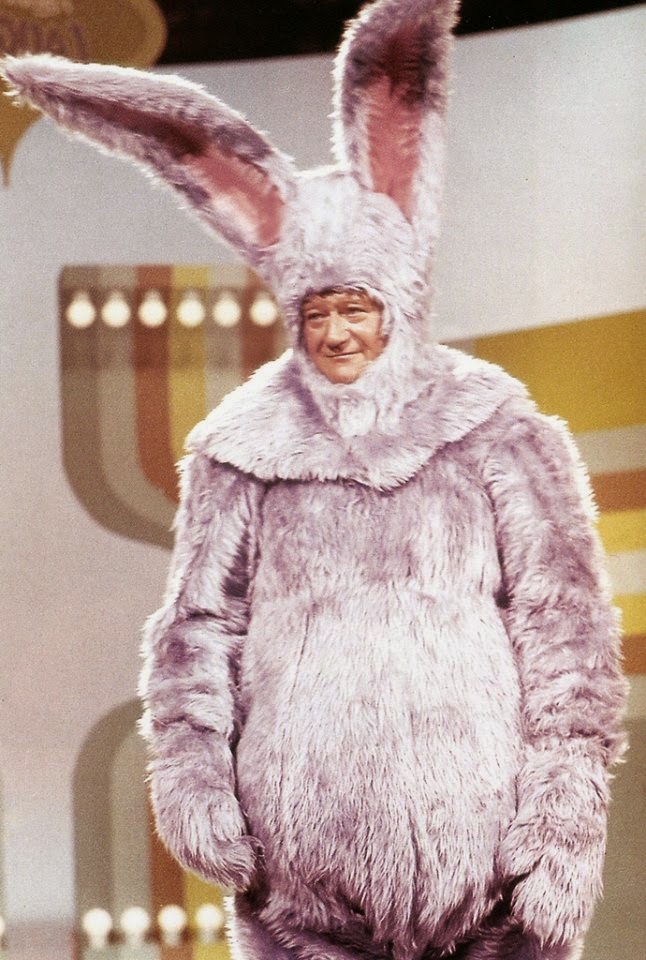
Happy Easter, Orange County

Did he lose a bet?
Yes, that's Newport Beach's own John "Duke" Wayne spoofing his own macho image in an appearance as the Easter Bunny in a 1972 episode of Rowan & Martin's Laugh-In.(Thanks to Manny M. for tipping me off to this.)
/Wayne is given two lucky rabbit's feet.

Wednesday, April 02, 2014

Golden West vs. Goldenwest

Tractor pulling a 20-ton dredger for Golden West Celery & Produce Co., 1915.
The Mayor of Huntington Beach, Matthew Harper, (an old friend from my high school days), just asked me, "Goldenwest or Golden West? The question will be on the agenda on Monday."

The origins and correct spelling of this north-south street running through Huntington Beach and Westminster have led to more than a little head scratching in recent years. I still don't have all the answers, but here's what I've discovered so far...

Maps from 1911 to the mid-1920s show part of the street -- from about Yorktown Ave. up to at least Ellis Ave. -- identified as Westminster Ave. One of the conventions for county roads was to name them for the community they led to.

Detail of 1916 map of Tract 62. Today's Goldenwest St. was shown as Westminster Ave. Today this tract is part of a private equestrian center between Garfield Ave and Ellis Ave in Huntington Beach (Courtesy O.C. Archives)
By 1935 at the latest, the road was called Golden West Ave. It likely took its name from the Golden West Celery & Produce Co., which incorporated in 1902 and did its packing in the town of Smeltzer, near the spot where Edinger Ave. now crosses the railroad tracks. (It became the Golden West Warehouse Co. after the celery industry tanked.)

On a related note, the phrase “the Golden West” was often used in the late 1800s and early 1900s to evoke a certain romantic or nostalgic notion of California. Examples include the play and opera entitled “The Girl of the Golden West,” the local Golden West Citrus Association, and the fraternal service group known as the Native Sons of the Golden West.
Golden West College, named for the street, opened in 1966.
The earliest reference I’ve found (so far) to the one-word “Goldenwest” in connection with the street is on a 1962 county survey map (RSB 59/2-3). But that seems to have been a fluke rather than the norm at that time. Almost always, “Golden West” was the preferred spelling until at least the 1980s or 1990s.

Beginning around 1981, a few references to “Goldenwest Ave.” began to appear in newspapers. By the end of the 1980s it was showing up that way on county survey maps and a few street signs. In 1997, the Thomas Guide changed the spelling in their maps from “Golden West” to “Goldenwest.”

In the 2000s, the digital mapping software used by Huntington Beach's police and fire departments in responding to calls was unable to cope with a single street having multiple names. City Council Resolution 2009-76 adopted a single name for each street facing this problem. One of these "fixes" was the official changing of “Golden West Ave.” to “Goldenwest Street."

I guess we'll learn the next chapter of this story after the City Council meets on Monday.
Akiyama Goldfish Farm, Golden West Ave, looking north from Bolsa Ave., Westminster, circa 1960.

Tuesday, April 01, 2014

The Most Historic Building in Orange County?

In 1796, Don Jesus Jose Maria Andreas Santiago Antonio Abramowitz was given permission by Mission San Juan Capistrano to build a home at what’s now 31971 Camino Capistrano, on the northwest corner at Del Obispo St. The men of the family mixed the adobe and made bricks while the women shaped the red clay roof tiles over their ample thighs.

Almost immediately upon its completion, cliff swallows began building their nests in the eaves of the house. One day, Fr. Junipero Serra was passing by the house just as the Don's son, Tavo, was shooing the birds away. Serra invited the birds to come live at the Mission, and they’ve been returning there ever since.(This annual migration, of course, inspired that beloved romantic hit tune of the 1940s, "Inka Dinka Doo.")

In December 1818, the cut-throat pirate Hippolyte de Bouchard ransacked San Juan Capistrano and commandeered the old adobe as his base of operations, burying a share of his pirate treasure under the home’s dirt floors. It is said that some of the treasure may yet remain.
 
In the 1850s, the building served as a stagecoach stop and roadside coffeehouse, operated by Juan Valdez. In the early 1850s, Valdez let the adobe’s basement be used as a hide-out for the notorious highwayman Joaquin Murrieta. The famous bandit fell in love with Valdez’ daughter, Guadalupe. After Murrieta’s death, Guadalupe could never bring herself to marry another man. She would tell the story of her whirlwind romance to anyone who would listen, right up until her death at the astonishing age of 135.

(The basement later also served as a hideout for Juan Flores, the Tomato Springs Bandit, and Patty Hearst during her time with the S.L.A. Each fugitive left their name etched in the adobe walls.)

For some years after the mission was secularized, the adobe served as the local Catholic Church. In fact, it was here, in 1865, that President Abraham Lincoln signed the document which returned the mission to the Church’s ownership. It’s said that his ghost can still be seen playing mumbleypeg on the porch each Presidents Day at midnight.

Shortly after the repatriation of the mission, the old adobe was purchased by Horst D. Westenfiel who sold beer and sandwiches. Ramona, (the half-Indian beauty for whom Helen Hunt Jackson’s named her blockbuster novel), famously ate part of a cheese sandwich there in the 1870s. Beginning around 1890 and continuing for half a century, the adobe was best known to tens of thousands of tourists as "The Place Where Ramona Ate A Cheese Sandwich." (Trade in Ramona/sandwich-related tourist tchotchkes kept the town's economy afloat even during the Great Depression.)

Next to the adobe was the famous “Old Hanging Tree,” on which many a criminal met a sudden end. Eventually the tree died, but its wood was used to build actress Helena Modjeska's home in the Santa Ana Mountains.
The main room as it appeared prior to the 1960 adaptive reuse project. Note the circa 1900 fireplace.
The back room of the adobe -- accessible via an outside door -- served as the town's first public library until the 1920s, when the building's new owner, Bessie May Mucho converted the whole building into a combination cathouse and speakeasy.

Rumrunners brought in booze through an old tunnel in the basement – once used for quick escapes by Murrieta – which ended in another basement on the far side of Camino Capistrano. The tunnel is sealed off now, but still exists and is said to be haunted.

Because it was so historically important, Walter Knott moved the adobe to Knott’s Berry Farm in 1941. But he moved it back when Capistrano locals complained.

In the early 1950s, the adobe was part of a large area suggested as a site for the future Disneyland by the Stanford Research Institute in a report developed for Walt Disney. Being close to a freeway and another major tourist attraction (the mission) was seen as a benefit. But the site was ultimately found unsuitable because a portion of it sat on an ancient Indian cemetery. Walt said a cemetery in his theme park would have been, "like, a major bummer, man."
Among the more modern of the many historical plaques that slather the adobe.
In 1961, the building was rehabbed and repurposed to become San Juan Capistrano Bank. Conveniently, the corner intended as the vault already had double-reinforced walls thanks to a brief period during which the building was used as the county jail.

Since then, it has remained a bank, cycling through a number of names, including Southern California First National Bank and California First Bank. It was already a Union Bank (its current name) in 1996 when an unarmed but extremely convincing robber made off with almost $2,000.

Many famous Orange County residents, including Gwen Stefani, Dean R. Koontz, John Wayne, Dennis Rodman, Richard Nixon and Octomom, have done their banking there.

A recent environmental impact report on the adobe found it to have no historical significance. It's scheduled to be bulldozed and replaced with a frozen yogurt stand next year.

Tuesday, March 11, 2014

Let's explore the Orange County Archives!

This photo was taken on Halloween. I don't normally dress like this for work!
I'm speaking on the subject of "What's New (and Old) at the Orange County Archives" at the March 13 meeting of the Orange County Historical Society, (this Thursday) 7:30 p.m., 2400 N. Canal St., in Orange. Along with an overview of the Archives, I'll be highlighting recent additions and sharing a new selection of rare historic photos (and film too, if time and technology allow). I know I've given talks about the Archives to many other organizations, but the majority of Thursday's program will be new and should be full of suprises for those who have seen my earlier presentations.

Here's a blurb on the Archives excerpted from this month's issue of the Orange County Courier:
In a democracy, access to public records – both past and present – is critical. Moreover, knowing our history is crucial to understanding our communities, where we’ve come from, and how best to plan for the future. And of course, preserving important information and images of the past is simply the right thing to do.

The Orange County Archives helps meet all these needs. It is a research center for the preservation and study of local history and is charged with promoting knowledge and understanding of the origins and history of Orange County.

Located in the Old Orange County Courthouse, at 211 W. Santa Ana Blvd, in Santa Ana, the Archives welcomes you to visit and use their unique collections of government records and other material documenting the rich history of our county.

The majority of the Archives’ records come from county government, beginning with Orange County’s separation from Los Angeles in 1889. However, when creating the Archives via an official resolution, the Orange County Board of Supervisors also provided that staff should collect “historical materials which are not official County records but which document the history of Orange County.” Because of this, the Archives has gathered and developed diverse collections that complement and strengthen one another.

Although its mission is partly to identify, collect, preserve and make available all these records, the Orange County Archives is more than its name might imply. It’s not a place where historical materials are simply boxed, numbered, and seldom seen again. These collections belong to the people of Orange County, and staff is on hand to help anyone and everyone find their way through 125 years of records in order to solve various historical, genealogical, and legal mysteries.

Archives staff members also organize historical exhibits, speak in public on subjects relating to county history, and sometimes help provide guidance for historical projects undertaken by county agencies or commissions. It is, in many ways, the central hub for Orange County history.

The Archives is a division of the Orange County Clerk-Recorder Dept., and is open to the public on weekdays (except holidays), 9:00 am to noon and 1:00 pm to 4:30 pm. For more information about the Archives, visit OCArchives.com or just stop by for a visit.

Saturday, March 01, 2014

The Taj Majal, aliens, Earl Nickles & Capistrano

I just came across this scene from the 1967 TV show, "The Invaders," featuring Laguna Hills' landmark Taj Majal Building(1964) in a starring role! (Didn't you always suspect that the at least some of South Orange County was developed by fiendish space aliens?) I understand that until 1968 the building was still owned by developer Ross Cortese, who headquartered his Leisure World Laguna Hills project there. (Hmmm.... Do you suppose the name of the "Santa Margaretta Dam" in this episode was borrowed from our old Rancho Santa Margarita y Las Flores?)

Our friend, Earl Nickles (the last of the railroad barbers) will share his collection of vintage local farm equipment at the Yorba Linda Historical Society, 7pm, March 10, at the Yorba Linda Community Center, 4501 Casa Loma Ave. Earl grew up on the Tuffree Ranch, so he can speak to the story of local agriculture first hand. His presentations are always both entertaining and educational.

The annual Fiesta de las Golondrinas is coming later this month, with the swallows theoretically making their return to Mission San Juan Capistrano on March 19. The Swallows Day Parade and Mercado Street Faire will be held on March 22.