Friday, January 31, 2020

Yes, I'm still a 12-year-old at heart

I was doing some property research this morning and stumbled across this in the Aug. 8, 1955 Pomona Progress Bulletin:
Jolly Neighbors Set Beach Outing
A wiener roast is planned by the Jolly Neighbors Club for Wednesday, at 11 a.m. at the home of Mrs. Esther Schmekel, 735 Main St., Huntington Beach. Members are to provide their own wieners and buns. Further information may be obtained from Mrs. Henry Keister, Ly. 2-5319.
Wait. Let me get this straight... 

Schmekels and Keisters need members to bring weiners and buns

I initially thought this must be a joke played on the newspaper editor. But no. Huntington Beach mayor Marcus M. McCallen sold the house at that address to Charles and Esther Schmekel on Dec. 13, 1943. And a quick check shows that Henry and Hertha Keister were well-known residents of Pomona. As Brigandi used to say, "I never make this stuff up, because I don't have to."

Ken Leavens (1933-2019)

Ken Leavens at the Old Orange County Courthouse (Photo by author)
I’ve just learned of the passing of Ken Leavens on May 12, 2019. It appears there was no obituary in the newspapers, nor an announcment of a service. But make no mistake,... Kenneth Sidney Leavens impacted many lives, including his countless students, his friends, and the whole Orange County historical community.

Ken Leavens was born January 26, 1933 in Ventura County. “Ken’s education started in a small rural school house (one or two rooms?) along Highway 126 in Santa Paula," writes Ken's friend, John Sorenson. "The red painted school house was still standing as a historical site when I visited Santa Paula in 2013.”

During World War II, Ken lived with his grandparents in Missouri. He later returned to California and graduated from Valencia High School in 1951.

“Ken had two sisters and a brother," said Sorenson. "His mother, Aurelia, was about twenty at the time of Ken’s birth. Aurelia lived into her late 90s in a care facility in Long Beach. His brother also resided in Long Beach. One sister lived in Santa Paula, the other in Placentia."

Interested in music from an early age, Ken graduated from Orange County State College (which later became Cal State Fullerton) with a B.A. in music in 1961. He worked his way through school,  employed at an auto parts manufacturing facility in the Fullerton area. Soon after graduating, he began his long career teaching music at Willard Intermediate School in Santa Ana.

"One of his duties was the marching band," said Sorenson, "a task he had for about twenty years. Taking additional classes, he qualified to be a history teacher for his last fifteen years. Whether he taught any music classes during this time, I just don’t know."

“Mr. Leavens was the director of the Willard Intermediate Boys' Choir,” writes Santa Ana historian Rob Richardson, who praised Ken's leadership. “He led us through some especially challenging pieces such as the choral Missa Brevis in D by Benjamin Britten.  I still have the record our choir made in 1973-74. I was a member of the choir from 1973 to 1975. [Mr. Leavens] built on the strong foundation of performing arts in the Santa Ana Unified School District for many generations.”
Ken as an Orange County State College graduate, 1961.
Ken never seemed excited to be in the limelight, but he sometimes appeared with the Willard choir in local televised performances. He also occasionally wrote letters to the editor of the Calendar or Arts section of the Los Angeles Times, sharing his insights on music. In one such letter, published Sunday, Nov. 11, 1984, Ken responded to a recent article by the Times' classical music critic Daniel Cariaga:
"Bravo!! Jeffrey Kahane [of the Los Angeles Chamber Orchestra] has dared to play a piano concerto that is not on the approved repertoire list of Daniel Cariaga. If you remember your 1950 freshman music history class 1-A, you know what the approved list is: the German-speaking composers, Mozart, Beethoven and Brahams. Tolerated: Schumann. All other Romantic period composers who composed for the piano have no substance. Unfortunately, 'no substance' seems to be code words for 'not chic.' Certainly, Daniel Cariaga's dismissal of Saint Saens Forth Piano Concerto as a 'mayonnaise sandwich' can hardly be taken as a scholarly analysis of a work that Paderewski and Cortot championed."
Ken retired in 1995 after more than 34 years at Willard, (although he occasionally returned as a substitute teacher). The school’s loss was the historical community’s gain. Ken becane very active in numerous historical organizations and had leadership roles in several, including the Orange County Historical Society where he served as a board member and society historian and made numerous friends.

“I met Ken while serving on the board of the Orange County Historical Society about 1995,” writes Sorenson. “Later we served on the Old Courthouse Museum Society and as members of the Santa Ana Parlor of the Native Sons of the Golden West. … Ken and I really got to know each other as we assembled the newsletter for the Old Courthouse Society. Three times a year, we talked on many subjects.

"Ken was very devoted to music and made many visits to the Hollywood Bowl and the Segerstrom Music Hall. On one trip to the Hollywood Bowl around 2005, he broke his hip. For many weeks he was in a hospital in Hollywood. Out of respect and compassion for a friend, I made trips from Irvine to Hollywood on every Saturday to visit him in his bed. The recovery period was long and hard. Ken emerged with one leg slightly shorter than the other. He wore special shoes for the balance of his life.”  
Ken Leavens conducts 1968 Willard boys choir. (Courtesy Fred Dolan)
For years, the highlight of the Orange County Historical Society's board meetings was Ken reading his responses to historical queries from the public. He was a natural at historical research and worked hard to answer each question – even if it meant spending days driving around from institution to institution, digging through old newspapers and microfilm and paying for parking and gas on his own nickel. His dedication to getting the facts straight and helping total strangers was remarkable.

“He was still on the OCHS board when I joined it and I enjoyed speaking with him immensely,” said Huntington Beach Historic Resources Board Chair Kathie Schey. “I was saddened when he decided to hang up his hat with regard to public queries. There was much discussion about how this work he contributed could be replaced and I remember the consensus being that it simply could not. His passing is another real loss to the history community.”

As a board member, Ken was always even-tempered, friendly, intelligent, and a voice of reason. It was impossible not to like the man. Health problems mostly kept him at home in the last few years and his presence has already been greatly missed. Now, unfortunately, we’ll be missing him in perpetuity.

Ken passed away in the same Fullerton home he’d lived in since 1956. “Ken was a very private person and his death was a sudden event even to his siblings,” writes Sorenson.  

Farewell and thank you for all you've done, Ken.

Wednesday, January 15, 2020

Shooby dooby down to Ruby's

Ruby's high school senior yearbook photo, 1940.
Ruby Cavanaugh of North Tustin was the inspiration, namesake and mascot for her son’s chain of Ruby’s Diner restaurants.

Ruby Fern Michael was born July 29, 1922, in Jefferson City, Missouri to Edwin and Victoria Michael. In 1936, the Michaels moved to Southern California. Ruby attended John C. Freemont High School in South Los Angeles.

“At 18, she met Douglas Clide Cavanaugh, a U.S. Navy veteran, who shared her love of swing music and dancing,” wrote Paul Hodgins in the Orange County Register. “Ruby and Doug married in 1944 and had two children, Doug Jr. and Jane.” Later, the family moved to a two-story tract house on a cul-de-sac (13571 Whembly Dr.) in North Tustin. Ruby would live there for nearly fifty years.
A family photo, with Ruby on the right.
Doug Jr. and his business partner and fellow Foothill High School grad Ralph Kosmides started Ruby’s Diner in 1982 on the Balboa Pier. Doug was jogging past an empty run-down bait shop on the end of the pier one day when the idea occurred to him to open a 1940s-style diner. He asked his mom if he could name the place after her, and she immediately said no. He ignored her and Ruby was more than a little surprised when she came to the grand opening and saw her name lit up in neon. The restaurant’s logo, drawn by a Balboa artist, is based on Ruby’s high school cheerleading photo.
A later photo of Ruby holding a photo of her younger self.
On the first day of business -- December 7, 1982 – Doug and Ralph worked the grill and cash register and made $63. The place grew in popularity, and in 1987 they opened a second Ruby’s at the end of the Seal Beach Pier. Ruby’s became the next in a long tradition of Orange County restaurants that grew into large and successful chains. By Spring 2019, Ruby's Diner had 32 locations, including 26 in Southern California.
Ruby died in Orange County on December 27, 2015. An estate sale soon followed, and a number of items were purchased by Lisa Baldwin of A & P Antiques in Downtown Orange. I purchased a few of these items (show in the photo above) from Lisa’s shop simply for their attachment to Ruby Cavanaugh. I picked out a plate and cookbook for their association with food, and a bright and colorful scarf which seemed to say something about her personality. I donated these items and added a current menu from the Ruby's Diner chain to the Orange County Historical Society at their annual Show & Tell program in December.

Tuesday, January 14, 2020

Phil Brigandi: Orange County Archivist

In the wake of Phil Brigandi's death, the Orange County Historical Society presented a tribute to him on Jan. 9, 2020, focusing on his Orange County historical work. At least 300 people attended. Each of the five speakers that night (Mark Hall-Patton, Art Hansen, myself, Stephanie George and Eric Plunkett) focused on a different segement of Phil's life and work, combined with other favorite memories. This was my contribution -- focusing primarily on Phil's time as County Archivist. My more comprehensive tribute to Phil and his life is posted here.

I first met Phil Brigandi in 2003, when he was the newly minted Orange County Archivist. I’d been trying to get into the Archives for years to do research, but it had closed in the wake of the County bankruptcy. The County Library handed the Archives over to the County Clerk-Recorder's Office, which didn't immediately reopen the place either. But in Spring 2003, Tom Daly was elected the new Clerk-Recorder and he made re-staffing the Archives and providing access to these publically-owned records one of his first priorities. During the search for a new archivist, Jim Sleeper told Tom that Phil was more than ready to return from his 13-years of exile in Hemet.

Phil had done some work at UCI’s Special Collections and had some training in the technical/library science end of archival practice, which added to his already vast understanding of Orange County history and how the records could be best utilized. He was the perfect man for the job.

I visited the Archives the first week it was reopened and met Phil when he was just figuring out what he had. The library folks had left no finding aids or clues – Just room after room of often cryptically-marked boxes. Within minutes of meeting me, Phil took me on a tour through the stacks. We peered into boxes, trying to figure out what was where – a process we would repeat for years until we got most of it reasonably organized and labeled. We probably talked for an hour or so, and then I sat down with some files he’d pulled for me on Googie architecture and early Santa Ana attorneys.  It was a good day and I enjoyed talking history with Phil, but figured that was it until the next time I had research to do.

But a few weeks later, I got a call from him saying, “This is not a one-person job, and it isn’t working to have random county employees assigned as my assistant. I need someone who cares about this stuff and who wants to learn. How’d you like to come work for me?” 

I didn’t ask what it paid or what the hours were. I just said yes. And I’ve been there ever since. I’d been doing local history projects since high school but never imagined that a paying gig might exist. 

The five years I worked for Phil were the best education I could have received anywhere. And I’m not talking about the basic archival practice stuff, although I learned that too. This was not a file clerk job, and as Phil often told me, “You’re doing the exact same job as me – just playing the tune in a different key.” Phil taught me how everything fit together. He taught historical context. He taught me how to see the physical environment around us with the eyes of a historian and to look for details others would miss. He taught me not just how to be a historian but also why. 

He showed me how to process collections, create finding aids, handle materials, encapsulate documents, read topo maps and conduct reference interviews. He taught me to keep my ear to the ground for historical materials that needed to be saved. He taught me that thoughtful accuracy was always infinitely more important than meeting an arbitrary deadline. And he taught me that sharing materials and knowledge was the only way to fly – as opposed to hoarding it or putting up barriers to public access. More than once he told me, “Treating something like a precious treasure and making it inaccessible isn’t much better than treating it like trash.” 

He also taught me that the individual historians, the old families, the historical institutions like the Archives, and the historical societies like OCHS were all intertwined and interdependent on one another as part of a larger historical community. They might somehow survive independent of one another, but none would ever really succeed or be relevant without the others. “Local history,” he often said, “is a small pond.” And the bigger the pond, the more patrons, the more people helping each other, the more forward momentum for everyone, and the more visibility for the kind of historical endeavors that make Archives worth having in the first place.

Phil approached history as a calling, not just a job or even a career. Getting paid for the work was, at most, an afterthought. Phil realized he had a gift and he used that gift to preserve history for future generations, spread the gospel of community, and help others. Like most of us, he was happiest doing what he did best.
Phil was not just a great mentor, but also the best boss you could ever hope to have. Too many government employees operate primarily from a place of fear and over-reverence for the fickle whims of elected officials. Phil, on the other hand, had a healthy disregard for such nonsense and ran the Archives for the betterment of the County, the public, and local history.

Our desks were about five feet apart and we more or less had a running conversation at all times, no matter what we were working on. Every day was interesting – in a good way. Having worked in the gulag-like veal fattening pens of corporate Irvine, this was so refreshing. It was a delight to come to work every day and our patrons were the main beneficiaries of our positive attitudes.

Phil brought in about 40 collections to the Archives, including such gems at the Knott’s Berry Farm Collection, a century-worth of naturalization records, the County’s bankruptcy records, the records of the El Toro Marine Corps Air Station reuse battle, and the papers of historian and court reporter Lecil Slayback and industrialist Adolph Schope.

As Archivist, Phil was a jack of all trades and master of most. Whatever the task at hand, Phil dove right in – From sorting records to installing map cases to helping patrons make sense of arcane records that somehow held the answers to their questions.

And he made everything fun. As he liked to say, “Too many people mistake being serious for being solemn.” He was deadly serious about his work, but he was hardly ever solemn. The Orange County Archives was a fun place to be, good work was being done, stress levels were near zero, Phil was sharing his brilliance with anyone who needed a hand, and researchers always told us how much they looked forward to their visits. It was truly a golden age, and I was so lucky to have been part of it.

An 2004 L.A. Times article hinted at the flavor of things, describing how Phil approached his work “with the enthusiasm of a kid on Christmas morning,” and how “with smiles, the archivist and his assistant, Chris Jepsen, interrupt each other as they tell of a recent visit from [a patron] in search of clues about her grandparents.”

Thanks to his sense of humor, even the most mindless of tasks – like a full day of reordering jumbled records to match old indices – could end up being fun. We did just that one day, and made a game of reading off funny names as we came to them. Once one of us read the name, the other had to briefly describe the person who should have such a name. By the end of an entire day we were nearly done with the project, having organized many boxes of documents, but we were really tired and acting accordingly punchy.  One of the last names I came to was “Fanny Sparks,” which I almost couldn’t say out loud because I was already laughing. But Phil made out what I’d said and immediately announced that Fanny Sparks was “one of the side effects listed on the warning labels of Olestra potato chips.” We both laughed until we were actually in pain. We had to go to separate rooms out of earshot of each other so we wouldn’t keep egging each other on. It probably took a good twenty minutes to stop laughing over that stupid joke and maybe the whole evening to recover. But we’d whipped through another large project – accurately and in a short period of time – and we’d had a hell of a time doing it. Things were like that with Phil.

Phil never lost track of the underlying reasons the Archives existed and he made pragmatic decisions based on a great deal of knowledge, intelligence and not-so-common sense. He threw himself into his work wholeheartedly and was exceptionally good at his job. He was there for all the right reasons.

The Archives were also scrupulously tidy and well-organized on his watch. We always knew where everything was, and – except for the place we called “The Evil Closet” – any corner of the stacks was presentable for tours at any moment. His own apartment was similarly organized to the n-th degree. Again, he was the perfect guy to hire as Archivist.
Although he had his reasons, I never quite forgave Phil for leaving the Archives when he did. But Phil was – as his scouting friends like to point out – extremely stubborn. I spent about six months trying to talk him out of quitting. I pointed out that he had near total autonomy in how he ran the Archives and that the job gave him not only pay and medical benefits but also great visibility and a bully pulpit for local history. But once Phil made up his mind about something it was a done deal. Ultimately, he did the one thing he’d always told ME never to do: He jumped before he had a place to land.

Not a week goes by that I don’t wish Phil had stayed.  Every one of our longtime patrons felt the same. They were heartbroken and so was I. I can only imagine what the County Archives could have accomplished with him still on the team.

Happily, Phil and I remained close friends after he left. We went to the Postcard and Paper Shows together and stopped at a different classic L.A. restaurant for dinner each time. I helped him find homes for Jim Sleeper’s historical materials after Jim’s death. In some ways, he was the older brother I never had. He stopped by often for lunch and I called him often for advice. I probably saw him about once a week in addition to phone calls and emails. Sometimes more. And yet, I deeply regret not spending more time with him in the last few years. With personal matters absorbing much of my time recently, our late night Del Taco brainstorming sessions and weekend expeditions to historic sites or postcard shows were effectively on hiatus. I thought they’d resume when my life calmed down a bit.

Instead, not only am I – like all of us – left grieving – But I’m also left with the shocking realization that the entire map of Orange County historical work has changed completely. No major research project was complete without touching base with Phil to see what he had in the file. He was the one I sent people to with so many questions on so many topics where there simply was no point in turning to any other source. And in the back of my mind, while doing my own writing, I always considered – would this pass muster with Phil? I will always try to hold myself to that standard – but I will never again know if I’ve met it.

Phil conspired with so many of us on so many projects. It’s hard to imagine who else will share our enthusiasm so thoroughly, engage us so thoughtfully, or inspire us to do our best work. Even as we did our own work, he remained our litmus test, gold standard, map, sounding board and ready volunteer.

When I met Phil, there was still a whole pantheon of great local historians we could look up to, from Esther Cramer and Jim Sleeper to Doris Walker and Barbara Milkovich. I was proud to help with whatever meager additions I could bring to table, but I hardly felt essential. But the ranks of those giants dwindled rapidly, and at a relatively young age Phil found himself in the unlikely position of elder statesman. Of course, he was up to the job.

But now, a few of us who are even younger than Phil now face the unthinkable: WE are the ones left holding the torch Phil was handed by Don Meadows and Jim Sleeper and which Terry Stephenson in turn once passed to them. We cannot replace these giants. There will never be another Phil Brigandi. But because we share his mission and because we love him, we will do all we can to keep the flame burning and eventually pass it to yet another generation. In the meanwhile, we have work to do: The work of local history -- The research, the writing, the publishing, the speaking and the sharing. Phil Brigandi isn’t going to do it for us, and neither is anyone else. It is good and rewarding work, but it is hard work nonetheless, and now more than ever we must support each other and our mission.
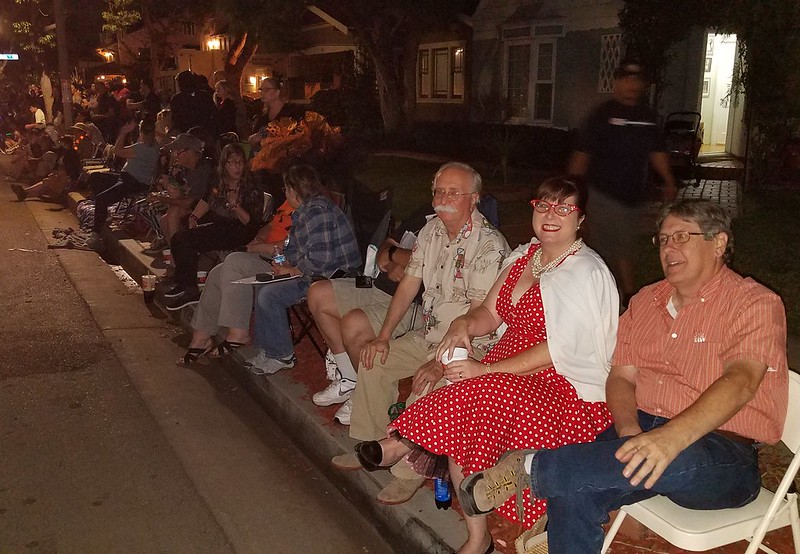
Photo taken at OCHS' tribute to Phil Brigandi, Jan. 9, 2020.

Thursday, January 02, 2020

Happy New Year!

A century ago: Mission San Juan Capistrano, Jan. 1920

Tuesday, December 31, 2019

Barbara A. Milkovich (1939-2019)

Barbara Milkovich "in the field," working on the excellent Huntington Beach Historic Resources Survey (1986).
Historian and preservationist Dr. Barbara A. Milkovich passed away June 6, 2019. Locally, she was known best for her work in discovering, describing and preserving Huntington Beach’s history. Indeed, her 1988 masters' thesis for California State University Long Beach – focusing on Huntington Beach from 1900 to 1930 – was the first significant look at that city's history by a graduate-level scholar. But that was just the tip of the iceberg.

Specializing in community history, Barbara was a serious academic historian who also understood the methods and purposes of the traditional local historian. Combining these approaches, she unearthed forgotten narratives and put them into thorough context before providing her own analysis. She was equally at home in halls of academe or collecting stories from old timers on a porch over lemonade. And although some newcomers to Orange County’s historical scene may not remember her, her work provides important foundations on which we continue to build.

She was born Barbara A. Hoeft to George and Francis Hoeft in Colorado in 1939. She went to East High School in Denver, and went on to receive a B.A. in Political Science at the University of Colorodo (Boulder), an M.A. in history and a post baccalaureate certificate in urban studies from CSU Long Beach, and a Ph. D. in history from the University of California, Riverside.
University of Colorado senior Barbara Hoeft, 1961.
Barbara married Joseph J. Milkovich in Los Angeles County, Dec. 29, 1962. In 1964 they moved to their new home at 832 Dundee Dr, in Huntington Beach, where they would live until 2002.

Barbara taught public history at CSU Fullerton and California history and oral history at Goldenwest College. She worked as a consulting historian and archivist, established the Carl Kartcher Enterprises, Inc. archives, was the founding chair of the Huntington Beach Historic Resource Board, and was a reader at the Huntington Library. As a member of the Orange County Historical Commission, she fought to have the County Archives reopened (after it was de-staffed in the wake of the County’s municipal bankruptcy) by going to the media and bending the ear of every county official she could corner.

Barbara also wrote innumerable articles, gave scores of public historical presentations, edited the Orange County Historical Society’s journal, and wrote at least one book, It's Gone; Did You Notice, A History Of The Mesabi Range Village Of Franklin, Minnesota, 1892-1994 (2000).
Photo Main St. at Walnut, Huntington Beach, 1984, by Barbara Milkovich.
Today, the folks who want to destroy every last historic structure and site in Huntington Beach have largely won the war. But Barbara made them fight for every inch of territory. At a time when all of historic Downtown was first threatened with demolition, Barbara, led the good fight to save the city from itself. Barbara could be pretty tough-minded about preservation, but she had to be in such a town. "I wish,” she told the Los Angeles Times, “they would understand that preservation is redevelopment."

Sadly, she could not defeat the solid wall of ignorance and developer campaign dollars she encountered. That said, Barbara is still remembered by those who love their hometown as someone who fought for them. She is also well-remembered by various morons and rotters as having been a major thorn in their side.

Back in the late 1980s, Barbara was one of the first people to help bring me into the world of local history. I’d put together a display of my own photos of historic Huntington Beach buildings for my high school photography class and had already received some pointers and background information (for captions) from City Historian Alicia Wentworth.  But once the display was complete and the grade given, I wanted to put it somewhere that could do some good. I took it over to the Huntington Beach Historical Society, where a diligent volunteer – Barbara Milkovich – accepted it and put it on display in the parlor. I was thrilled, but had little idea that this was a gateway for what would one day be my career.
Photo of the Golden Bear, Huntington Beach, 1984, by Barbara Milkovich.
I’m certainly not the only one she inspired. Through her tenacious research, teaching, community activism and volunteer efforts, Barbara Milkovich laid essential groundwork for the future of historical preservation in Orange County and scholarship on Huntington Beach. And while she did not live to see all her goals achieved, she should be remembered as a central figure who made such goals achievable in the future. Progress is already being made, and the current generation stands on her shoulders.

In 2002, the Milkovichs – much to Orange County’s detriment – moved to Hayden, Idaho. Some years later, Barbara very graciously sent her extensive papers to me, which I, in turn, donated to the same Orange County Archives she once fought to reopen.

Unfortunately, I haven't found an obituary for Barbara and only found out about her death very recently. As such, this small tribute is based entirely on an old resume (for which I thank Joe Milkovich and Diane Ryan-Wiegand), records on Ancestry.com, newspaper clippings, and (primarily)
my own memories. If you have more memories or better photos, please let me know. I'm happy to update and expand this post.

Friday, December 27, 2019

Views from the heart of Santa Ana

A still-unpaved W. 4th St, in 1889 – the year Orange County was formed. The tracks down the middle of the street were for the Santa Ana, Orange & Tustin horse-drawn streetcar, which was later converted to steam power. (Photo by B. F. Conaway)
This year marked the 150th anniversary of the City of Santa Ana. What follows is based very loosely on a small tribute exhibit we put together earlier this year at the Archives, which looked at the city’s history through the lens of its historic core.

Fourth Street was the heart of Santa Ana from the moment William Spurgeon sketched out plans for his new town in 1869. Indeed, as the town developed, the intersection of Fourth St. and Main St. became the center of Santa Ana’s commercial and professional life. And in 1889, when Santa Ana became the seat of the new County of Orange, Fourth St. became the whole county’s primary hub of shopping and business, and the temporary home of our county government’s offices. Over the decades, a succession of horse-drawn, steam-driven and electric trolley services served this hive of activity.

For more than half a century, Fourth St. was where Orange County came to see their lawyer, doctor or dentist. It was where one bought linens, china, housewares or clothes, in department stores like Rankin’s. It was where the country folk came on Saturday night to dine, dance, or see a movie. And in wartime, at holidays, or when the circus came to town – Fourth St. was the place to hold parades. 
Woodcut image of 4th St. in 1887.
During the post-World War II boom, Downtown Santa Ana faced competition from countless suburban shopping centers, malls, and professional complexes. Trolley service ended and many long-standing businesses closed along Fourth St.. But new tenants moved in, and soon “Calle Cuatro” was a bustling hub of commerce again – This time serving the large population of migrants from Mexico and Central America. Business continued – just in another language. And aside from the newer Fiesta Marketplace (1980s) and Reagan Federal Building (1990s) much of Fourth Street’s historic charm remains.

The following images do not constitute a comprehensive history, nor are they particularly chronological. They are simply snapshots: A few sample moments in time from a place with a century-and-a-half of rich history.
This (above) was the Congdon Block, at 304 E. Fourth St. at Spurgeon St., in 1890. The new County of Orange rented much of this block as the first county government offices before constructing its own buildings. Grocer F. M. Goff, whose advertising can be seen here, was one of the founders of the Arch Beach community in South Laguna and later (1897) purchased and moved to a coffee plantation in Honduras.
East Fourth St., looking east, circa 1905. Santa Ana was rightly proud of its new Pacific Electric trolley line. These “Red Cars” were the backbone of transportation in Southern California until automobiles fully dominated the landscape.  The Santa Ana line operated until July 1950.
Interior of the John L. Martin Store, on the southwest corner of E. Fourth St. and Bush St., in 1900. Martin sold groceries, china and glassware for fifteen years before selling his store in 1908 and moving back to Indiana to be near his elderly father. Martin returned to Santa Ana to stay in 1912 and was pleasantly surprised at the town’s growth: "Fourth Street looks mighty good to me. New businesses new store fronts have gone in, and the business portion of the town looks thoroughly alive."
The Ringling Bros. Circus Parade marches along the 100 block of E. Fourth St. on Sept. 24, 1909. The Santa Ana Register reported that the parade “was more than two miles long” and “that none one of the thousands who saw it today will ever forget it." A roller-skating chimpanzee in a suit, dubbed “Darwin, the man-monkey,” headed the menagerie.
During the Great Depression, the Works Progress Administration’s surplus commodities program distributed such basics as clothing, bedding, staple foods and beer at the Karo Building, at 805-807 E. Fourth St. The building, shown here on a “distribution day” in 1937, also housed the KA-RO Hotel and an auto garage.
East Fourth St. in 1935, looking southeast. With the exception of the Alpha Beta grocery store, most of the buildings shown here on the south side of the street still stand today. The photographer stood on the site of the current Reagan Federal Building. (The theater building on the right is still a particular favorite of mine.)
The Santa Ana Hotel, at Main and Fourth St., circa 1880. The front of this hotel is where politicians generally gave speeches. In March 1879, one such speaker was Denis Kearney, a labor leader who advocated lynching, violence against his foes, and the eradication of Chinese from California. Kearney made scurrilous accusations against such popular locals as W. H. Spurgeon, J. H. Fruit, and especially James McFadden. McFadden employee T. W. Rule hit Kearney hard, “spoiling his nose.” Kearny ran into a drugstore and was followed by Rule and Bob McFadden, who took turns pummeling him. A badly beaten Kearny hopped the next stagecoach to San Diego.
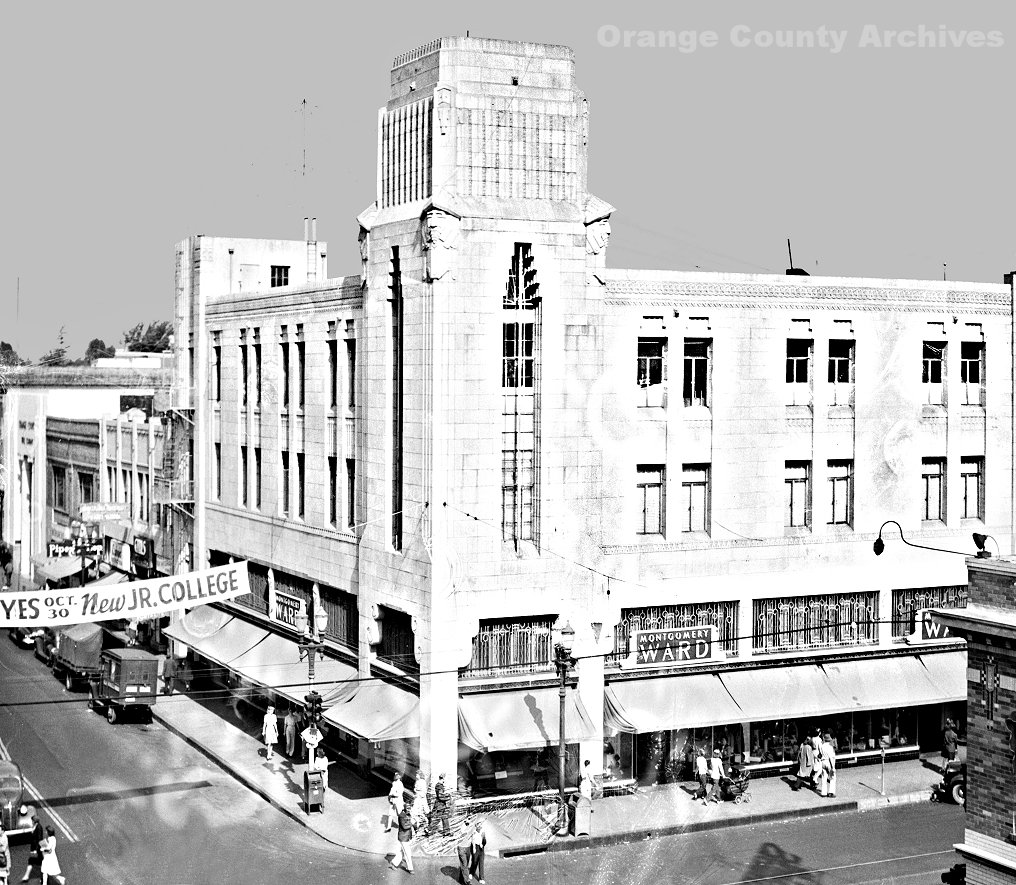
The Montgomery Ward department store's dramatic art deco-styled store at Main and Fourth St. was designed by local architect Horace Austin, and opened in 1933. It was demolished in 1974 as the first step in a downtown redevelopment plan. Part of it's decorative ironwork was incorporated into the walls that currently surround the parking lot where "Monkey Wards" once stood. This photo was taken in 1945, as evidenced by the banner promoting a bond measure to build a new Santa Ana College campus.
Like most downtown businesses, the Parke S. Roper Book Store at 210 W. Fourth St. decorated their store for the large Civil War veterans’ convention held in Santa Ana in April 1908. Note the Grand Army of the Republic (Union veterans organization) ribbons in the window.
This photo shows repairs underway on buildings along W. Fourth St., between Sycamore and Main, after the earthquake of March 10, 1933. The magnitude 6.4 quake caused 120 fatalities and widespread property damage throughout the Long Beach and Orange County areas.
A Pacific Electric trolley rolls past the William H. Spurgeon Building on W. Fourth St. at Sycamore in the 1930s. This was the third “Spurgeon Building” to grace the street and was built in 1913 to replace the 1882 iteration on the same site. Today, its clock tower is an iconic symbol of Santa Ana.
Santa Ana's National Guard Company L marches off to World War I in 1917. Here they march past the Rossmoor Hotel on W. Fourth St.
Many still remember Fourth St. as it appeared in the 1950s. This photo was taken at Fourth St. and Broadway, around 1956. 
 
Today, a broad array of Orange Countians are rediscovering Fourth Street’s charms. Quinceanera dress shops and international money transfer services have been joined by coffee houses, banks, and hip restaurants. New life has been breathed into old theaters, large festivals are occasionally held in the street, and even trolley service is set for a comeback.
W. 4th St. torn up for redevelopment, circa 1982-1983.

Saturday, December 14, 2019

Phil Brigandi (1959-2019)

Phil at San Juan Hot Springs, 2009 (Photo by author)
Orange County Historian, author, former County Archivist, and lifelong Boy Scout Phillip K. “Phil” Brigandi passed away this week in his beloved hometown of Orange at the age of sixty. He was the author of at least thirty books and countless well-researched articles about Southern California history. He had, as his friend Lisa Baldwin said, an “amazing gift for retaining, distilling and recounting local history.” His loss has left a gaping hole in the heart of the local historical community and those who loved him.

Memorials and tributes to Phil included...
  • Phil's funeral, planned by his brothers, was held Jan. 29 at Waverly Chapel, Fairhaven Cemetery in Santa Ana. More than 200 people attended. Video has been posted. Fairhaven's website includes public comments.
  • Orange County Council, Boy Scouts of American Annual Awards Gala: Phil was already scheduled to receive the highest honor awarded to volunteers in Scouting -- the Silver Beaver -- on Jan. 25. It was awarded posthumously before a crowd of 600. See video here.
  • The Orange County Historical Society held a public tribute to the man, his work and his legacy on Jan. 9 at Trinity Episcopal Church in Orange. More than 300 people attended. Video  of the first half and the second half of the program are now both online. I've also posted my comments as text here. The Society is also starting a fund in his name that will help support the newly renamed Phil Brigandi History Room at OCHS. The Society will also host a memorial hike later this year.
  • Hemet/Temecula historical community: The Hemet Heritage Foundation, Hemet Museum, San Jacinto Museum, and the Ramona Bowl Foundation held a tribute to Phil at the Diamond Valley Arts Center, in Hemet on Jan. 10. Historian Steve Lech gave the eulogy. About 60 attended.
  • City of Orange Public Library assembled a small exhibit about Phil and the books he's written about Orange's history.
  • A Scouting Celebration of Life was held at the O.C. Boy Scouts of America office in Santa Ana on Jan. 4 with John Nordenstam and David Daniels. See video here.
  • California State Historic Resources Commissioner Alan Hess honored Phil as part of the Commission's Jan. 31 meeting. (Skip to about 1:15:00 in the video.)
  • Government: The Orange County Board of Supervisors and the city councils of Anaheim and Santa Ana adjourned meetings in his memory.
I'm sure this will not be the end of the tributes to Phil, and I'll do my best to keep this page updated as I learn more.

Half of Phil's ashes will be interred with his mother's ashes in a niche at Fairhaven. The other half will be spread at his Lost Valley Scout Camp (where the flag is already at half mast) sometime this spring.

Phil was born in Orange, California, on June 29, 1959 to Pamela and Michael Brigandi. Michael was a Jungle Cruise skipper at Disneyland and would later have a long career working for the Orange County Probation Department. Phil and his brothers Stephen and Christopher were raised in Orange.

Phil was fascinated with local history even as a student at Handy Elementary School. He began to do actual historical research and writing as a teenager, compiling stories of Orange High School and interviewing “old timers.” This, in turn, led him to the Orange Community Historical Society where he was elected to the board of directors at the age of 18. It was there that he began to forge lifelong friendships with fellow historians, including that society’s president, Mark-Hall Patton.
Phil Brigandi, circa 1990s. (More photos posted on Flickr)
At the same time, Phil was very involved in his local Boy Scout Troop and learned to love camping, hiking and backpacking. He especially loved his time at the Lost Valley scout camp near Warner Springs. He later joined the camp staff and eventually ran the place, becoming something of a legend among Orange County scouters. For the rest of his life, he would return each year to clear trails and teach a new generation of scouts.

Phil was also a Marx Brothers fan from an early age. He interviewed a number of those who worked on their movies and he counted being personally insulted by Groucho Marx as one of the high points of his life.

In Orange, Phil began writing historical columns for the local newspaper. He started writing lengthier pieces by the time he was 19 and published his first real book at age 23. He graduated from California State University Fullerton, where his abilities and enthusiasm were identified, encouraged and guided by Dr. Art Hansen and top History Department faculty.

Phil’s college work took him back to study the history in the areas of San Diego County near his beloved Lost Valley. He made close friendships with elders at the Pala reservation and steeped himself in the lore of the Anza-Borrego desert.
With Phil Brigandi and Jim Sleeper in Jim's office, 2009. (Photo by author)
All through his years as a developing historian, Phil was also befriending and learning from the great Orange County local historians of the day, including Jim Sleeper, Ether Cramer, and Phil’s greatest role model, Don Meadows. They were his heroes, his friends and – by example – his teachers. They were, in some ways, like family to him. He never missed an opportunity to pay tribute to their contributions and he would always hold himself and his own work up to their highest standards.

“Local history is often underappreciated, viewed as parochial, or simply ignored, written by ‘blue hairs’ and the ‘untrained.’,” writes historian and close friend Stephanie George. “But, Phil's research skills and knowledge of his beloved city of Orange, his county, and southern California could match any academic -- and then some -- as he explored through multiple disciplines the very fabric of who we were/are through his multiple books, articles, presentations, and storytelling.”

Phil approached local history as a calling, not just a job or even a career. As such, he was never very interested in how much (or sometimes even if) he was paid for his work. He once said, “My brain just doesn’t make the connection between the work I do and the pay I get. I just do what I do, the best way I know how. Money appears sometime later, and it’s always kind of a surprise.”

What did matter to him was the quality of his work and whether he was helping the greater cause of understanding and preserving Southern California’s history. He wanted to, and constantly did, make meaningful contributions to the subjects about which he cared so deeply.
Phil speaks at Orange County's 125th birthday party, hosted by OCHS. (Photo by author)
“I come from that older tradition of historians who put an emphasis on gathering up the facts and stress the narrative and chronological account over theory and analysis,” said Phil. “You have to start with the facts, after all. The analysis should come later. And too often, I've been the first historian to really research a specific topic or place. My emphasis has always been on telling the story.”

Phil’s articles appeared in Dezert Magazine, the Westerners' Branding Iron, the Orange County Historical Society's Orange Countiana, the High Country, the Overland Journal, the Journal of San Diego History, the Inland Chronicler, Desert Tracks, the Ventura County Historical Society Quarterly, the Journal of California and Great Basin Anthropology, the Sand Paper, the California Museum of Photography Bulletin, Preview magazine, and many more.

His regular columns appeared in such periodicals as the Orange City News, the Orange Progress, the Rancho News (Temecula), the Aza-Aguanga Stageline, the Hemet News, the Borrego Sun, the Valley Chronicle (Hemet), and the Old Towne Orange Plaza Review and others.
Phil and Mark Hall-Patton with fellow book collector at the 2017 Pasadena Antiquarian Book Show
His many books included such titles as…
  • The History of Lost Valley and the Surrounding Area (1978)
  • The Plaza. A Local Drama in Five Acts (1982)
  • Looking Back . . . on the Ramona Pageant (1985)
  • A New Creation. The Incorporation of the City of Orange, 1888 (1988)
  • A Place Called Home. Orange's Architectural Legacy (1990 with Karen Wilson Turnbull)
  • Garnet Holme: California's Pageant Master (1991)  
  • Prayers, Presence, Gifts and Service. A Centennial History of the Hemet United Methodist Church, 1894-1994 (1994)
  • Orange, The City ‘Round the Plaza (1997)
  • The Ramona Pageant. A Pictorial History, 1923-1998 (1997)
  • Temecula, at the Crossroads of History (1998)
  • First Church. A 125th Anniversary History of the First United Methodist Church of Orange (1998)
  • Watson's Drug Store. A Downtown Orange Tradition. A Centennial History, 1899-1999 (1999)
  • 100 Years of Headline News [The Orange County Register] (1999)
  • Building the Future. The Story of the Eastern Municipal Water District (2000)
  • Old Orange County Courthouse; A Centennial History (2001)
  • Borrego Beginnings. Early Days in the Borrego Valley, 1910-1960 (2001)
  • "Out Among the Groves of Orange" A History of Orange Union High School, 1903-1953 (2003)
  • Barnstorming the Desert. The Life of Randall Henderson, Founder of Desert Magazine and a Pioneer Pilot of the Desert Southwest (2004)
  • Orange County Place Names A to Z (2006)
  • Images of America ... Orange (2008)
  • On My Honor, A Century of Scouting in Orange County, California (2010)
  • A Brief History of Orange, California - The Plaza City (2011)
  • Orange County Chronicles (2013)
  • A Call for Reform, The Southern California Indian Writings of Helen Hunt Jackson (2015 with Valerie Sherer Mathes)
  • Reservations, Removal and Reform: The Mission Indian Agents of Southern California, 1878-1903 (2018 with Valerie Sherer Mathes)
  • The Portola Expedition In Orange County (2019 with Eric Plunkett)
Phil also served as editor for a number of books, including A Hundred Years of Yesterdays by the Orange County Historical Commission.
Phil Brigandi, Orange County Archivist (Photo by author)
Phil had little patience for those who did lazy, inaccurate, or out-of-context historical work and for those who used history to grind political axes, invoke divisiveness, drum up marketable shock value, or “check off the boxes” of political correctness for the sake of career advancement.

The few detractors Phil ever had were usually bad historians with a jealous streak. At least a couple of these dismissed him as “a purist.” But that’s exactly what Phil was shooting for. He wanted to tell the narrative and get it right. He was happy to leave fiction, half-truths and wishful interpretation to others.

Phil grew up in a home without much, if any religion. But through friends he found Christ, made a personal study of theology, and was eventually very active in the Methodist church. Over time, he came to feel that the Methodists might not be the right fit for him and he no longer affiliated with a specific denomination. But his faith was always central in his life. Phil never evangelized by hitting people over the head with religion. But he made no secret of being a Christian and he lived and behaved in ways that made others want to know how they might have what he had.
Senior picture from Orange High annual
Phil never had a career plan beyond a consuming determination to research and write history. And for the most part, trusting in God worked out for him.

A couple years out of college Phil was hired as the historian and museum curator for the Ramona Pageant in Hemet. During his years in the desert, he was usually working multiple jobs at once – running the Temecula Museum, publishing books, and writing history columns for local newspapers. Work seemed to fall into his lap as he needed it.

After thirteen years in “exile,” Phil was invited back to Orange County. New Clerk-Recorder Tom Daly was reopening the Orange County Archives after a post-County-bankruptcy closure, and he turned to historian Jim Sleeper for recommendations on who should run the place. Sleeper suggested Phil, who happily accepted.

Phil had done some work at UCI’s Special Collections and had some training in the technical/library science end of archival practice, which added to his already vast understanding of Orange County history and how the records were used and could be best utilized. He was the perfect man for the job.
Phil, me, Stephanie George and Kevin Starr at Chapman University.
But Phil soon discovered that running the County Archives was not a one-person job. And the work at hand was not something that a randomly reassigned county employee could assist with. The work of identifying, preserving and sharing the County’s history required someone who not only could do the day-to-day work, but also cared deeply about local history. It was at this point he called me and offered me a job as his assistant. Disillusioned with the culture of the PR and marketing field that had been my day job, I immediately renounced evil, took my vow of poverty, devoted myself to the cause of preserving and sharing Orange County’s history, and never looked back.

The five years I worked for Phil were a far better education than I’d received with my university degree. As my mentor, he helped me build not just a knowledge of facts and how to “do” history, but also the underlying philosophical constructs that are critical to doing this kind of work WELL. He was not only my teacher and the best boss anyone ever had, but ultimately also a good friend. I had been spending my free time on local history projects and had even worked for a Museum before ever meeting Phil – But he showed me how to be an Orange County historian, introduced me to the people I needed to know, and set an enormously high bar for me by example.

And all of this was fun. As he liked to say, “Too many people mistake being serious for being solemn.” He was deadly serious about his work, but he was hardly ever solemn. The Orange County Archives was a fun place to be, good work was being done, stress levels were near zero, Phil was sharing his brilliance with anyone who needed a hand, and researchers always told us how much they looked forward to their visits. It was truly a golden age, and I was so lucky to have been part of it.
OCHS' Portola Trail Tour 2019 organizers.
Although he had his reasons, I never quite forgave Phil for leaving the Archives when he did. But we remained close friends. We went to the Glendale Postcard and Paper Shows together and stopped at a different classic L.A. restaurant for dinner each time. I helped him find homes for Jim Sleeper’s historical materials after Jim’s death. In some ways, he was the older brother I never had. He stopped by often for lunch and I called him often for advice.

And since I’d become president of the Orange County Historical Society, I had plenty of opportunities to Shanghai him as a speaker or volunteer.

And what a volunteer! He was the most reliable – and of course, trustworthy – volunteer a nonprofit ever had. From packing up our office, to speaking several times a year, to leading tours and hikes, to editing the Orange Countiana journal (for eight years), to breaking down tables after meetings, he was the Society’s not-so-secret weapon.

Phil was also a longtime member of the Los Angeles Corral of Westerners (where he also served as editor), Los Compadres Con Libros, the Queho Posse of the E Clampus Vitus, and the Orange Community Historical Society. And although scrupulously honest, Phil won the famed Pegleg Smith Liars Contest so many times that they finally had to disqualify him and make him a judge.
Phil with Cynthia and Richard Ward at the 2019 Anaheim Halloween Parade 
Phil made a lot of rules for himself and compromise was not in his vocabulary. Even when sticking to his guns required shooting himself in the foot, Phil insisted on doing things his own way or not at all. It was both noble and confounding.

Phil wanted no part of social media, even when it clearly would have been an invaluable platform for promoting his work. And he would quit a major project if he felt he was being disrespected – Even when he needed the work.

But generally, Phil’s commitment to a personal code was downright inspirational.

His work on the cultural phenomenon that surrounded the Ramona myth was a good example. Phil’s knowledge, research and hard work on the subject were vast. He planned to write a book about the far-reaching effects of Helen Hunt Jackson’s Ramona on Southern California’s tourism industry, self-image, and more. But early in his life, Phil had decided to be a “sharer” rather than a “hoarder.” So when he learned that Dr. Dydia DeLyser was working independently on a book on the exact same subject, he not only offered to share his knowledge and files, but became fast friends with Dydia and her boyfriend Paul. (Their Christmas Eve dinners together in L.A.’s Chinatown were always a highlight of the holidays for Phil.) Dydia went on to publish the definitive book on the topic and – true to his nature -- Phil was absolutely thrilled.

In the last few years, school teacher Eric Plunkett joined the merry band of serious local historians and Phil began collaborating with him on a number of projects. Their shared interest in the Spanish, Mexican and Early American eras of California, in particular, brought them together to work on articles, on a special Orange County Historical Society tour following the trail of Portola, and other projects. In recent weeks, they were jointly approached to work on a new book about the Portola Expedition for a major university press, and were just beginning that process.
Phil and I in Calico, 2014.
With no history of health problems, Phil was hit by a massive heart attack while crossing Lemon Street on his way to the Christmas tree lighting ceremony at the Plaza in Downtown Orange on December 8, 2019. A good Samaritan found him lying in the middle of Lemon Street, administered CPR, and called an ambulance. He was in a coma for four days at St. Joseph’s Hospital before passing away at 10:40 p.m. on Dec. 12. Stephanie George, Eric Plunkett and I were the last ones to see him and talk to him, just minutes before. I cannot, frankly, imagine what the landscape of local history will be like with his passing, but it is immeasurably diminished. And on a personal level, I can’t yet fathom what my own life will be like in a post-Phil world. I know I’m not the only one who feels this way.

Phil always predicted that he would die relatively young, as had so many men in his family. Although, one wonders if ignoring medical check-ups and eating a bachelor dude diet didn’t help make this a self-fulfilling prophecy. But we will never know.
Flag lowered for Phil's passing, Lost Valley Scout Reservation. (Courtesy Justin Scott)
At least we won’t have to wonder what his wishes were in the event of his untimely demise. Phil’s brother, Chris Brigandi, visited his apartment on the 13th. It was not difficult to find Phil’s recently-updated will. It began, “Grieve for yourself, but not for me, I truly believe Jesus Christ will see my soul safely in Heaven.”

We do grieve for ourselves, Phil. We grieve for all the work you would have accomplished in the coming decades – including projects already in progress. We grieve for all the great schemes yet to be hatched over late night tacos. We grieve for all the times our own work will suffer because we won’t have the benefit of your insights before going to press. We grieve all our future adventures together, exploring historic corners of California’s backcountry. We grieve never again seeing the excitement in your eyes when you encountered a new discovery or “aha” moment. We grieve the times we’d laugh so hard that we feared passing out. We will even miss the stories we’d already heard a dozen times – because they were part of you.

Phil was the best of Orange County. I will always miss him.
Phil Brigandi atop Tomato Springs, 2019. (Photo by author)