Wednesday, March 09, 2022

Anaheim's Birthplace: Lütgens’ Hotel, San Francisco

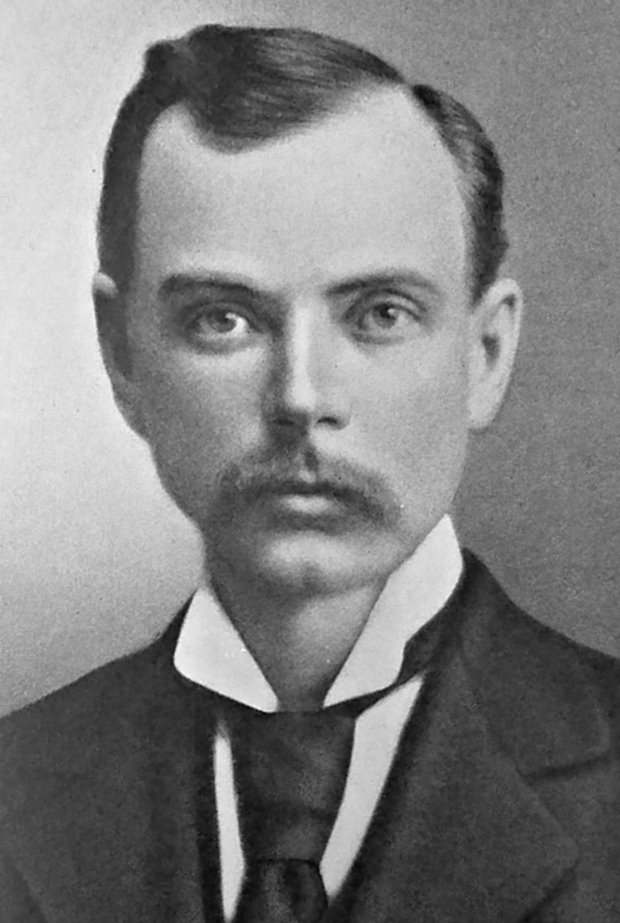
John H. & Johanna Lütgens (Courtesy thoneybourne on Ancestry.com)

Anaheim, Orange County’s first incorporated city and one of California’s first “planned communities,” was actually born in San Francisco. Specifically, it was planned, named, and financially supported at meetings held at John Lütgens’ Hotel, on Montgomery St. across from the Russ House in what’s now the Financial District. Lütgens’ Hotel, as the San Francisco Chronicle later recalled, “was the favorite lodging-house of the better class of Germans.” And that – along with a smattering of immigrants from other European countries – is exactly who created Anaheim. Likewise, their host, hotelier John Henry (Johan Heinrich) Christian Lütgens had been born in Kiel, Germany in 1816 and was naturalized in San Francisco in 1856 – at the end of the California Gold Rush. 

The story of Anaheim's founding has been told many times before (including solid accounts from historian Leo J. Friis). But seldom, if ever, has Anaheim's actual birthplace been put in the spotlight.  
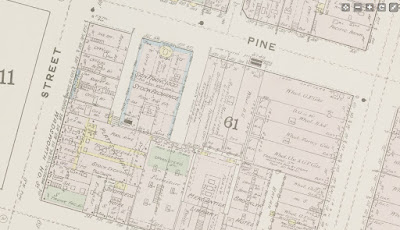
Sanborn Fire Insurance Co. map, 1887, showing Lütgens’ Hotel.

The concept of Anaheim began when Los Angeles vintner John Fröhling and his San Francisco distributor, Charles Kohler, needed a more reliable supply of wine to sell. The two men, along with fellow German immigrant and wine dealer Otto Weyse, imagined a new cooperative vineyard colony in Southern California. They quickly enlisted Austrian-born surveyor and civil engineer George Hansen of Los Angeles. They made attorney Otmar Caler president of a group – composed primarily of other Bay Area Germans -- that would further organize and promote the colony. They called an organizational meeting for February 24, 1857 at Lütgens’ Hotel, during which they agreed to incorporate as the Los Angeles Vineyard Society. They also made Hansen superintendent and sent him south to find, purchase and prepare an appropriate piece of land. 

Seal of the Los Angeles Vineyard Society. (Courtesy Anaheim Public Library)

Four days after the organizational meeting, a second meeting was held at which officers and directors were chosen and twenty-seven shares of stock were sold at $250 each. Those who bought share were, again, mainly prominent Germans in the San Francisco area. The expense of the stock was somewhat hidden, as the investors each had to kick in the difference each time the stock prices were raised. 

From then on, monthly Board of Directors meetings were held at the hotel, always beginning promptly at 8:00 p.m. At the March 2, 1857 meeting, they appointed a finance committee. 

The board of the Vineyard Society included many (now) well known Anaheim pioneers. It also included John Lütgens.
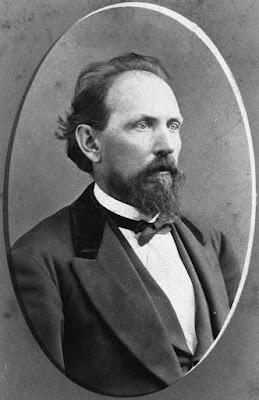
George Hansen, father of Anaheim (Courtesy Anaheim Public Library)

By April, George Hansen was trying to cut deals with various major property owners in Southern California and was sending progress reports back to the board. After several false starts, Hansen found a good spot on the Rancho San Juan Cajon de Santa Ana and found a willing seller in rancho owner Juan Pacifico Ontiveros who was looking to move north to the Santa Maria area. (Hansen knew the Ontiveros family, as he had surveyed their land a few years earlier.) Pending reimbursement by the Society, Frohling and Hansen paid Ontiveros, out of their own pockets, two dollars an acre for 1,165 acres.
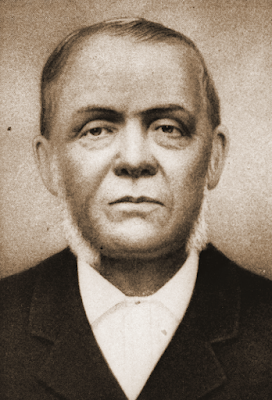
Don Juan Pacifico Ontiveros. (Courtesy Anaheim Public Library)

During the Jan. 13th, 1858 Society meeting at Lütgens’, members voted to give their colony the name Annaheim. (Later, the second “n” was dropped.) The moniker referenced their new home (“heim” in German) on the Santa Ana River and in the Santa Ana Valley. The name beat out two contenders: Annagau and Weinheim. Board member Theodore E. Schmidt likely suggested the winning name. At this meeting they also voted to increase their cumulative stock value to $50,000 as soon as the State Legislature amended the Incorporation Act to allow agricultural companies to incorporate. 

State Senator (and former Los Angeles mayor) Cameron E. Thom submitting just such an amendment to the legislature in 1859. The measure was opposed by some who feared large corporations would eventually accumulate huge areas of real estate. (The Daily Alta California opined that "this fear is an absurd one.") But a version of the bill amending the Incorporation Act ultimately became law.
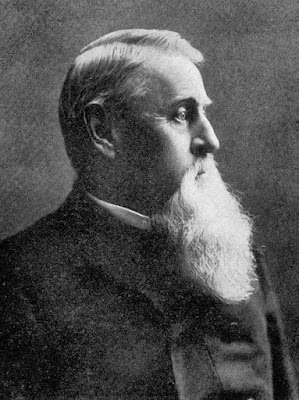
Cameron E. Thom. (Courtesy Los Angeles Public Library)

On October 2, 1858, the following paid notice was printed in the Los Angeles Star:

"The members of the Los Angeles Vineyard Society are hereby notified by the undersigned, constituting a majority of the Board of Trustees thereof, that a meeting of the Stockholders will be held in this city [San Francisco], on Saturday Evening, October 23, 1858, at Lütgens' Hotel on Montgomery Street between Pine and Bush streets, for the object of increasing the Capital Stock of said Company to Sixty Thousand dollars... or each share to One Thousand Two Hundred Dollars...

C. C. KUCHEL, President
T. E. SCHMIDT
HUGO SCHENK
RUD LUEDKE
JOHN LÜTGENS
H. BREMERMAN
J HARTMAN
JOHN BACH
H. PODDERATZ
JOHN P. ZEYN
JOHN FISCHER, Secretary

San Francisco, Cal... 1858"

At a general meeting on February 28, 1859, fifty building parcels in the center of Anaheim were distributed to Society members by drawing lots, with another fourteen parcels held in reserve by the Society. 

Map of the Anaheim "Mother Colony." (Courtesy Anaheim Public Library)

In advance of the arrival of the first colonists to Anaheim, later that year, Hansen began preparing the land for them. After obtaining rights to an easement across Bernardo Yorba’s adjacent ranch, Hansen built an irrigation ditch which brought water down from the river, and then laid out Anaheim on the same angle as the ditch. To this day, the heart of Anaheim still has this cockeyed orientation. Hansen divided the land into town lots and vineyard lots – all within the boundaries of North, South, East and West streets. He also oversaw the planting of 400,000 vines, as well as some fruit trees. Additionally, he planted willows all around the town’s perimeter, creating a living fence to keep out roaming animals. The “gates” in the fence along each side of town would become landmarks.   

By early spring, the new ditch was bringing Santa Ana River water into town and Anaheim’s vineyards were a bustling hub of activity.  
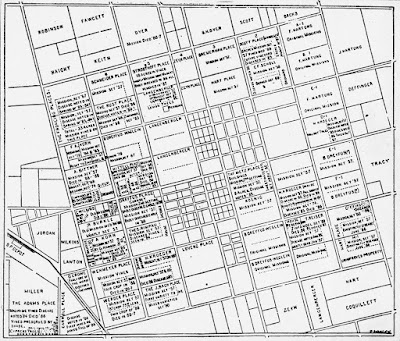
Plat map of early Anaheim. (Courtesy Anaheim Public Library)

On June 23, 1859, the Society held a dinner at Lütgens’ Hotel in honor of their surveyor and vineyard superintendent, George Hansen. He had worked hard for them in Anaheim for two years and this was his first trip back to San Francisco. Hansen addressed the Society, reviewed their own history, caught them up on progress, and told them that their first 400 acres of vineyards were already flourishing. Everyone had a grand time, wine flowed freely, and the party finally broke up in the wee small hours of the morning.

At the Society’s monthly meeting at the hotel on September 12, 1859 they voted to increase share prices to $1,840, “and to make a distribution of the Vineyard lots among the shareholders of the Association." More shareholders announced that they planned to move down to Anaheim soon and make their permanent homes there.
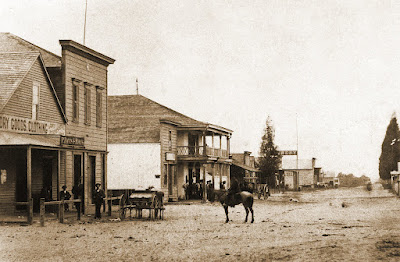
West Center St. (now Lincoln Ave.), Downtown Anaheim, 1873. (Courtesy Anaheim Public Library)

In December 1860, recognizing the colony’s rapid development, the Los Angeles Board of Supervisors ordered that a new Anaheim Township be carved out of the old Santa Ana Township. Anaheim was already a well-established community. While Pierce’s Disease would wipe out Anaheim’s wine grape industry in the 1880s, growers would turn to other crops, like walnuts and citrus, and Anaheim’s growth continued. Today, it’s an internationally famous city of 350,000 residents.
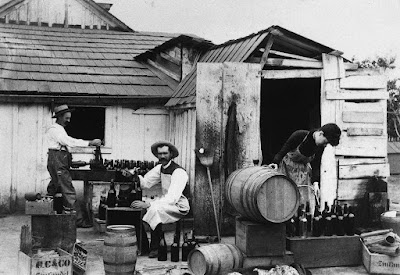
Bottling wine at the Bullard Winery, Anaheim, circa 1885. (Courtesy Anaheim Public Library)

Lütgens’ Hotel was sold later in the 1860s and torn down in 1891 to make way for the construction of the Mills Building on the same site. Darius Ogden Mills had previously founded the National Gold Bank of D.O. Mills & Co., (the first bank west of the Rocky Mountains) and later helped found the Bank of California. He hired architects Burnham and Root of Chicago to design his Mills Building. 
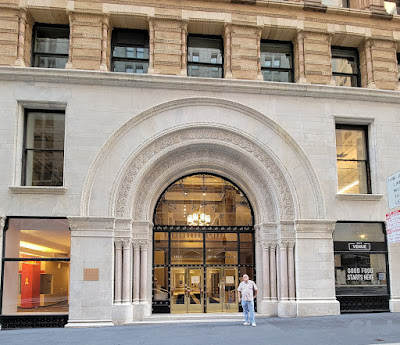
The author in front of the Mills Building, Thanksgiving, 2021.

The steel-framed Mills Building survived the 1906 earthquake. Although the interior was damaged in the fire following the quake, it was restored to original condition in 1907.  Today, the Mills Building is San Francisco’s last example of the “Chicago school” of architecture, which features Richardson Romanesque elements. In the case of the Mills Building, these elements include a dramatic entrance arch facing Montgomery Street. The 22-story Mills Tower was added in 1932. 
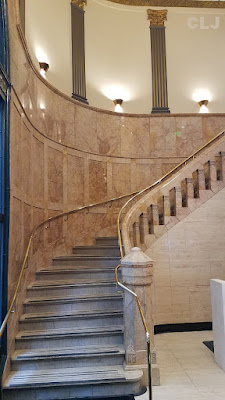
The staircase in the Montgomery St. lobby – made of French “Jaune Fleuri marble” – is original.

In December 1868 – the same year in which his wife, Johanna, died -- John Lütgens opened a new Lütgens' Hotel with a partner, Mr. Lowrey (formerly of the Western House), on Post Street, above Kearny Street in San Francisco. Wine, of course, flowed freely at the grand opening.
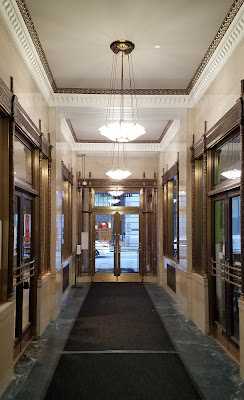
Interior view, Mills Building, 2021 (Photo by author)

Perhaps inspired by memories of his old Vineyard Society friends, Lütgens spent a time as a liquor dealer later in life. In 1878, his liquor business was located at 233 Montgomery Ave. – just across the street from the original Lütgens’ Hotel. He died in San Francisco on June 23, 1899. Anaheim continued to flourish and has since largely forgotten John Lütgens and the exact location of its own birth.
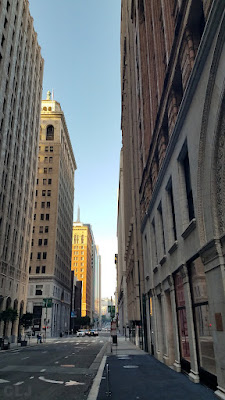
View up Montgomery St. from the site of the old Lütgens Hotel, 2021. (Photo by author)

Tuesday, January 18, 2022

Ilse Byrnes (1927-2022)

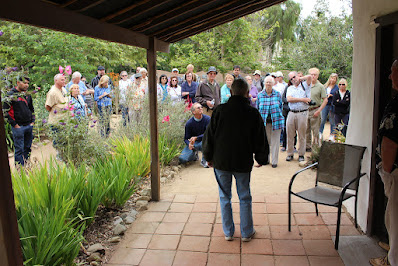
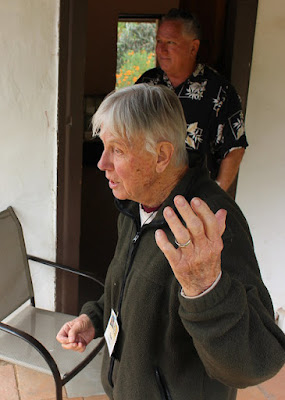
Ilse Byrnes leading an O.C. Historical Society tour at the Montanez Adobe, 2016. (Photo by author)

One of my heroes has passed: Ilse M. Byrnes. San Juan Capistrano would be a much lesser place and much of its rich heritage would already be long gone if not for her decades of hard work and tenacity. Her name should be remembered alongside Fr. St. John O'Sullivan when we speak of preservation in Orange County. I'm proud to have known her. 

Krista Nicholds of Preserve O.C. writes, "Ilse successfully nominated 16 sites in Orange County to the National or California Register [of Historic Places]- mostly in San Juan Capistrano, including her last in 2015, the SDG&E Substation building on Camino Capistrano which was facing imminent demolition and is still standing- but also Crystal Cove State Park in Newport Beach and Casa Romantica in San Clemente!!"

And that doesn't even take into account the many other historic sites that may not have ended up on state or national registers but which she also had a hand in protecting. She was also a great tour guide -- sharing her love and knowledge of her adopted hometown. (She was from Switzerland.)
Ilse with Jerry Nieblas in Capistrano, 2016.

She never did seem comfortable in the limelight and seemed to keep a low profile when not actively in the process of rattling people's cages. I can think of many meetings of the O.C. Historical Commission where she barely said a word. She saved her fire for when it would do the most good. That said, she was always one of the smartest people in any room she was in. 

Ilse held strong opinions and acted with conviction. Once she even threw a brontosaurus out of the Los Rios district! She objected to the giant concrete dinosaur in front of a local business in the otherwise well-curated historical district. There was a staring contest and the dinosaur lost. 

One of my favorite moments in Huell Howser's "California's Gold" TV series was when Ilse gave him a tour of Los Rios. She was being professional and polite, but I actually laughed out loud at some of her comments. I'm sure the subtext was entirely lost on Huell and 99.999% of his audience, but those who knew Ilse knew exactly what she was up to! 

In addition to her preservation work, Ilse was also an advocate for local equestrianism and helped establish San Juan Capistrano's excellent trail system.

Her husband, former San Juan Capistrano mayor Dr. Roy Byrnes, passed away in 2019

Like so many, I'm sad Ilse Byrnes is gone -- but I'm so glad she was here.

Friday, October 29, 2021

Delhi's Haunted House

The ghost of a "lady in white." (Art by C. Wilkins, courtesy J'aime Rubio)

 [Author’s note: When I stumbled across this story in old newspapers, I wanted to share it. But after working on this article for a while I was surprised to find that my friend Mary Adams Urashima had already posted a piece about the same incident. After some consideration I went ahead with my own article, hoping to find a way to provide a unique spin. I hope I've done that. Happy Halloween!]

"Police today were mystified by the reported appearance of a ‘ghost’ in a home at Delhi, [a] small settlement a mile south of Santa Ana," reported the Los Angeles Times on August 27, 1941. The eerie goings-on caused quite a stir.

To try to chase down that ghost, it may help to start with an understanding of the place it appeared and the cultural norms and lore of the locals.

Early Delhi

The community of Delhi (pronounced “dell high”) is centered east of Main St. along Warner Ave., which was once named Delhi Ave. Pioneer James McFadden purchased 4,000 acres here in 1868 and named the area for his family’s old hometown of Delhi, New York. 

In the early 1900s, McFadden gave a portion of his land to the Southern California Sugar Company for the purpose of building a sugar factory to serve the area’s vast sugar beet growing industry. Soon, with the factory nearly complete and a new railroad spur under construction, McFadden was able to sell off other parcels of his ranch at advanced prices to land speculators. 

The Southern California Sugar Co. factory (Courtesy Orange County Archives)

In 1909, Fred and Henry W. Hinze created the first of several subdivisions to support the new industry. Henry also oversaw the factory’s construction and served as its first superintendent. But the sugar company's two largest stockholders: James McFadden and James Irvine, soon sued Henry, saying he'd cheaped out on construction in order to keep a larger profit for himself. By 1910, McFadden and Irvine were invested in a new rival factory -- the Santa Ana Co-Operative Sugar Co.-- within sight of the first factory. Two years later, Delhi’s second residential tract was carved out of the adjacent W. G. Emmett ranch. "To the man of small means," Emmett advertised, "this is YOUR opportunity.”

 And finally, in 1915, the C. E. Measor Subdivision was added to Delhi by inveterate Santa Ana bootlegger Catherine Measor Leieritz and her unruly children.

The Santa Ana Co-Operative Sugar Co. factory (Courtesy Orange County Archives)

From early on, the new community of Delhi was largely Hispanic. Many of its early residents had come to the U.S. to flee the violence of the Mexican Revolution. In Delhi they found a relatively peaceful spot where non-Anglos were allowed to buy land (a rarity in the early 20th century) and where many jobs were available at the sugar factory. The neighborhood had only five hundred residents in 1920, but grew by leaps and bounds from the 1930s through the 1950s. It was annexed into the City of Santa Ana in 1929.

Culture and the Supernatural

Belief in the supernatural is largely taken for granted in Latin American and continues to run deep with many Mexican Americans. These ideas are often rooted in a combination of Christian and indigenous traditions. 

A good example is El Dia de los Muertos (the Day of the Dead) which is celebrated on November 1st and 2nd. Celebrants visit family graves and build decorated home altars to help the spirits of dead loved ones find their way home to visit. Decorations, parades, and other traditional elements are more light-hearted than somber. In part, the celebration has its origins in the Medieval European Christian traditions of All Saints’ Day and All Souls' Day. But it’s also infused with ancient indigenous cultural traditions honoring the dead. The Aztecs had at least six festivals throughout the year that resembled Day of the Dead, the most similar of which was celebrated between October 20th and November 8th. One of the precepts of El Dia de los Muertos is that the veil between life and the afterlife is a very thin and sometimes permeable.

A Day of the Dead offrenda (altar) (Courtesy Paolaricaurte)

As recently as 2014, a Pew Research survey still found widespread belief among U.S. Hispanics in the presence of ghosts in our midst. Combine these cultural norms with the dynamics of any small town (i.e. word travels fast and everyone knows everyone's business) and it seems 1940s Delhi was the perfect place for a ghost story to develop and spread. 

The Ghost Appears

The aforementioned Times article continued with the details of the haunting. But the better telling of the story appeared in the Aug. 26, 1941 Santa Ana Register:

'GHOST' VISITS DELHI; HAS RESIDENTS OF HOUSE ON RUN

The first "ghost" seen in Orange County in many years may not be "the real McCoy," but is sufficiently real to three women who were given medical treatment last night in Delhi after "seeing" the apparition, and a man was so frightened he could neither talk nor move for three minutes according to reports by Santa Ana police and Matt Lujan, well-known Delhi resident and unofficial mayor of that community.

The "ghost" was so real, Officers Harry Prichard and Roy Hartley reported, that an entire family moved from their home at 522 Central Avenue. Lujan says he doesn't know what the "ghost" could be, is going to try to find out, if possible, by visiting the Central Avenue home some midnight soon. Last night when he searched the place with a flashlight, he found nothing to disturb him, but both he and the officers will vouch for the fright caused by the apparition.

As 8:45 o'clock last night, Lujan called police to the scene. The officers found Frank Garcia walking about the yard at 516 Central in a daze. Lujan then reported he first noticed Garcia acting strangely, stopped and found him unable to move or talk. 

Finally, when Garcia could speak, he said he was planning to move into the house at 522 Central, vacated by Pedro Munoz, Mrs. Munoz and family at 4 o'clock yesterday morning. Garcia is son-in-law of the Munoz'. He said, when he entered the front room of the house, he saw a woman with long hair and dressed in white, standing in the middle of the room but when he spoke to her, she faded away. It was just after that episode that Lujan discovered the paralyzed Garcia.

While Lujan was calling police, Mrs. Munoz arrived at the place she had left that morning, "saw" the woman dressed in white--and fainted into unconsciousness. According to the officers, Mrs. Munoz was suffering a bad case of shock. A physician was called to treat her after they gave first aid.

Mrs. Gomesinda Calderon, 510 Central, and Mrs. Bruno Canstaneda, 510 Adams, residents of the area, also received medical treatment last night after hearing of the excitement. They too had seen and heard of the "ghost" before, they said.

According to the Munoz family report, they heard noises at 4 a.m. yesterday "and couldn't stand it any longer," Lujan said. Munoz then took one load of furniture away and while he was gone, a voice outside the door inquired: "So you are leaving?" and when Mrs. Munoz opened the door, nobody was there. Last week, while the Munoz boys, 8 and 10 years old, were alone at home, a masked man appeared in the house, the boys said after running from the house to a neighbor's. Four nights ago, Mrs. Munoz was frightened "speechless," it was reported, when a "cold hand" touched her forehead.

But to date, nobody has offered an explanation of the "ghost's" activities nor explained the noises which drove the Munoz family from the home.

Mysteriously, even the house that replaced the "haunted house" is now blurred out on Google maps.

The following day’s Register had even more on the subject,… 

'GHOST' OF DELHI FAILS TO APPEAR

The "ghost" of Delhi was "on vacation" last night.

That's what several persons who watched for "her" reported today. Frank Garcia, . . . said he had a quiet night last night. He added that he had several men friends with him at the "ghost" place, however. 

Matt Lujan, unofficial mayor of Delhi; Manuel Viega, Santa Ana funeral director; F. Villanueva, editor of Las Noticias, Orange County weekly; and Frank Estrada, 1901 West Fifth, stayed at the "ghost" place, . . . from 9 o'clock last night until 12:30 o'clock this morning, Lujan reported, but saw nothing out of the ordinary. A score of curious persons drove to the Central Avenue residence to "have a look" last night but none reported seeing anything even resembling a ghost. . . 

Garcia, after his first night of occupying the house, reported he had been uncomfortable and that he thought he had been slapped in the face during the night. A living room door which had been closed, was found open later. Nobody has been able to explain the cause of the excitement to date. Lujan reported a Long Beach man offered Garcia $5000 [the equivalent of about $92,000 in 2021 dollars] if Garcia could show him the "woman in white."

Ghostbusters of Delhi

From a newspaper editor, to an undertaker, to sugar plant workers, the group that staked out the house all night came to the task with a wide variety of skill sets. 

The most famous among the team of “ghost hunters,” Matt Lujan of 304 Adams St., was indeed known as the “unofficial mayor of Delhi” for decades. Born in Chihuahua, Mexico in 1906, he and his wife Nellie were living in Delhi by 1932. At some point he became the designated interpreter for the community, often acting as a liaison between the residents and the police, City Hall and the press. He also organized Delhi’s holiday events, actively protected the interests of his neighbors, and even disassembled malfunctioning streetlights himself, bringing the broken parts to the city for repair. He lobbied hard for improved roads in Delhi, and when the city wouldn’t upgrade them, he lobbied for Delhi’s succession from Santa Ana. (Every town should have a Matt Lujan or two.)

Modern view of Main St. near Delhi (Courtesy HistoricSouthernSantaAna)

One of the less well-known among the party was sugar factory worker Frank Estrada, whose previous fifteen minutes of fame came in 1916 when he was arrested for running a “blind pig” frequented by sugar plant workers in Los Alamitos.

Meanwhile, the two police officers who were sent to investigate, Harrison "Harry" Prichard and Roy Hartley, were among the department's older officers -- both nearing retirement. Perhaps the Santa Ana P.D.'s dispatcher felt that ghostbusting wasn't the most strenuous work.

Who's That Ghost?

Delhi’s ghostly woman in white matches some elements of the Mexican folktale of La Llorona, although the story is missing a few of its usual pieces: La Llorona is typically wailing and often appears near a body of water. However, there are supernatural "white lady" stories in many cultures, and the key recurring thread is that of a woman's ghost bound to the earth by some tragedy. 

Advertising art for the 2019 movie, "Curse of La Llorona"

Historian J'aime Rubio traces the story of La Llorena back to pre-Columbian tales of "the Aztec Goddess Cihuacoatl, who took the form of a beautiful, almost angelic lady in white" who drifted through the night, lamenting, . . . ‘Oh my children…your destruction has arrived. Where can I take you?’” Rubio also finds roots in an early legend of a native woman who was rejected by the Spanish soldier who fathered her child. In the story, the child dies (in some versions by her own hand) and the mother kills herself. But "even in death she faced the agony and torture of roaming the land eternally, especially any area with waterways or lakes, searching for her lost child."

Statue of Cihuacoatl (Courtesty INAH Museum)

Just about every older town in California seems to have some version of a "woman in white" (or blue, or black, or pink) ghost story. Why not Delhi?

The Delhi "ghost" also has similarities to San Juan Capistrano's famous "Lady In White," who was supposedly first seen in 1930, walking along the railroad tracks. Historian Pam Hallan-Gibson describes her: "The 'white lady,' who materializes in fog and likes to call attention to herself, has been sighted on Los Rios Street, the Capistrano Villas, Las Brisas, and in the foothills behind Del Obispo. She's a playful ghost, dressed in a long white dress, who cavorts and teases, but never lets anyone catch up to her." Hallan-Gibson says that the ghost's appearances on Los Rios St. are generally "near the giant pepper tree north of the Rios Adobe" and that the spectral woman can be seen "tossing her mane of long, black hair [and] beckoning you to follow." Sometimes the woman is seen with a black dog.

No Further Sign of Ms. Ghost

Today, the house in Delhi where the haunting occurred is gone and a more modern house sits at that address. No further news reports of ghosts at that address can be found after the 1941 incidents.

The current house on the property was built around 1955. Shrubs obscure it nearly as much in person as Google's "fuzz" filter does online.

Most communities have local stories that have been passed from generation to generation. It would be interesting to know if some version of this haunted house tale persists today in Delhi's folklore. 

Whether or not one believes in ghosts, the study of folklore is as important as it is interesting to learn about. Knowing the stories that we pass on to one another is part of understanding history and community.

Tuesday, October 05, 2021

Lost paintings of Orange County adobes

"The Yorba Adobe" by Anne Robinson (Photo by Don Dobmeier)
Help find two missing paintings! 

Laguna Beach artist Anne Robinson (Olivera) painted painted scenes of two historically important Orange County adobes: The home of Bernardo Yorba in Santa Ana Canyon, and the Trabuco Adobe (an estancia of Mission San Juan Capistrano) near today’s Rancho Santa Margarita. The painting of Yorba's home was done sometime before 1933. The painting of the Trabuco Adobe was done around 1926, when Robinson presented a paper about the history of Trabuco Mesa to the Orange County Historical Society.
"Truabuco Canyon" by Anne Robinson (Photo by Don Dobmier)
These two photos were taken by Don Dobmeier in 1977, so we know the paintings still existed then. 

A note tucked into OCHS' subject files (generations ago) under the heading "Trabuco" shows that the paintings were stored in "mirror box[s]" in "Bowers storage" and were marked or identified as "#1816, EG6 and EG7.” 

We do know a handful of places where the paintings do not seem to be currently located: Bowers Museum, CSUF Special Collections, the Orange County Historical Society, and the Orange County Archives. 

Here's what the folks at AskArt.com have to say about the artist: 
"Born on a ranch in the Santa Ana Mountains near Trabuco, California on April 3, 1893, Anne married Joe Olivera early in life but kept her maiden name on her artworks. By 1918 she had settled in Laguna Beach and had become active in the local art scene. She soon built a house there at 565 Monterey Drive where she lived for the rest of her life. She and Anna Hills often made painting excursions on horseback into the Santa Ana Mountains and nearby deserts. Working en plein air, she painted small oils on wood with a palette knife prior to 1953, after which poor vision prevented her from continuing. 
Her signature was usually in brown paint in block letters 'AR' or 'A. Robinson.' The artist died in Laguna on Dec. 26, 1977." 
Please drop me a line if you know the whereabouts of these two paintings.

Thursday, September 23, 2021

W. L. Adams (1841-1926) of Tustin

Recently, Guy Ball sent me a copy of this photo (above) from the Tustin Area Historical Society’s collections, which was identified as “W. L. Adams home, Main and B Streets in Tustin, circa 1890.” He wondered what else I could learn about Adams. Here’s what I was able to glean from vital records, census, newspapers, directories, etc, over the course of a couple hours:

William Lawson Adams, Jr. was born in 1841 in Morrisville, New York. He married Clara Eliza Kellow in Omaha, Nebraska on Sept. 7, 1875.  They still lived in Omaha just prior to coming to California in the 1880s.

William Lawson Adams, Jr.
They lived in Tustin, near 4th and B Street, from at least early 1892 until at least 1904 and grew oranges. Along with D. H. Thomas and Paul Seeger, William was among the three men who drafted the constitution and by-laws of the Tustin Fruit Association in September 1893. It appears he also owned sizable pieces of property in New York and Tennessee. Mrs. Adams was a member of the Tustin Thimble Club.

In February 1907, the Adams sold six acres in Tustin to Mrs. H. F. Story of Highland. It’s unclear whether this transaction marked the family’s departure from Tustin, but by 1910 they were living in Los Angeles. Clara and their daughter, Helen Dunn, both died in 1911. By that point, their old Tustin property was owned by Orange County Supervisor Jasper Leck and his family. 

Clara Eliza (Kellow) Adams

William L. Adams died in Los Angeles at age 84 on February 7, 1926 and was buried at Fairhaven Cemetery in Santa Ana. He was survived by his daughters: Mrs. J.A. Koontz, Jr. (Gertrude Adams) and Mrs. A.J. Bridger (Mildred Adams). 

Wednesday, September 22, 2021

Alice Chandler: O.C. cowgirl and Sheriff's Deputy

Orange County’s Dorothy Alice Chandler was a cowgirl, sheriff’s deputy, pilot, trick rider, horse trainer, riding instructor, dog breeder, ranch hand, missionary, movie extra, and model – all during an era when many expected women to stay home and keep house.

Right now, the Orange County Archives is exhibiting a small display about Chandler in the first-floor lobby of the Old Orange County Courthouse in Santa Ana. It’s unclear exactly how much longer this display will be up, but plans are already beginning for a new display on a different topic. So those with an interest should probably check it out soon.

Part of the Orange County Archive's exhibit about Chandler.

Born June 19, 1928 in Memphis, Tennessee to George Ernest Chandler and Constance “Connie” Clara (nee Williams) Chandler, Alice Chandler was destined for a colorful life “way out west.”

When Alice Chandler was three her family came west to visit her grandmother in Tustin. Connie was pregnant with Alice’s younger brother and fell very ill, requiring a longer than expected stay. Ultimately, they spent the rest of their lives in Southern California. 

Alice grew up living in a small house with her parents, six brothers and two sisters. The Great Depression was hard on the Chandlers. Alice’s father worked as a grove fumigator and was once charged with lying to get unemployment insurance money. In 1940, Alice witnessed her five-year-old brother accidentally killed with a shotgun.

While in elementary school, Alice fell in love with the outdoors, horses, and the Old West. In eighth grade, she dropped out of school and was then home-schooled by her mother. From then on, she wore blue jeans, which were not allowed for girls in school. 

The family finally caught a lucky break when George got a job working on the Irvine Ranch.

In the 1940s, Alice Chandler’s father was a gardener for the Irvine family, and the family lived in a shack near today’s Peters Canyon Park and Irvine Park, in Orange Park Acres. Their light came from lanterns and there was an outhouse in back, but – much to Alice’s delight – the house was right in the middle of the Irvine Ranch’s cattle operations. 

Alice Chandler on the Irvine Ranch, circa 1950s.

Chandler was given a horse for her 16th birthday. Soon, she and her sister had learned to break horses. Alice was as expert horsewoman by the age of 21. In later years she would sometimes help the Irvine Ranch cowboys during large cattle roundups.

Alice often chased trespassing hunters and fisherman off the property. Local Sheriff’s deputies suggested that her efforts might be more effective if made official. On August 1, 1949 she went to see Orange County Sheriff Jim Musick who interviewed her, made her a deputy, and gave her a badge. Her duties were to keep trespassers – especially poachers -- away from Peters Lake (which Myford Irvine considered his private hunting and fishing refuge) and to respond to other local emergencies as needed. “You may be a special deputy assigned to the Irvine Company,” said Musick, “but you’re a real deputy. And if I ever need you, you’ll be on call.”

It was an unpaid position, and no training was provided but several deputies and cowboys had already taught Alice how to shoot. Her mother purchased a .32-caliber Smith and Wesson revolver for her to carry while on duty. For three years, her presence kept poachers at bay. “What the guys knew was that I was tough,” she said. “I can be feminine, but don’t mess with me.”

Beginning in the early 1940s, Connie Chandler bought the land they’d been living on in Orange Park Acres, plus 100 acres surrounding it, creating the Chandler Ranch – an equestrian center at 20342 Chapman Ave. Many young Orange Countians learned the fundamentals of horsemanship there. Alice Chandler worked the ranch and taught riding lessons. 

The ranch faced some financial troubles beginning in the mid-1950s and there were attempts to take advantage of the situation and defraud the Chandlers of their land. Connie Chandler went to court repeatedly, studying the law, acting as her own attorney, winning reversals in the District Court of Appeal on two occasions, and holding onto her ranch for many more years. However, eventually the ranch went bankrupt on its own and Connie sold it to what Alice later called “a religious cult.”

In the early 1950s, Alice Chandler tracked down and purchased a descendant of celebrity dog Rin Tin Tin and made extra money breeding German Shepherds. She became a respected breeder and supplied a new Rin Tin Tin to producer Lee Duncan.

When her brother began flying his own plane, Chandler caught the flying bug. The sale of the puppies paid for ground school for Alice and her sister. Her father paid for their first plane and often rode along with them. 

Sign (attached to a bus) advertising Chandler Ranch. (Courtesy O.C. Archives)

Alice first became a pilot, then an instructor, and eventually owned her own four-seat Cessna. She even earned a hot air balloon license, which she never had the opportunity to use. She only gave up flying when her mother was injured in an auto accident and required a great deal of care for the rest of her life.

During the 1950s, Gene Holter’s Wild Animal Show would stable some of their exotic animals at Chandler Ranch when they were in the area. It was an early brush with show business for Alice Chandler, but hardly the last.

Alice visited the Irvine Ranch on business and met movie director Billy Wilder who was filming parts of the 1957 Jimmy Stewart film, “The Spirit of St. Louis” there. Wilder saw Chandler and two of her sisters and made them extras in the film. Although she briefly joined the Screen Actors Guild, Alice was never on the big screen again and never saw Wilder’s film. “There are a lot of chores on a ranch,” she said. “We didn’t have time to go to the movies.”

But in the 1960s, noted rodeo rider Montie Montana offered her a job trick riding and barrel racing in his traveling Western equestrian show. “We rode with his wife and daughter for years,” Alice said. 

In the early 1970s, Alice Chandler served as Secretary and Treasurer of the Southern California Cattleman’s Association, working side by side with the likes of Tony Moiso of Rancho Mission Viejo.

Alice also did missionary work with children in the Middle East. She returned to Orange County to care for her ailing mother, who died in San Juan Capistrano in 1975. 

Alice’s experience with her mother prepared her for yet another career, working as a caregiver for the elderly. She herself eventually retired to Laguna Woods. 

Chandler (right) celebrates her 79th birthday in 2008 with Sheriff Sandra Hutchens.

In 2008, at the age of 79, Alice wrote a letter to Orange County’s first female Sherriff, Sandra Hutchens, sharing her story and offering to finally turn in her special deputy badge. It seems the Department had never officially decommissioned Chandler or asked for her badge back. She also offered some words of support: “I could not have been more blessed to have the wonderful memories that I have of all these men that thought enough of me  to respect me, and there should be no reason that you are not respected also, and I am sure you will be.”

The Archives’ exhibit about Chandler includes artifacts and many photos. The Old Courthouse, at 211 W. Santa Ana Blvd, Santa Ana, is open Monday through Friday, 8:00 a.m. to 5:00 p.m. (The Orange County Archives, located in Room 108, is open Monday through Friday, 9:00 a.m. to noon and 1:00 p.m. to 4:30 p.m.) As always, I encourage you to see the historical exhibits by OC Parks throughout the building as well. 

Wednesday, September 08, 2021

P.E. Red Cars to O.C. Streetcar: What goes around...

N. Main St. at Santa Ana Blvd, trolley track removal, Santa Ana, Sept. 1960. (Kim Richards Collection, OCA)
Recently, Kim Richards donated a collection of photos to the County Archives that included scenes of the Pacific Electric Railway trolley tracks being torn out of the streets of Downtown Santa Ana in 1960. They're not just good photos, but also particularly timely since they arrived just as new tracks are being installed through some of those same streets for the forthcoming $407.76 million OC Streetcar project.

N. Main St. at Santa Ana Blvd, Sept. 2021. Striped barriers mark the boundaries of an area where new streetcar track is still under construction. (Photo by author)

The Pacific Electric's big "Red Car" trolleys first arrived in Santa Ana in 1905, to much fanfare. There had been an earlier trolley system -- first horse-powered and then steam-powered -- that ran between Santa Ana, Orange, and Tustin. But the Red Cars were an enormous improvement. Not only were they larger and more reliable, but they also connected Santa Ana to a vastly larger area of Southern California. This private trolley line was an absolute boon to the public.

City crew removes "Red Car" tracks from a Downtown Santa Ana street, Sept. 1960. (Kim Richards Collection, OCA) 

But as the 20th century marched on, the proliferation of the automobile and of bus services made the Red Cars obsolete. Now people could go EXACTLY where they wanted to go EXACTLY when they wanted to go there. And a route change could be made in a moment rather than a period of months and the cost of a huge construction project. The last day of P.E. passenger service in Santa Ana was July 2, 1950. 

Crew installing OC Streetcar tracks on Santa Ana Blvd at Sycamore St., Aug. 2021. The Old Courthouse is behind them. (Photo by author)

The Pacific Electric tried to adapt by switching many lines over to bus service. But apparently it was too little to late. The P.E. is now but a fond memory for a dwindling number of Southern Californians. (Oh, and you can still ride restored cars at San Pedro or the Southern California Railway Museum.)

On Sept. 12, 1960, over ten years after service to Santa Ana ended, city crews began tearing the old track out of the streets in advance of a large repaving project.

Kim Steaffens Richards' father and stepmother both worked for the City of Santa Ana, and she presumes the 1960s photos (including the two samples in this post) came into the family's possession at that time.  

Turning onto 4th St. on a farewell excursion run, 1950. (Old Courthouse Museum)

This final photo is not from the Richards Collection, but shows P.E. Red Car 309 on Fourth St. during it's last run through Downtown Santa Ana on June 30, 1950. Veteran conduction Les Frank bought donuts and coffee for his passengers. 

Wednesday, September 01, 2021

Arch Beach Won’t Stay Put

Arch Beach postcard, circa late 1920s.
When it comes to researching the history of real estate, no place in Orange County holds a candle to the Laguna Beach area for sheer convolution, complexity, and opportunities for confusion. Even seemingly simple questions about Laguna often end up requiring days or weeks of research to sort out. For example, since the late 1800s the name “Arch Beach” has described a significant area of the south coast, now annexed into Laguna Beach. But where IS Arch Beach exactly? Historically, the moniker has drifted like a jellyfish from one spot to another to another.  

“First, the name was applied to the large homestead-period township,” writes Jane Janz, the only Laguna Beach historian ever to make much sense of the Arch Beach story. “Secondly, it was used for the small town of Arch Beach whose name appears on lists of towns that failed due to the real estate collapse [at the end] of the 1880s. This area centered around the Diamond Street area. Thirdly, and for the largest period of time, the name of Arch Beach was applied to [an area from] approximately Sleepy Hollow, on south to Nyes Place.”

That seems plenty complicated enough. But there’s even more to the story. In fact, “Arch Beach” has migrated up and down the shoreline over one and a half miles and has variously been confined to the coast or stretched well inland into Laguna Canyon. Let’s take a look at the various spots called Arch Beach and how (or whether) they intersect:

Township of Homesteaders

In June 1876, William Henry Brooks arrived in the area now known as Woods Cove, about halfway between the mouth of Aliso Canyon and what is now the heart of Downtown Laguna Beach. He was joined that December by his brother, Lorenzo Nathan “Nate” Brooks who started a homestead there. It was empty land for many miles around, and the local Indians greeted them by trying to steal their ponies. But Nate Brooks, in particular, saw this as “the choicest spot on earth.” William’s wife, Annie H. Brooks, named the place Arch Beach after a natural rock arch (near the end of Pearl Steet) through which one could walk at low tide. In 1883, Nate Brooks platted the land and brought a little water down from the hills by digging a 500-foot tunnel. He also opened a dirt wagon path to the village of Laguna Beach, which was platted that same year by Henry E. Goff – one of the four pioneer Goff Brothers.

Early iteration of Arch Beach (in blue). Map from Jane Janz's book, Naming Laguna Beach.

The name Arch Beach was soon applied to the entire Township immediately south of Laguna Beach, which extended all the way up across the hills to Laguna Canyon. The only beachfront included within the township boundaries extended from Victoria Beach south to about Wesley Drive.

A Boom Town

Later, during the railroad boom of the 1880s, there was talk that the A.T.& S.F. Railroad would lay tracks along the coast south of Laguna Beach as part of their San Diego line. As such, some speculated that Arch Beach would be an ideal spot for a little resort town, if only someone would build a hotel, wharf and depot there. 

Hubbard Goff's Arch Beach Hotel, late 1880s.

Around 1886 one of Henry Goff’s brothers, Hubbard S. “Hub” Goff built his Arch Beach Hotel and a store on the blufftop at the end of today's Diamond Street. With no source of local lumber for the hotel’s construction, a schooner (possibly the "Emma") anchored offshore and floated in the needed redwood. At about the same time, Hub’s seventeen-year-old daughter, Lulu V. Goff, filed for a homestead on another key portion of Arch Beach. Whether she was acting at her father’s behest or whether she was independently following in her family’s pioneer tradition is unclear. (She completed the homestead to achieve ownership of the land in 1891.)

In 1887, Hub Goff, Nate Brooks, and Pomona City Engineer Harry F. Stafford laid out the new subdivision or town of Arch Beach around the hotel. It extended from Bluebird Canyon Drive to Upland Road. Curiously, the town was not located within the boundaries of the old Arch Beach Township. The March 26, 1887 Santa Ana Blade reported, "During the past few weeks about seventy-five lots have been sold in the new town. The hotel is nearly or quite completed, and a restaurant, news-stand, livery stable, meat market and about twenty other buildings will there be constructed within the next six weeks." 

Arch Beach tract map, 1887 (Click to enlarge)

Around the same time, Santa Ana Valley Land & Improvement Co. bought some of the Goff Brothers’ land adjacent to the new village and began to advertise a forthcoming new hundred-acre city they dubbed Catalina-on-the-Main (or sometimes Santa Catalina-on-the-Main). According to their October 1887 promotional pamphlet, History of Santa Ana City & Valley, the new seaside community was to extend "from Aliso Beach to Arch Beach on the North and to Three Arches on the South." By the time of the pamphlet’s publication, the company had already purchased 300 acres toward the new development. 

(Note: Conflicting contemporary newspaper reports indicate that Catalina-on-the-Main was a joint effort by the Fairview Development Co. and the Santa Ana Immigration Association, or, alternately, was a project by Boston-based travel agency Raymond & Whitcomb Co. On a related note, almost a half century after the fact, a Santa Ana Register article claimed that in 1880 "the Raymond S. Whitcomb interests had purchased a point, which became known as Goff's Island," because it showed promise "as an ideal resort spot.")

Catalina-on-the-Main, 1887. From a photo by Conaway and Hummel.

The pamphlet continued: "The lands at the sea shore are the most delightful imaginable, abounding in the wild and picturesque scenery, quaint grottos and caves, splendid beach, and exposed and quiet bathing 'grounds.' For years this particular beach has been the resort each summer of hundreds of persons . . . At this city the company will plot, lay off and improve the suburban property, affording opportunity for purchase to those who may wish. . . Nor is this all. This development company will build a railroad to connect Santa Ana and Catalina-on-the-Main. A line will be built within the next two years to connect this city with Long Beach . . . which already has rail communications with Los Angeles. Every indication points unerringly to the centering here of immense railroad interests and wealth, the completion of which will alone suffice to sustain a large and flourishing city.”

In 1888 a hopeful Hub Goff and Nate Brooks built a pier at Arch Beach. The town also had an improved supply of water (piped in from Bluebird Canyon) which gave it an advantage over nearby Laguna Beach. Essentially all the pieces were in place for Arch Beach to be a big success, except for the most crucial element: the railroad. 

The precarious-looking Arch Beach Pier

At that point, Laguna Beach and Arch Beach were still separate towns with some significant topography between them, including Bluebird Canyon and Sleepy Hollow. One way into Arch Beach was to take the stagecoach from El Toro (a.k.a. Aliso City) down through Aliso Canyon to the shore. According to local historian Jane Janz, the little dirt road between Laguna Beach and Arch Beach – eventually improved and known as “The Old Coast Road” – could be difficult going in inclement weather but was frequently used. “My mother said that her Dad would hook up the old buggy to the horse and take her mother to Capistrano for a treat dinner.”  But roads on this part of the coast were less than ideal. (Access up and down the coast improved dramatically in the 1920s with the advent of the State Highway.)

Nate Brooks

The Bubble Bursts

When the railroad boom went bust, dreams for Catalina-on-the-Main dissolved before the surveyors were even done driving their stakes, and the land reverted to the Goff Brothers. (It seems only marine biologists would continue referring to Catalina-on-the-Main as a place name into the mid-1890s.) Brooks’ original Arch Beach subdivision did a little better. Writes Meadows, “Some houses were built and a small village developed. On June 21, 1889 the community was granted a post office [two years before Laguna Beach], but lack of patronage caused it to be closed on May 24, 1894.”

Another view of the Arch Beach Hotel, circa 1889.

The boom town of Arch Beach gradually fizzled out. In March 1892, Goff sold the hotel to Charles D. Ambrose of Pomona and returned to farming.  The Santa Ana Blade put a positive spin on the story, claiming “This deal is the beginning of a new era of prosperity for Arch Beach.” At this point the hotel’s rates were $1.50 a day or $10 a week. Arch Beach was still a vacation spot, especially for folks from Riverside looking for a place to escape the summer heat. There was still hope.

But the Panic of 1893 set in, the Santa Fe built their line inland (more or less following the old El Camino Real), and any lingering dreams of a successful Arch Beach faded rapidly away. Businesses closed, people moved away, and a good deal of the land was sold for taxes. After the largely touristless summer season of 1894, Ambrose abandoned the hotel and went back to farming himself. The hotel and the land around it were sold for $500. 

In 1895 Augusta E. Towner wrote an article for Charles Fletcher LummisLand of Sunshine magazine, still extolling the virtues of Arch Beach: 

"Arch Beach is a most romantic spot; set like an amphitheater amidst hills, its oceanward frontage precipitous, with fanciful arches at base of the cliff, against which the breakers fling high their spray. A curious natural rock-arch gives name to the beach. …Good water is piped to the cottages. Arch Beach is exceedingly attractive, too, out of season, when wildflowers cover the hills, or winter storms roll in a thunderous surf."

The Arch, 1895. Photo from Land of Sunshine, Vol. 3, No. 2

But Towner’s efforts were too little too late. The boom town was no more.

In late 1897 and/or early 1898, the long-deserted hotel’s new owner, Joseph Yoch, paid Santa Ana house mover Fremont Thorpe to cut the building into three pieces and move it across the hills and arroyos to Laguna Beach. There, it was added to Yoch’s Laguna Beach Hotel to become the New Hotel Laguna. This newly Frankensteined-together building was located at the corner of today's Coast Highway and Laguna Avenue and had thirty rooms and two bathrooms. It proved popular and in 1930 was replaced with a new and modern Hotel Laguna, which still stands.

Woods Point

In 1906 and 1907, Clementine “Clemma” E. Woods – Pasadena resident and treasurer of a Colorado mining company – bought up much of the Arch Beach boom town area. Soon, the townsite atop the cliffs was being called Woods Point, and the coast below Woods Cove. Her husband, Harry Edwin Woods, had been a newspaper publisher in Ohio but had moved west and gone into the mining business. The two proved an important asset to the greater Laguna Beach area, contributing generously out of their own pockets to improve the community. 

Woods Point and Arch Rock, circa late 1910s. Photo by Clara Mason Fox.

Meanwhile, in 1912, the somewhat flimsy Arch Beach Pier finally succumbed to the elements, bringing an end to one of the last symbols of the former boom town.

A hotel would not grace Arch Beach again until 1915, when the Arch Beach Tavern was built a few blocks inland at 2180 Catalina Street. By that point, automobiles and better roads were both more commonplace. And in the 1920s, the completion of Coast Highway made this area even less isolated, increasing property values. Large vacation homes were built in the area, primarily by rich out-of-towners, including many from Los Angeles and Pasadena. 

Postcard from the Arch Beach Tavern.

In the late 1920s, Clemma Woods subdivided her property and sold lots through the Skidmore Brothers’ real estate firm. One of the many homes built during that era – a large Tudor which sat at approximately the site of the old Arch Beach Hotel – would later serve as the home of actress Bette Davis. (A large “D” can still be seen on the chimney of the house, which is just north of the public stairs leading down to the beach.)

People remembered for some time that this area was called Arch Beach, and it was still referred to that way into the 1910s. In 1911, for instance, a new development just to the northeast (inland) was dubbed Arch Beach Heights.

Lost in Downtown Laguna

In 1887, the same year he helped file the Arch Beach town plat map, Nate Brooks also filed a plat map labeled “Part of Arch Beach, Plat II,” which extended from Cleo Street south to Calliope Street near the heart of Laguna Beach. Aside to references to the official subdivision name, it would be many decades before people commonly referred to this area as Arch Beach.

Arch Beach, Plat II, surveyed by S. H. Finley, July 1887.

Arch Beach Migrates South Again

The 1920s saw the name Arch Beach on the move again. Depending on who you asked and when, it could have been located anywhere from Bluebird Canyon Road down to today’s Aliso Circle.  

In his 1922 promotional pamphlet, A Rambling Sketch in and About Laguna and Arch Beaches, Orange County, California, David Andrew Hufford hedged on the exact location but rambled on with a plethora of puffery about Arch Beach:

“A few years ago, a noted globe trotter once said, ‘there is but one Arch beach as there is but one Yosemite,’ and I am not inclined to dispute his opinion. And another world traveler who visited all the European watering places, said nowhere could he find such a beautiful coastline, and to ‘see it once was to live.’ Everything considered – climactic conditions, pure oxygen, in the frostless belt, where Nature has done so much, it is now up to the home builders—is par excellence for your seaside home.”

Hufford also offered the following acrostic: 

ARCH-BEACH-BY-THE-SEA

Announced to the world by Jesuit Fathers, 

Revealing its picturesque caves and pools;

Carved out here and there, its rugged beauty

Hidden so long from the open road.

But now a castle ov’rlooks the sea, and 

Each rock and promontory beckons

Artists, who marvel at the changing colors.

Coast line so picturesque, mountains so grand,

Here Nature repays you for an automobile ride.

The Arch Beach Realty Co., located at Pearl Street and Coast Highway, opened in the mid-1920s. They remained into the early 1930s, selling coastal property to the rich and famous and property on the inland side of the highway to the slightly less rich and famous.

An 1894 sketch of "The Arch" by Clara Mason Fox. (Courtesy O.C. Archives)

By the late 1920s, people were referring to Villa Rockledge – the elaborate summer home of the Mission Inn’s Frank Miller– as being in Arch Beach. It was not in or adjacent to the boom town site, but rather farther down the coast. It was, however, right atop the old Aliso Beach Township northern boundary line. In fact, people started gradually applying the name Arch Beach primarily to the area from Villa Rockledge down to about today’s Wesley Drive – an area once included in the old Aliso Beach Township. This stretch constitutes one of Orange County’s most picturesque stretches of coastline, including Pirate Tower, Treasure Island Beach, Victoria Beach, and Goff’s Island. Whether by dumb luck or by dint of historical precedence, the name Arch Beach had finally come home to roost on part of the land where it started. 

Postcard of Arch Beach, circa 1920s.

Every Arch Beach is the Real Arch Beach

Eventually, the area called Arch Beach expanded northward to again consume EVERY section of coastline that had ever been given that name, from Sleepy Hollow down to Nyes Place. However, the far inland reaches of the old township weren’t included in this. 

The old Arch Beach boom town site became part of the newly incorporated City of Laguna Beach in 1927. Still, some of the picturesque homes of the early Woods Cove years remain. And of course, the beautiful, rugged shore still beckons to those with a little romance in their heart.  

View of beach below original Arch Beach Hotel site, 2021.

But the true location of Arch Beach remains fuzzy in the minds of many. “People have confused the name many times,” says Janz. “There is one local lad who insists Arch Beach was only around the Bluebird Beach area.”

So if anyone asks, “Where is Arch Beach,” just tell them it’s south of the original boundaries of Laguna Beach. It will probably satisfy their curiosity and won’t require a half hour of explanation.


[Thanks to historian Jane Janz of the Laguna Beach Historical Society for sharing her family stories and historical resources, clarifying several important points, and generally helping the author sound smarter than he is. No Laguna Beach history article is complete until it’s run through “Janecheck.” Thanks also to historian Eric Plunkett for pointing out spots where I needed to be clearer.]