Friday, September 16, 2022

The Blinking Owl, Santa Ana

The building that housed the Blinking Owl bar is now Cafe Cito. (Author's photo)
Over the years -- even before the name was borrowed for Santa Ana's Blinking Owl Distillery -- I've received questions about The Blinking Owl, which was a bar at 312 N. Birch St, in Downtown Santa Ana. Rumor has it that a it featured "a mechanical sign of an owl with a moving eyelid that went up and down." But I've never found a photo of the place (or the sign) from the years The Blinking Owl existed: 1971 to about 1976.
Those nondescript doors in the yellow building (right) would become the entrance to The Blinking Owl about a decade after this photo was taken. (Courtesy SAPL)
The best we can do, so far, is a photo like the one above, which was shot circa the 1960s, nearly a decade before The Blinking Owl moved in. This view is from the middle of 4th St, looking south down Birch. You can see the corner of the beautiful West End Theatre on the left, the lush foliage of Birch Park in the background, and the yellow building (with two doors) that would eventually house The Blinking Owl.

The building itself (which has been made to look like it's part of the larger building facing 4th St.) had a second story added to it in 1910. Beginning with King's Coffee Cup in 1930, it served as a number of cafes throughout the Great Depression. From at least 1939 through at least 1967 it was a bar called The Marquis Club. And in late 1970 it was Chick & Whiteys, owned by Chick Stober and Hollis J. Stober. Very little is known about The Blinking Owl bar that moved in after Chick and Whitey moved out.

Same view today. The building's a similar color, but partly obscured by a tree.
Therese Galvan, who grew up in Santa Ana, recalls visiting the Owl after a wedding reception at the adjacent Veterans' Hall: "It was a trip. Every corner and shelf was covered with hundreds of ceramic owls lit up with lights or candles in them. As you were drinking it felt like the eyes were following you. The bartender was a cool crusty old dude wearing a vest and a carnival-type straw hat with a lace garter around his arm."

Flash forward: The new Blinking Owl Distillery (no direct relation to the bar) opened not far from the Santa Ana municipal water tower and Barrio Logan in 2016. According to the distillery's website, "Brian and Robin Christenson, longtime Santa Ana residents, had heard stories of the midcentury (sic) 'Blinking Owl Bar' on the corner of Birch and Third Streets, known for an iconic owl sign that would blink. Inspired by the craft cocktail movement, the farm-to-table food movement, and current thriving craft distilleries, the husband and wife team saw an opportunity to bring a local distillery to the neighborhood, paying homage to the history of Santa Ana."

Naturally, the success of the distillery has only added to the public's interest in knowing something more about its namesake.  If you have memories, stories, photos, etc, relating to The Blinking Owl of the 1970s, please drop me a line.

UPDATE:
The Blinking Owl Distillery closed in 2023. According to a November 2023 article by Susannah Skiver Barton in Distiller Magazine, the Blinking Owl "saw its best sales period during COVID, thanks to hand sanitizer that it was able to sell nationally. 'That lasted about a year and a half and then that all, obviously, dried up very quickly,' says co-founder Robin Christenson. But, she adds, the distillery invested the additional revenue into opening an on-site restaurant that would allow it to sell spirits during the state’s prolonged shutdown period. The challenges of running that business alongside a production distillery, plus a partnership that fell through, forced Blinking Owl to shutter..."

Monday, August 29, 2022

A recent place name mystery: J G Island

J G Island outlined in red.
Does anyone know what the "J G" means in the placename "J G Island Beach?" The name refers to the "island" (really a peninsula) that was created next to the Santa Ana River's mouth in Huntington Beach around 1990 when the Talbert Channel outlet was rerouted. Most of the "island" is taken up by a Least Tern Preserve. This may be recent enough that someone out there will have a firsthand account of how it got the name "J G Island." 

For what it's worth, earlier names for the beach just north of the current river outlet (near Brookhurst) include Santiago, Celery, and my favorite: Nago. The beach there was particularly popular with local Japanese families in the early 20th Century.

Update, 4/21/2023: Drew Griffiths suggests that "JG" may stand for "Junior Guards," as in the popular Huntington State Beach Junior Lifeguards program. He was part of that program in the 1990s and says that area of the beach is "where we were based until [we] moved near the Newland station. If I remember correctly the area was called JG Island back then, and to get us kids' attention the instructors would yell things like 'JG’s line up!'" 

So that's one distinct possibility! I'm still awaiting some kind of official documentation, but it's the best clue we have so far.

Friday, August 19, 2022

A Lost Place Name: Cañada del Rodeo

Detail from a sligtly wonky 1912 oil map. (Courtesy Paul Spitzzeri)

Cañada del Rodeo (a.k.a. Rodeo Canyon) was an early name for a portion of or offshoot of Brea Canyon in the Puente Hills, bridging Orange and Los Angeles counties. The name Cañada del Rodeo appears on assorted mining maps and in surface water reports beginning at least as early as 1898 until at least 1917. The anglicized Rodeo Canyon name continued in use until at least 1946. This area was generally considered part of the Fullerton oil fields.  

"At the head of Rodeo Canyon, close to the divide, are several large granite boulders, which have weathered out of the sandstone," wrote Walter A. English, in Geology and Oil Resources of the Puente Hills Region, Southern California -- a 1926 USGS bulletin. "One of them is 10 feet in diameter. There are perhaps half a dozen bolders, all told. No small boulders or pebbles are clustered around the few large blocks, and the sandstone close to the boulders is not noticably different from the fine yellow sandstone elsewhere in the formation."

Map filed with Los Angeles County (DM6298-96)
In Parks, Playgrounds and Beaches for the Los Angeles Region (1930) the famed Olmstead Brothers and Harland Bartholomew & Assoc. describe "the head of Rodeo Canyon" being "two miles east of Brea Canyon Road, where the route turns north, a rugged and picturesque gorge is encountered that will involve heavy construction."

There was both a Rodeo Oil Co. and a Rodeo Land & Water Co. operating in the Los Angeles area during the early years of the 20th century, which might suggest a couple possible sources for the canyon's name. But no direct connections have yet been made. 

Historian Paul Spitzzeri offers another educated guess: "“Rodeo” [also] means “detour,” so a sharp change in the topography of a canyon may be our best clue [to the source of  the canyon's name].  As the canyon and creek make the abrupt westward turn toward where Birch had his rich oil property, it could well be how this feature got its moniker." 

If you know anything definitive about the source of this old place name (or even have a good clue or lead), please drop me a line.

Thursday, July 28, 2022

Holy Jim: The Canyon and the Man

Jim (right) with two fellow G.A.R. members, circa 1900.
A lot of flatlanders were left scratching their heads when fire authorities dubbed a 2018 wildfire in the Santa Ana Mountains "the Holy Fire." And four years later -- when "the Jim Fire" was in the news -- the new fire's name sounded almost as odd. But there was a good reason for the curious monikers. Both of these fires burned through a branch of Trabuco Canyon called Holy Jim Canyon. The question, of course, is "Who was Holy Jim and how did he get a canyon named after him?"

In 1888, decidedly unsaintly Union veteran James T. Smith (1841-1934) bought land in a remote canyon between Santiago Peak and Trabuco Creek. There he raised bees and lived with his wife, Hat. Although reasonably even-tempered, Smith swore frequently, loudly, longwindedly, creatively, and without regard for the company he was in. Smith, wrote historian Jim Sleeper, could “cuss the devil into a bottle and screw on the cap.”

Smith usually sported a hat with an upturned brim, a walrus moustache, a jacket with a big plug of tobacco in the pocket, and no shirt. He earned the nicknames "Greasy Jim" and, naturally, "Cussin' Jim." In 1900, government cartographers named the canyon for its best-known resident, but some prissy bureaucrat in Washington undoubtedly changed “Cussin’” to “Holy.” 

Somewhat surprisingly, Smith had an interest in marine biology. He was an early supporter of Pomona College's Laguna Marine Laboratory, appearantly providing space for them on property he owned in Laguna Beach. (Thanks to Annlia Paganini-Hill for making this connection.) 

The Laguna Marine Laboratory team, Summer 1911. Back: Miss C. K. Rice and John Guernsey. Front (L to R): Prof. C. F. Baker, Harry V. M. Hall, F. R. Cole, Charles W. Metz, Leon Gardner, Miss Baker, Blanche E. Stafford, Vinnie R. Stout, Mabel Guernsey and a gussied-up Jim Smith

Around 1908, Smith retired to Santa Ana. As an old man, he’d get lost downtown and sheriff's deputies would give him a lift. Jim swore all the way home.

Smith died in Santa Ana at age 91 on January 4, 1934.

For more on Smith, see the article, On the Trail of Holy Jim Smith: The Man Behind the Legend, by the late great historian (and longtime Holy Jim Canyon resident) Jim Sleeper. It was published in the Orange County Genealogical Society Quarterly, v. 5, no. 1, March 1968. It likely also appeared in the Rancho San Joaquin Gazette around the same time.

Tuesday, July 19, 2022

Spare a thought for Orange County’s bears

California grizzly (taxidermied) on display at the Old Orange County Courthouse in 2010 (Photo by author)

For the modern Orange Countian – trapped in a cycle of freeway commutes between condo, school, office, Starbucks and grocery store – it may be hard to believe that this area was once home to great lumbering bears. Many are little aware of the early nature of this land, which has long since been capped with orange groves, oil wells, concrete, and ultimately with housing tracts and shopping centers.  

To experience “old Orange County,” visit our back country: canyons, wetlands, wilderness parks, and of course, the Santa Ana Mountains. In the "shadow of Old Saddleback” one can still find mountain lions, salamanders, mule deer, bats, snakes, badgers, golden eagles, woodpeckers, and innumerable other wild animals. Sycamores line our creeks, oaks grace our mountains and valleys, pines top the ridges, and the chaparral and coastal scrub brush give our rolling hills not just the look but also the distinct smell of Old California.

Some species that once roamed Orange County – like wolves, antelope, and California condors – are gone, but still survive elsewhere. Others, like saber-toothed cats and duck-billed dinosaurs, are extinct. 

Notably, the Santa Ana Mountians were the last refuge of our state animal: The California grizzly bear (Ursus arctos californicus). These bears once roamed our flatlands until a growing human population made them head for the hills. The local Indians thought the deity Chinigchinich sent bears (which they called “Hunwutvum”) down from the mountains to punish people for their transgressions. 
A local citrus crate label, celebrating the grizzly bear.
Bears were a threat to livestock during the Mexican rancho era, and vaqueros made a sport of tracking and lassoing them prior to killing them or dragging them off to participate in gory bull and bear fights. In such fights, a bear and a long-horned bull were chained together in a corral or pit, and spectators would bet on which animal would survive. 

In the decades after California joined the Union, bears were still hunted – sometimes after attacks on livestock, apiaries, or people, and sometimes just for sport. Ultimately, even the mountains weren’t safe for the bears. 

The very last of Orange County’s grizzlies – a trouble-making elderly female, misleadingly nicknamed “Little Black Bear” – was shot by local pioneer Ed Adkinson (with assistance from Andrew Joplin) somewhere above Holy Jim Canyon in 1908. The bear’s skin was displayed in the window of Turner’s Shoe Store in Downtown Santa Ana before being sent to the Smithsonian, along with the bear’s skull. (Turner’s was located at 121 W. 4th St. The display window faced Sycamore St. where Pizza Press is today in the Rankin Building. And yes, that’s only a few yards from the spot where Francisco Torres had been lynched, 16 years earlier.) 

In 1975, while researching his excellent A Boys Book of Bear Stories (Not for Boys): A Grizzly Introduction to the Santa Ana Mountains, Orange County historian Jim Sleeper contacted the Smithsonian for more information on Little Black Bear, but they could no longer locate the pelt or skull. Our last California grizzly had vanished completely. It seemed an especially sad ending to an already sad story.

Little Black Bear, photographed in 1908.

But in 2014, while assisting local naturalist Joel Robinson with research, Museum Specialist Esther Langan finally found our furry friend (the bear, not Joel) in a Maryland storage facility of the Smithsonian Institution National Museum of Natural History. So the story of Little Black Bear continues. And so, it would seem, may some of her cousins…

Although the last local California a grizzly died over a century ago, hikers, game wardens, forest service employees, and even marines at Camp Pendleton have reported rare sightings of black bears (Ursus americanus) ever since. According to Sleeper, the bears occasionally seen in modern times are probably descended from escaped pets. One such bear, trained to ride a bicycle, escaped from its owner near Corona in 1973 and into the Santa Ana Mountains. 

In theory, black bears only live about thirty years in the wild. But err on the side of caution: If you hear a bicycle bell in the woods, run.

Local attorney E. E. Keech (right) and friend, bear hunting, circa 1900.

(Earlier versions of this article appeared first in Orange Coast magazine, then in the Dec. 2014 edition of the County Connection, and later in the O.C. Historical Society’s County Courier newsletter.)

Monday, July 18, 2022

Historical facts: Because truth matters

Clocktower of the historic Spurgeon Building, Santa Ana. (Photo by author)

A fellow historian (and all-around good guy) just sent me a link to James M. Banner, Jr's thought-provoking article "All History Is Revisionist History" in Humanities magazine (published by the NEH).

In one sense, of course, the headline is correct. There are always more facts to learn, or some new way to describe them more clearly or to provide more context. That's not really revisionist history. And finding previously untapped sources of contemporary information to shed new light on old stories is also not revisionist history, but rather is the heart of historical work itself.

But I strongly disagree with this article’s claims that, 1) Facts are meaningless in and of themselves, 2) Bringing the historian’s personal biases to bear on said facts is the only way to make them relevant, and 3) There’s such a thing as “different truths.” Let me take those one at a time,...

1) Facts are of primary importance. If one is actually contributing something useful (rather than just regurgitating and offering an opinion), it means one has been dredging up newly-discovered, long-overlooked or neglected facts. At minimum, it means bringing together various *known* facts to assemble a storyline that had not previously been assembled, thereby adding value. 

2) Much like a journalist (or should I say like the journalists of certain publications of old), the goal should be to suppress our biases to the extent possible and tell the who, what, where, when, why, and how of the subject at hand. As imperfect humans, this goal may not be 100% attainable, but that is indeed the goal. It is worth the effort. The idea that we should try to make our biases and modern attitudes part of the story is foolish and does a tremendous disservice to our field. We can never write a perfect description of any episode in history – but the task at hand is to get as close as we can. (If we can’t improve on what’s been done nor add new information, there’s not much point in even picking up a pen.) Many of the complaints I hear about “revisionist history” are rightly aimed at those who simply want to use/abuse history as a platform upon which to grind their own modern political axes. 

3) No less a philosopher than Oprah Winfrey popularized the term “your truth.” But in reality there is only THE truth. Any given statement can only be true, untrue, or so vague as to be meaningless. Again, the facts -- as closely as we can vet them -- are our guiding light. And if we goof we should admit it and make corrections when we can. Getting to as much of the truth as we can and presenting it in a straightforward way is not only enough, it's also the ideal. And if that weren't enough, the truth usually makes for a far better story than any alternate version we might dream up. 

All this reminds me of something Robert Heinlein once wrote (about the present and future rather than the past, but still…): “What are the facts? Again and again and again – what are the facts? Shun wishful thinking, ignore divine revelation, forget what ‘the stars foretell,’ avoid opinion, care not what the neighbors think, never mind the unguessable ‘verdict of history’ – what are the facts, and to how many decimal places? You pilot always into an unknown future; facts are your single clue. Get the facts!”

I know the pressure is on for some history writers to bend things, cut corners, purposely ignore context, or drift into conjecture. These measures make it easier to gin up shock value, which in turn sells copy. It wins you pats on the back from others who are grinding the same ax you are. It can even give you street cred among certain academics who focus more on political orthodoxy than scholarship.

But being able to look at yourself in the mirror has advantages also.  So take your time, write for quality rather than quanitity, pull from the best sources available (with primary sources when possible), play the ball where it lies, and write it in a clear and engaging way so that someone may actually read it someday. Is that too much to hope for in the 2020s?

Tuesday, July 05, 2022

A Few O.C. Lawmen of the Late 1890s

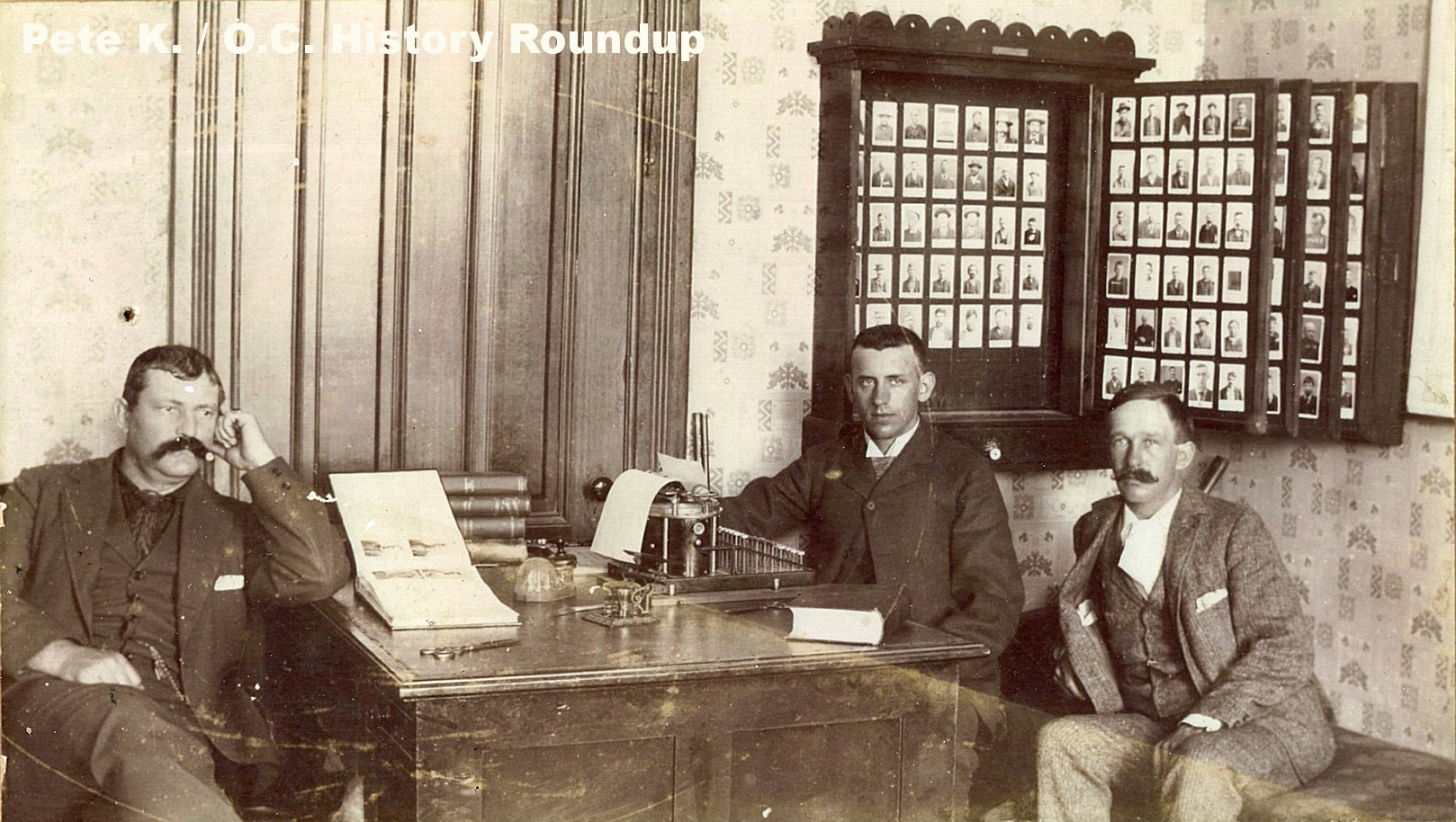
I was recently contacted by Pete K., who just purchased this rare original print of a late-1890s photo of Orange County Sheriff Joseph Nichols and two of his deputies. The image is already known to those who have studied the history of Orange County law enforcement -- but an original print is still an exciting find.

Over the years, I've seen this image captioned with a variety of name IDs, dates, and so forth. Pete's print has this written on the back: “To Filipe Barante. Three of a kind. Joe Nichols, Nov. 23, 1897.” In another spot it is marked “F – de papa – S.A.” These inscriptions by Nichols provide both more clarity and new mysteries. 

Although "Felipe Barante and "F - de papa - S.A." don't ring any bells, the fact that Nichols signed it in 1897 puts to bed the long-held notion that the photo was taken in 1898.
Photocopy of the back of Pete's print of the photo.

Pete wanted to know a little something about the men in the photo. As I dug for information, I was surprised learn the degree to which these three men were connected to so many significant aspects and personalities of our early local history. Undoubtedly, there's much more to be learned about these three, but here's what I turned up so far:

JOSEPH C. NICHOLS

Born in Indiana in August 1860, Joseph Clark “Joe” Nichols arrived in Orange County in the 1880s. While living in Anaheim in 1889, he married Mary Margaret Parker. Together, they would have three daughters: Marguerite Olive (1897-1941), Norma (1894-1989), and Henrietta (1895-1945).

J. C. Nichols served as Orange County’s third Sheriff, from 1895 to 1899 and was the first elected for a newly adopted four-year term. He is remembered for improving inmate record keeping, overseeing the completion of the jail on Courthouse Square (1896), and keeping increasing numbers of transients in check. Although generally well liked and having a well-funded campaign, he was defeated in the election of 1898 by Theo Lacy. His loss was largely due to the national sentiment of the moment, which skewed toward the Democratic Party and their “Free Silver” movement.  

After leaving office, Nichols had his own furniture store in Santa Ana. Around 1907 he and his family moved to Los Angeles where he went into the real estate business. He died in Los Angeles on April 27, 1950.

JOHN W. "JACK" LANDELL

Born in Philadelphia in 1866, the oldest of the six children of James and Sally Landell, John W. Landell came to California with his family in the 1870s. He became an insurance salesman and something of a mover-and-shaker in the Anaheim area. He was City Marshal of Anaheim Township for five years circa 1890. (Some newspaper accounts cite him as Anaheim’s Justice of the Peace or Constable, but in he himself described his position as City Marshal in Samuel Armor’s 1921 History of Orange County.) After that, he went to Santa Ana where he worked as a Sheriff’s Deputy for four years. At some point early in his career, he also worked as a Los Angeles Sheriff’s Deputy.

In April 1897 at what’s now Capistrano Beach (then called San-Juan-By-The Sea and later known as Serra), Landell married Soledad Cristina Pryor, daughter of ranchero Pablo Pryor and granddaughter of Don Juan Avila. They would have several children: Gladys (1908–1995), John Paul (1910–1994), and Charles (1901-1933).

Landell resigned his post in Santa Ana in December 1898 and the next month took the position of Justice of the Peace (J. P.) for San Juan Township (San Juan Capistrano area). He held that post for at least 12 years. Afterward, Landell and his wife briefly moved to San Diego, but quickly moved back to Capistrano Beach. He ran again for J.P. of San Juan in 1918 but lost the election. He then focused his attention on his ranch – primarily growing walnuts – and also opened an adjacent auto service station and convenience store. He also served as a member of the local school board. 

For most of the rest of his life, he filled in whenever any Orange County J.P. was away due to illness or travel. This included the period from August to December of 1924 when he filled in for Judge Cox of Santa Ana during the illness that would ultimately take Cox’ life. By 1930 Landell was again San Juan’s Justice of the Peace. 

He died in San Juan Capistrano on April 4, 1939 and is buried at Anaheim Cemetery.

NATHAN ALLEN ULM

N. A. Ulm was born August 10, 1869 in Jefferson County, Illinois. He arrived in Santa Ana in the late 1880s and married Nellie Jeanette Abercrombie on April 16, 1888. They would have several children: Earl (1890-1925), Nathan Lamar (1892-1957), and Audrey (1894-1960).

Nathan A. Ulm was manager of the Grand Opera House, proprietor of the Santa Ana Book Store, secretary of the Orange County Republican Central Committee, captain in Company L, 7th Regiment (Santa Ana’s National Guard Unit), founding secretary of the Santa Ana Merchants & Manufacturers Association, and generally a prominent figure in the community. Under Sheriff Joe Nichols, he served as the county’s jailer. In 1912, Ulm was part of the posse involved in the infamous 1912 shoot-out in Irvine with the “Tomato Springs Bandit.” 

In November 1913 – after a brief investigation --- the State Building & Loan Commissioner George Walker informed the Santa Ana Merchants & Manufacturers Association’s board that their books were short $15,000 to $17,000. Although the Orange County Sheriff’s Department was soon on the case, the Associations’ directors asked that a warrant not be issued Ulm’s immediate arrest but asked instead that he be watched. However, on November 19, Walker went to Ulm and collected the Association’s books from him. Four hours later, Ulm committed suicide by cyanide at his home at 818 E. 2nd Street. Later investigation showed that Ulm had been forging Association president C. D. Ball’s name to help obscure the missing money. The shortfall appeared to date back to 1906.

A few days after his suicide, the Santa Ana Armory Association -- of which Ulm was also secretary -- reviewed their books as well and found $2,500 had somehow gone missing. 

In many copies of the 1897 photo of the three lawmen, Ulm is certainly the least remembered today and his name is often misspelled in the caption. But his story certainly turned out to be a colorful one.

If you know more -- and specifically if you know more about "Filipe Barante" or the meaning of "F – de papa – S.A.," drop me a line via email or DM me on Facebook.

Wednesday, June 22, 2022

Mystery book cover unmystified

When Phil Brigandi died in 2019, we (his historian friends) spent countless hours working to appropriately distribute his vast personal historical library and artifacts to the appropriate institutions. (Again, many thanks to his brothers for allowing us to do this.) Because we knew his areas of historical study, most items were fairly easy to identify. But there are certain items that have taken longer to puzzle out. For instance, when I found this front cover torn off an old hardbound book in his apartment, I had no idea of its significance. I *did* know that it must have SOME significance, or Phil wouldn’t have kept it. He was methodical about collecting and only kept things that were somehow relevant.

In this case, a bit of searching turned up information about Mr. Mason M. Fishback, who once owned the book this cover once, well, COVERED. 

Mason Fishback from the 1930 OUHS annual.

Mason McCloud Fishback was born in Marshall, Illinois on Feb. 1, 1878 to James and Orrel Fishback. He left Illinois for Orange County in the very early 1900s. He started as a history teacher at Orange Union High School (which was also Phil’s beloved alma mater) in 1906. In 1915 he married Lenore Rose, but she died in April 1917. The following year, while continuing to teach, he was given the additional responsibility of becoming the Boys’ Vice Principal for Orange High. He remained in that position for the rest of his life. 

During World War II Fishback led the successful effort at OUHS to raise enough funds by selling oranges to buy the Red Cross another ambulance to serve on the front lines. For this, he received a personal thank-you from President Woodrow Wilson.

In 1920, Mason married fellow Orange High teacher, Mabel Parker. According to the National Register of Historic Places application for Old Towne Orange, Mason had a new Dutch Colonial Revival home built for his bride at 284 N. Glassell Ave. in Orange, which was completed in 1921. 

A modern view of 284 N. Glassell Ave.

Mason was an authority on the life of Abraham Lincoln, and he was well-liked at work and in the community. In fact, at the time of his death, January 9, 1941, the Los Angeles Times referred to him as “the most popular man in the county.”

Luckily, the house at 284 N. Glassell still stands and is a perfect match for the house depicted on Fishback’s “Ex Libris” label. It appears the house is now the headquarters for the local law firms.

The Ex Libris labels themselves were undoubtedly created and placed in the books of Fishback’s personal library around the time of his death. As books were given to the city library, the church or friends, the labels would serve as a continuing memorial to Orange’s favorite vice principal.

Closeup of the label.
Now knowing that Fishback was such a well-known figure in Orange during his era, knowing his association with Orange High, and knowing that the house on the label is in historic Downtown Orange, it makes perfect sense that Phil would save this relic. He was, among other things, the great City of Orange historian.