Saturday, April 19, 2025

"Pioneer Bird Man" Roy Chamness

Ad for Orana Bird & Goldfish Co. in the Anaheim Bulletin, 8-30-1926.

Orange County's "Pioneer Bird Man," Leroy Hood "Roy" Chamness (1890-1947), started out as an auto mechanic in Santa Ana around 1908 and worked on some of Glenn Martin's early airplanes, including his first. Roy was also a locally well-known hunter, regularly bringing down large bucks with a single shot and even capturing a bobcat to keep as a "pet." But neither the experimental airplanes he helped build nor the wild birds he shot were the source of Roy's nickname.

Glenn L. Martin's first airplane, built in an abandoned Santa Ana church (Los Angeles Times 8-4-1910)

Roy married Beatrice May "Bessie" Shaw in 1910. Somewhere along the line, they were given a canary as a gift. Bessie then bought a femalem, and soon they had a little flock. The Chamness' growing love of birds would direct the course of their lives. Throughout the early 1920s, Roy was running Chamness Brothers Bird Yard, at 915 E. Pine Street in Santa Ana, raising "fancy and song birds" with his brother, J. L. Chamness. In July of 1921 Roy and Bessie's son, Charles Herbert Chamness, was born.  

By late 1923, Roy, Bessie, and business partner William Paterson had their own Rare Bird Farm on Newport Blvd near 21st Street in Costa Mesa. While the focus was on their thousands of birds -- from finches, to macaws, to pheasants -- the farm also raised bull terriers, rare water plants, and fish. 

Charlie Chamness with macaws, parrot, and puppies in Costa Mesa. (Santa Ana Register 1-19-1924)

After a big article about the farm in the January 19, 1924 edition of the Santa Ana Register, the farm became quite popular. It was said that film comedian Buster Keaton was looking for a way to use the property in one of his films. 

On May 16, 1925 -- Roy and Bessie sold their interest in the farm to Paterson. They moved north and opened the Orana Bird & Goldfish Co. at the north end of Main Street at Chapman Ave. (Highway 101) in the little community of Orana. They were advertising in the Register in time for Christmas 1925.

Orana Bird & Gold Fish Co., circa 1928 (Courtesy Santa Ana Public Library)

Historian Phil Brigandi described the community of Orana in his book, Orange County Place Names A to Z: "In 1913, local rancher L. E. Smith built a garage  at the southwest corner of Chapman Avenue and Main Street, on the route of the new state highway through Orange County. Smith and his mechanic, Otto Buer, coined the name Orana because the spot was midway between Orange and Santa Ana. A 'scruffy business district' (as Jim Sleeper once described it) eventually grew up there. The name was well-known by the 1950s."

In 1927, the store expanded to include many more aviaries and a lily pond. But in August 1929, Chamness dropped "& Goldfish" from the store's name. It would remain the "Orana Bird Store" until at least 1934. 

Roy (left) and brother J. L. Chamness (right) with three-point buck Roy shot in Verdugo Canyon (Santa Ana Register 10-3-1922)

From 1936 onward, the store didn't even appear in local directories. But it seems Roy was operating a version of his store just up the highway from his old location, across from the Melrose Abbey mausoleum in what's now part of Anaheim. 

Chamness continued to be listed as a seller of birds and/or a gunsmith through at least the mid-1940s. Indeed, hunters from all over the country brought their guns to Chamness for repairs. Roy was already in poor health in September 1945, when a drunk driver crashed into the Anaheim store. The store closed, and Roy died on June 5, 1947. Bessie married widower William Isaac "Will" Donica of Costa Mesa in October 1948. Will died in 1965, and Bessie followed in 1973.

Thursday, April 17, 2025

The Mint Julep and Disneyland

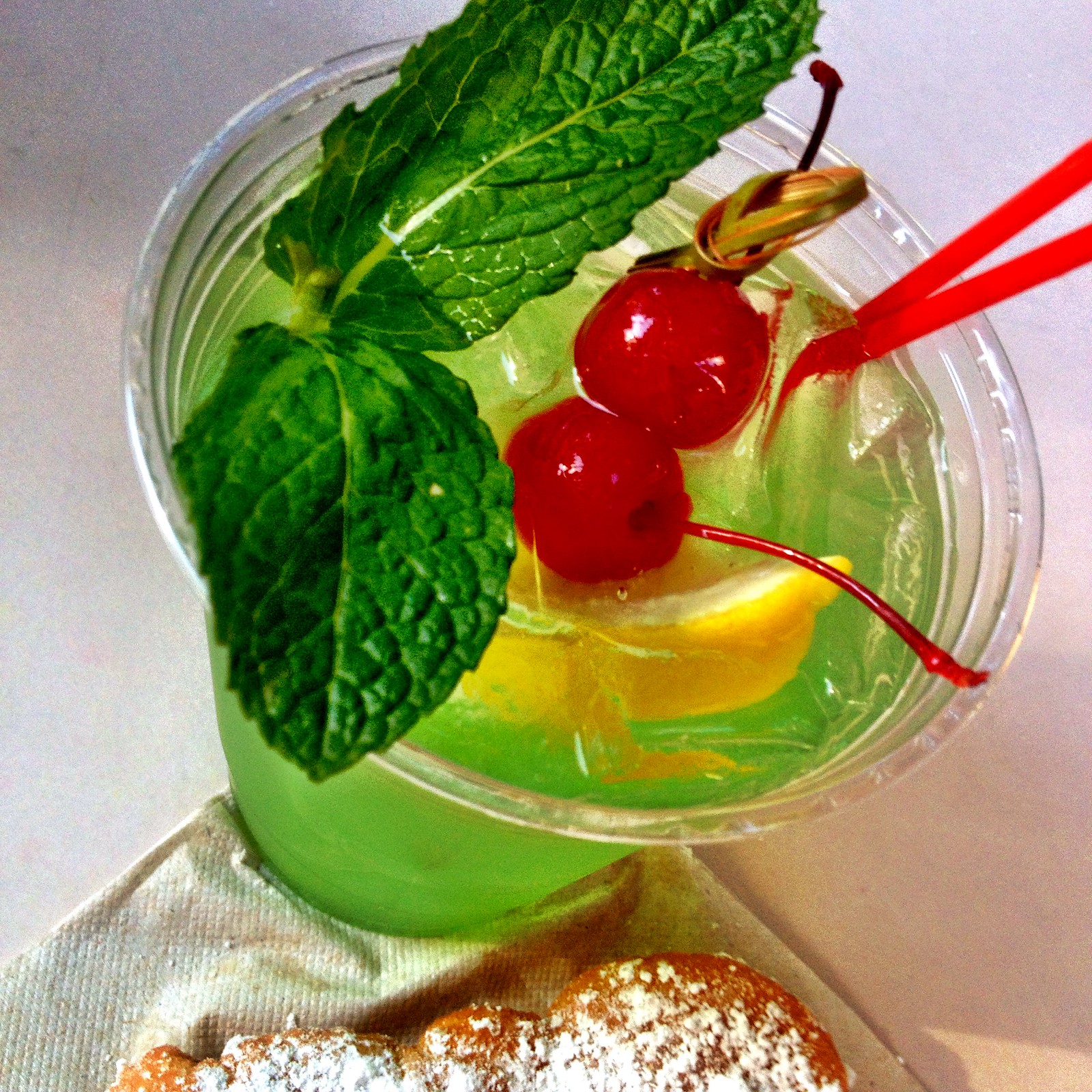
A Disneyland mint julep. (Photo courtesy Larry Tenney)

Those who grew up with Disneyland are starkly divided on the subject of New Orleans Square’s vibrantly green, non-alcoholic, “mint julep.” Nobody’s on the fence. It’s either a uniquely refreshing minty delight or it tastes like a horrible Listerine/Windex hybrid. Either way, the mint julep – in one form or another – has been part of Disneyland since before opening day. 

Walt and Lillian Disney celebrated their thirtieth wedding anniversary just four days before Disneyland's grand opening, on July 13, 1955. They took 250 of their family and friends (including many Hollywood stars) on the maiden voyage of the Mark Twain steamboat and then for a big dinner at the Golden Horseshoe in Frontierland. Aboard the Twain, a live Dixieland band provided the music and real mint juleps were served.  

L to R: Diane, Lillian, Sharon and Walt Disney at Walt and Lillian's 30th anniversary party.

So, what’s a real mint julep? Exact details vary, but the drink is essentially as follows:

Fresh mint

1/2 oz simple syrup

2 1/2 oz bourbon 

Put 4 or 5 fresh mint leaves and 1/2 oz simple syrup into a silver julep cup or double old-fashioned glass. Muddle thoroughly. Add 2 1/2 oz bourbon. Fill the glass with crushed ice and stir until the glass is frosty. Garnish with a sprig or two of fresh mint. 

Using good bourbon and crushed ice are key. For a sweeter, mintier julep, muddle 10 mint leaves, use 3/4 oz simple syrup, and 2 oz bourbon.

After the Disneys’ party, famed gossip columnist Hedda Hopper described their “trip on the showboat… which Dinah Shore guided through perilous waters. We all sipped mint juleps served by waiters in red coats. But once the park is opened no alcoholic beverages will be served." 

Disney history expert and former Imagineer Tom Morris writes that one of the aforementioned "red-coated bartenders serving up real mint juleps aboard the Mark Twain the evening of Walt and Lillian’s anniversary was Dick Nunis, future Disneyland and Walt Disney World overlord." [Disney Legend Nunis started as an assistant for Disneyland employee orientation sessions in 1955 and worked his way up to become president of both Disneyland and Walt Disney World in 1980 and chairman of Walt Disney Attractions in 1991.]
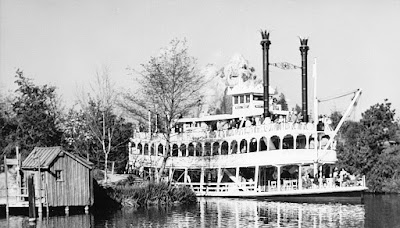
The Mark Twain, Disneyland, 1963.

In any case, Hopper was right: Once the park opened, there was no alcohol served the the public. Indeed, less than seven months after the Disneys' anniversary party, a journalist specified that “on the Mark Twain, you can see all the romantic figures of the Old South except the river boat gamblers and you can do everything but sip a mint julep. Disneyland is strictly moral." 

But outside Disneyland property, Walt still appreciated a real mint julep.

On June 8, 1956, Walt once again called upon the regional iconography of the genuine and entirely alcoholic mint julep. He was in Atlanta for the premiere of his movie, "The Great Locomotive Chase," which was set in the South during the Civil War. (Essentially a remake of Buster Keaton’s “The General,” sans comedic genius.) Disney told reporters, "I'm really a Southerner at heart. I was born in South Chicago and I live in Southern California." Befitting a Southern gentleman, he served mint juleps to his guests. Walt understood the power of symbolism better than most, and at that time there were few more positive and immediately identifiable symbols of Southern hospitality than the mint julep. 

But when did the non-alcoholic mint julep come to Disneyland? 

Tom Morris writes, “The idea for it goes back to the early 1960s when they were considering the kinds of shops and restaurants that should be included in New Orleans Square.” 

Mint julep fountain dispenser, Disneyland. (Courtesy TV's Spatch)

Among the creative folk behind Disneyland, said Morris, there was “a recurring proposal, going as far back as 1961, for a soda ‘bar’ inspired by the Lafitte’s Bar in New Orleans! Exotic concoctions, sans alcohol! But no specific mention of juleps. The soda/juice bar idea continued to be pushed in various forms by the Foods Division and Lessee Relations. As late as 1965 they were proposing a Welch’s-sponsored juice bar themed to Mardi Gras with a Bacchus fountain dispensing grape and other juice flavors! … That idea went by the wayside, but I think it was always a no-brainer to have some form of mint julep … served on one of the menus.”

By 1962, no-booze mint juleps were sold to guests aboard Disneyland’s Mark Twain riverboat as it plied “The Rivers of America.” Noted one reporter from Missouri, "The juleps are sold by a Negro wearing a bright red coat of authentic southern riverboat fashion of yesteryear.”

Indira Gandhi and her father, India Prime Minister Nehru, on the Mark Twain, probably enjoying Disney-style mint juleps. Nov. 13, 1961.

Notably, the drinks held by guests on the Mark Twain in the April 1962 “Disneyland After Dark” TV special – watching Louis Armstrong perform with a handful of other jazz greats -- are very likely non-alcoholic mint juleps. Some of the small white cups are marked with a Mark Twain logo on the side. (Years later, the drinks would be served in clear cups, showing off their garish green color.)

Drinking a mint julep on the Mark Twain in "Disneyland After Dark," 1962.

The 1966 opening of Disneyland’s beautiful New Orleans Square included the opening of the Mint Julep Bar. “Hidden away” on the back side of the French Market restaurant, across from the train station, the attractively decorated Mint Julep Bar gave each of its millions of customers the feeling that they’d discovered a great secret.

Tim Eldred, who worked the Mint Julep Bar at Disneyland from 1968 to 1971, remembers his time as a "julepjerk": 

"The julep syrup came in five-gallon containers that we had to fetch from the downstairs storage in the middle of the afternoons all summer. It had to be poured into smallish metal tanks that were kept in a cabinet under the cash register. It was incredibly sticky and hard to pour into the containers, causing it to go all over the floor. [It was] very difficult for the closer to have to take the mats for steam cleaning after the park closed. 

"In summer, we [used] a team approach to preparing multiple drinks. We set up cafeteria trays with glasses and ice, then used buckets to pour the carbonated mix into the classes. The trays were then moved to the serving window. The official garnish was mint, a slice of lime and a cherry. But when things got busy, the mint was left out. 

"[During] the summer of 1970, we trained a Florida cast member so he would be ready for the opening of Walt Disney World. I can still hear Brent's Southern drawl description of a mint julep as "carbonated Scope with a hint of mint." Personally, I couldn't drink it straight from the fountain - I made a half-and-half julep and lemonade to cut the cloying sweetness."

The Mint Julep Bar in 2017. (Photo courtesy Diana)

The Mint Julep Bar sold a number of refreshments, but the Mint Julep itself was, of course, the star. The Bar’s other special treat was a softball (later baseball)-sized “choux fritter” that was more like giant cinnamon-dusted doughnut hole. "The choux fritters were marvelous," remembers Eldred, "especially when we filled them with whipped cream ... for [our employee] breaks. [We] called them 'fuel-injected fritters.'"

In later decades, the fritters were served with a side of “apple butter” that was like a buttery apple pie filling. Around 2009, the fritters were replaced with underwhelming beignets as a marketing tie-in with Disney’s similarly underwhelming new animated film, “The Princess and the Frog.”  

Within a few years of the Mint Julep Bar’s 1966 opening, it seems Disney’s mint julep was no longer served aboard the Mark Twain. Some say it was simply too difficult to keep the boat stocked with drinks. In time, however, the mint julep would be added – unofficially or officially – to the menus of several other restaurants in New Orleans Square.

French Market Restaurant, September 1970. (Courtesy Dave DeCaro)

Guests who asked for the recipe for Disneyland’s teetotal mint julep have traditionally either been given a photocopied recipe on the spot or were directed to City Hall on Main Street, U.S.A. where a copy was provided. The recipe provided has come in several slight variations over the decades, all of which are essentially as follows:

1 1/4 oz Lime Juice

1 lb. Granulated sugar

8 1/2 oz Lemonade concentrate

3/4 oz Crème de Menthe syrup (non-alcoholic)

6 cups Water

Combine sugar and water in a 3-quart sauce pan. Stir until sugar is dissolved. Stir in lime juice and lemonade concentrate. Add creme de menthe syrup and mix well. Continue stirring and bring to just below the boiling point (210° F). Do not boil. Remove from heat and chill. Add a ratio of one part syrup to five parts chilled water. Yield: 2 quarts.

All versions of the recipe (except one of dubious origin) specify NOT boiling the mixture, but they differ regarding the temperature you should bring the syrup to: 185°, 200°, or 210° F. Additional versions have also appeared in various Disney cookbooks, magazines, and elsewhere.

(The author’s ham-fisted attempt at following this recipe resulted in glop that was utterly unlike anything ever served in Disneyland. He fears he used the wrong crème de menthe syrup. Your own attempt can only be an improvement.)

Concept art for still-under-development New Orleans Square.

What’s that you say? You also want the aforementioned recipe of “dubious origin?”  Well, here’s that one, too:

3 lbs sugar

1 gallon water

1 pint crème de menthe syrup topping

½ (6 oz) can frozen limeade concentrate

½ (6 oz) can frozen lemonade concentrate

Combine sugar and water in a large kettle and bring to a boil. Add crème de menthe syrup, limeade and lemonade and bring to a boil. Remove from heat and chill. Serve in tall glasses with springs of mint, maraschino cherries and pineapple pieces, if wished. Makes about 24 (1-cup) serving.

The latter recipe appears several places on the web and in newspaper columns and is attributed to Disneyland, but with no further details.

A 1931 illustration of a mint julep drinker.

According to several sources, Disney’s mint julep was a lot mintier and was also carbonated prior to some point in the 1980s. There certainly hasn’t been any fizz in the drink since at least the early 2000s.

Longtime Disneyland regular Roger Colton also says that from about 1980 to around 1999 he was able to purchase jugs of the mint julep syrup at the Mint Julep Bar for use in making the drink at home. But by the early 2000s, Disney got twitchier about their proprietary soft drink. When the name of the company manufacturing the syrup for Disneyland (likely located in Tustin) was leaked onto Usenet’s alt.disney.disneyland, phone calls to the business proved unrewarding: 

“Do you make the mint julep syrup for Disneyland? And if so, can I buy some?”

“We can neither confirm nor deny that we currently or in the past have, or have had, any business interactions with the Walt Disney Company or Disneyland.”

Today, rumors circulate that Disney changed the formula (and taste) of their boozeless mint julep again in 2017; that juleps in non-mint flavors (a contraction in terms) are sometimes available in the park; and that one can now order a real mint julep in New Orleans Square’s Café Orleans. The author can neither confirm nor deny these rumors. He has only one full-time job and therefore can no longer afford the current cost of a day in the park. 

Author with a mint julep at Disneyland back in 2014.

Thanks to Christopher Hanson, Tom Morris, Melissa Rhone and Cindy of the Disneyland Alumni Club, Christopher Merritt, Marcy Carriker Smothers, Peggie Farris, Steve Valkenburg, Tim Eldred and Roger Colton for their input. This article was first published in Eat Me: The Zine About Vintage SoCal Food, Winter 2024/2025.


PARTIAL BIBLIOGRAPHY:

  • Bumbarger, Paul. "Armed Forces," The Daily Sikeston [Missouri] Standard, 5-9-1962, pg 11.
  • Eldred, Tim. Interviewed by author on Vintage Disneyland Facebook group, 7-8-2025.
  • Hopper, Hedda. "Walt Disneys Fete 250 at Fabulous Disneyland," Chicago Tribune, 7-16-1955, pg 17.
  • Jenkins, Frank. "In the Day's News," Medford [Oregon] Mail Tribune, 2-6-1956, pg 4.
  • Morris, Tom. Multiple discussions with the author via Facebook, 2004 and 2005.
  • Morrissey, Ralph. "Under the Green Lamp," The Tennessean, 7-9-1956.
  • Vagnini, Steven. "Favorite Memories from Walt and Lillian's 30th Anniversary Party," D23.com, 2-11-2016.


Tuesday, March 25, 2025

Fritz Smythe Attacks the Courthouse

John S. Smythe (ca 1890) and the Orange County Courthouse (ca 1903)

Who was the first nut to vandalize County property? It's hard to be sure, but we have a strong contender.

In the early hours of Saturday, July 9th, 1903, once-prominent Anaheim pioneer, 79-year-old John Sydney “Fritz” Smythe, mounted a dramatic one-man assault on the Orange County Courthouse. Fritz was the husband of Maria Antonia Josefa Yorba de Smythe of the locally famed Yorba family, and was the father of both Mrs. Fred Rimpau of Anaheim and of the first Orange County Assessor, Frederick C. Smythe. 

Fritz had been hanging around the then-newish Orange County Courthouse for a couple days, requesting admittance to Orange County Hospital. But the County Hospital was a service reserved for the indigent. Fritz was told he didn’t qualify because his family was well-off and had explicitly told the county that they were willing and able to care for him themselves. In any case, it seems Fritz’ problems were largely in his brain, which isn’t something a hospital could do much about in 1903. 

A quick aside about the hospital: Two years earlier, the County began renting a “hotel” building on Second St. in Santa Ana to use as the County Hospital. Prior to that, the building had been operated by madam Mary “Glass-eyed Mollie” Wright. By 1903, however, the only remaining unorthodox aspect of the place was that Wright’s father, “Mysterious Bill,” was still living in a shack on the property. 

In any case, Fritz was furious about being turned away. In fact, he didn’t seem to care which County agency institutionalized him. The makeshift hospital and the jail were similarly appealing to him.

"An honest man has no chance in this county," Fritz complained to bystanders. "A man has to be a criminal before getting anything to do in this county," he said, gesturing toward a chain-gang of vagrants on maintenance detail on the Courthouse grounds.

Prisoners used as labor on the Courthouse grounds many years later -- cleaning up after the 1933 earthquake.

At 4:15 a.m. that Saturday, Fritz performed what the Anaheim Gazette called a “ghost dance” on the front lawn of the red sandstone courthouse and then proceeded to throw large, carefully selected rocks through ten of the big, expensive windows on the front (south side) of the building. One wonders if the stones were taken from the cobble curbing still found along sections of the Courthouse Block. Casualties included windows in the offices of the Assessor, Tax Collector, and Board of Supervisors.

Stone curbing on the Courthouse Block, 2025.

The sound of breaking glass awakened Courthouse janitor George Benedict, who lived in an apartment near the south door on the ground floor. He initially assumed that the building’s large skylight had been broken. But then crash after crash after crash indicated that the whole building was under attack.

Detail of basement (ground floor) plans for Orange County Courthouse, circa1900.

Benedict threw on some clothes, dashed to a good vantage point, saw what appeared to be a mad man hurling rocks at the building. He went back for his gun. By the time he got outside with his gun, Fritz Smythe was done with his tantrum and was sauntering off the Courthouse grounds. 

Benedict went to awaken Sheriff Lacy, whose apartment in the County Jail, which – being behind the courthouse – may have been out of earshot from the breaking glass. 

The County Jail (a.k.a. "Lacy's Hotel"), behind the Courthouse.

Lacy caught up with Smythe little more than a block from the Courthouse, in front of the Fashion Livery (419 N. Sycamore), where the Ramona Building now stands. There, Fritz freely admitted to his vandalism spree. He was arrested and examined on a charge of insanity. There was talk of sending him to an asylum. According to the Los Angeles Times, he appeared "unexcited and rational" but also "peculiar, and his manner suggestive of a restrained irrationality."

Looking down Sycamore from the Courthouse cupola, early 1900s. Fashion Livery, where Smythe was apprehended, highlighted in green.
The Los Angeles Evening Express wrote that Fritz Smyth “long has been known as a very quarrelsome old man” and opined that earlier similar attacks by Smythe against his “perceived enemies” were proof that he was not insane. 

On Easter morning, 1899, Fritz had lobbed several rocks through the plate glass windows of Samuel S. Federman’s dry goods store in Anaheim, which had apparently offended him in some way. In that instance, his friends and family ponied up the money to pay for the damage and charges were dropped. How the Express drew the conclusion that this incident was proof of Smythe’s sanity is a mystery.

Federman's Store is on the right, behind the white horse. View is Center St., looking west from Claudina, Anaheim, circa 1901.

Fritz was tried for malicious mischief on July 11th for his early-morning Courthouse escapade. Again, some of his friends came forward in court, offering to smooth things over by paying for the windows. But this time, when they found out what the windows would cost (at least $140), they rescinded their offers and left Fritz to the tender mercies of the law. Perhaps they also hoped a little punishment might discourage yet more window-breaking escapades.

Fritz was sentenced to six months in County Jail, which must have pleased him. Due to his advanced age, he was not put on the chain-gang as he’d pined for. But he proved a “good prisoner” and requested only one meal (breakfast) each day. 

The appeal of jail life wore thin, however. In December he formally appealed for early release for good behavior. The Board of Supervisors said they’d agree to early release if he, in turn, would agree to leave the county. But Smythe refused and served the rest of his sentence, which ended in the middle of January.

John S. “Fritz” Smythe appeared to still be in relatively good heath when he died of sudden heart failure June 22, 1906 at his home in Anaheim.

The Orange County Courthouse, including new windows, circa1904

The problem of lunatics creating headaches in and around what's now called the Old Orange County Courthouse is still with us. Having spent decades in Downtown Santa Ana, I’ve seen a LOT of crazy, heartbreaking, and destructive behavior from the homeless, the vast majority of whom suffer from serious mental illness, drug addiction, or both. I’ve seen way more than my fair share of screaming/unintelligible rants, endless wacky conspiracy theories, sidewalk poop, attempted arson, prone human forms that might or might not be dead, scattered drug paraphernalia, shockingly creative property damage, and so much more. And I’ve seen the Old Courthouse – now a beloved historical landmark and iconic symbol of our county – defaced (and repaired) many times. 

The crowd surrounding the Old Courthouse in the late 2010s and early 2020s.

In a move Smythe would have appreciated, there have even been many windows broken at the Old Courthouse and other civic buildings in recent years. At the time, I didn't recognize these incidents as historical re-enactments.

The situation is much better than it was in the late 2010s and early 2020s, but it's still part of daily reality. Just one example is a person I see frequently who's given to writing paranoid screeds on public property. She claims she lived on Mars for three years, trained Queen Elizabeth’s horses, and brought down mob kingpins for J. Edgar Hoover. Presumably not simultaneously, but who knows? 

Saturday, March 08, 2025

Willard Smith of Villa Park

Orange County Supervisor Willard Smith

One of the most influential Orange County citizens of the 20th century is barely remembered today. Willard Smith of Villa Park was a huge figure in the citrus and banking industries, water and land development, and most notably, as a County Supervisor from 1925 to 1955.

Willard Smith was born March 24, 1882 in the rural community of Mountain View (now Villa Park), in the house his father, rancher James M. Smith, built at the east end of Santiago Boulevard. (Now 18992 Santiago Blvd. at Sycamore and listed on the National Register of Historic Places.) Willard would live in the house most of his life. He attended Mountain View Elementary School and Santa Ana High School, and graduated from the Orange County Business College in Santa Ana.

VPOA's Red Dog brand of Valencia oranges, inspired by one of Smith's prized bulldogs.
As a young man, Smith tried his hand at various jobs. He left home in 1900 to work in the sawmills of Redding but soon returned to Orange County to start a citrus grove fumigation business. Next, he entered the photo engraving business, which took him to San Diego and then to Los Angeles. But the chemicals he had to work with were bad for his health. In 1906 he returned to Villa Park where he managed three citrus ranches and began raising prize-winning English bulldogs. 

Within a year, Smith was made president of the Serrano Water Co. (later called the Serrano Irrigation District), which served the Villa Park area. In that role, he was involved in the construction of the Santiago Dam and the creation of Irvine Lake in 1931. Smith served on the board of the Bixby Development Co. and was involved with the development of the Cerro Villa and Peralta Hills tracts. 

A financial whiz and already a stockholder and director of the National Bank of Orange, Smith filled in “temporarily” for an ailing cashier and soon also found himself in a lifelong banking career. When the bank merged with the First National Bank of Orange, he remained on their board for more than forty years and he served, at various times, as vice president and chairman of the board.
L to R: Willard Smith, Mr. Hasenjaeger, Willis Warner, Dick Hater, and Pat Arnold horsing around after a planning meeting with Walt Disney (right) at Disney Studios, December 1954.
Willard married Edna Lee in 1910, and the couple had two sons, Dr. George Abbott Smith (1911-2002) and Willard Irving Smith (1914-1957).

Smith was a founding member of the Villa Park Orchards Association, and served as its president from 1913 to 1959. He also served on the board of the Orange County Fruit Exchange, and was a founding member of the Orange County Farm Bureau.

Smith was active in numerous fraternal and civic organizations. He was a member of the Orange Grove Lodge #293, Free and Accepted Masons, serving as Worshipful Master in 1918. He was also active with the Orange Chapter #99, Royal Arch Masons, the Al Malikah Shrine Temple, the Orange Elks Lodge, the Orange Rotary Club, the Orange Community Chamber of Commerce, and the Native Sons of the Golden West.

L to R: Orange County Supervisors George Jeffrey and Willard Smith with the mayor of Laguna Beach at the end of Blue Lantern St. in Dana Point after a tour of the under-construction Ortega Highway, 1930.

As a prominent and capable community leader, Willard Smith was an obvious choice when, in 1925, it came time for the governor to appoint a replacement for Orange County Supervisor Leon Whittsel, who had been appointed to the State Railroad Commission. 

Once on the board, Smith’s talents, experience, penchant for research, and community connections made him a force to be reckoned with. He was “the sparkplug of the county’s executive board,” wrote the Orange Daily News. “There is little of the sensational about Willard Smith, he is instead a quiet, level-headed executive who takes every responsibility in dead earnest and never makes a play for publicity.” 

Smith would not have run for re-election, but a contingent of friends and supporters arm-twisted him into it. He would end up being the longest-serving Supervisor in the history of Orange County.

Representing the Fourth District, he saw the county through some of its most turbulent and transformative times, including prohibition; the dedication of the Orange County Airport; the building of the Ortega, Imperial and Coast Highways; the Great Depression; the 1933 Long Beach Earthquake; the development of Newport Harbor; the 1938 flood, the construction of Prado Dam and other flood control infrastructure; World War II, the shift away from an agricultural economy, the planning of Disneyland, and the beginnings of Orange County’s post-war population boom. No other individual was more responsible for guiding and shaping Orange County during its greatest era of development. During his time in office, he served several terms as chairman of the board.

Willard Smith's home and orange groves, Villa Park.

Although involved in steering the County through a vast array of critical issues, Smith was best known as an expert on county finances, water, flood control and agriculture. He also took a strong roll in forestry issues, fire prevention, and the growing population’s need for good roads.  

Politically, he was a proponent of keeping taxes low and spending revenue locally rather than turning to state and federal government for local needs. That said, he was more than willing to travel to Sacramento or Washington, D.C., when an advocate for Orange County was needed in the halls of power.

Despite his career and his impressive resume of public service, Willard Smith always regarded himself primarily as a farmer. His other interests were, he said, “incidental.”

Upon his retirement, Los Angeles Airways named their new heliport between Orange and Santa Ana in honor of Smith. After several years of poor health, he died in Orange on May 20, 1969. 

So much of what he created or laid the groundwork for is still part of Orange County today.

Sunday, February 09, 2025

Anaheim’s “Missing” Jewish Cemetery

Anaheim in 1876. (Courtesy Anaheim Heritage Center)

There was almost a real cemetery in what became Disneyland’s backyard. But like some of the Haunted Mansion’s 999 ghosts, it failed to fully materialize.

Anaheim was planned and settled beginning in the late 1850s by the Los Angeles Vineyard Society, which was composed primarily of Germans and other Europeans who’d been living in San Francisco. It’s less well-known that some of Anaheim’s pioneers were Jewish – beginning with vintner, merchant and philanthropist Benjamin Dreyfus, who arrived in 1857. 

Jewish communities often prioritize acquiring land for a cemetery even before establishing a synagogue or school. The cemeteries are generally established by a local Jewish burial society – a tradition that began in Prague in the 16th Century. In keeping with religious law and tradition, these cemeteries are generally established outside of town. 

Gustav Davis, a founder of the Anaheim Hebrew Cemetery Assoc., joined his brother Phil in Anaheim in 1870. They opened a grocery and hardware store in 1878. (Courtesy Anaheim Heritage Center)

Indeed, as Anaheim’s Jewish community grew, the Anaheim Hebrew Cemetery Association was formed around 1876 and filed incorporation papers in January 1877. The first directors were Louis Wartenberg, Gustav Davis, Joseph Fisher, Morris A. Mendelson and H. Cohn. 

Henry Kroeger Building, south side of 100 block of Center St, (now Lincoln Ave.), Anaheim,1895. Early meeting place of the Anaheim Hebrew Cemetery Assoc. (Courtesy Anaheim Heritage Center)

The Association finally selected and purchased (from the Robinson Trust) two and a half acres south of town on July 8, 1882 for $125. 

In modern terms, the land is occupied by both the northbound and southbound lanes of Disneyland Drive, just south of Ball Road. 

Site of cemetery land highlighted in green.

Prior to the development of Disneyland Drive, the parcel was on the southeast corner of Ball and West Streets. (For you surveyor-types: The NE 1/4 of NW 1/4 of NW 1/4 of NW 1/4, of Section 22, Township 4 South, Range 10 West, San Bernardino Base & Meridian.) This spot was well known to locals into the early 1900s.

“However,” writes historian Dalia Taft, in JLife magazine, “no place of burial ended up being created and most Jews were interred in either Los Angeles or San Francisco." 

Site of proposed Anaheim Hebrew Cemetery as it appeared in 2024.

The fact that the land was never consecrated or used as intended was “perhaps because of the greater convenience of using the cemetery of the Hebrew Benevolent Society of Los Angeles located in Chavez Ravine,” writes Norton B. Stern in Western States Jewish History (Vol. 17, 1984). The reason was NOT – as one later history buff suggested – because God kept Anaheim’s Jews too healthy to ever need a cemetery.

Early Los Angeles map (detail) shows the Jewish cemetery on Reservoir St. in Chavez Ravine (Courtesy Huntington Library)

After being delinquent on taxes on their cemetery property since 1903, the Anaheim Hebrew Cemetery Association lost the property to the State of California on July 9, 1909. 

In a curious footnote to history, had Anaheim’s Jewish Cemetery been established it would have meant that Disneyland would have ended up elsewhere. Walt Disney made it clear to those helping him select a site, that he did not want his “Happiest Place on Earth” near a cemetery. 


Thanks to Jane Newell and Cynthia Ward for their help with this article.

Friday, January 10, 2025

Orange County’s Swamps & Marshes: A Historical Thumbnail Sketch

Bolsa Chica Ecological Preserve, 2012 (Photo by author)

You’ll never hear it from the Chamber of Commerce, but much of Orange County – from Irvine to Seal Beach to Westminster – was once covered in swamps and marshes. In a few places, segments of these swamps can still be found. But more often, over a century of elaborate drainage efforts have obliterated most signs of the wetlands. Let’s look at a few lowland highlights:

The area southeast of Garden Grove was known as “the Willows” for the dense swampy thickets that trapped wandering cattle and hid fugitive criminals. Even after the dense tangle of willows was carved away, simply driving a pipe into the ground a short distance would send a geyser of water into the air. Fountain Valley took its name from this phenomenon. 

Marshy willow thickets below the Newland House, Huntington Beach, 2007.

The miles-wide, willow-clogged river delta between the Huntington Beach mesa and Costa Mesa was occasionally described as being part of “the Willows,” but was also known by other names, including Talbert Gap. This swampland providing bait for fishermen, and seclusion for moonshiners and hermits. It included numerous lagoons including the large “Bitter Water Lake.”

The Talbert dredger, dredging a drainage canal near today's Atlanta and Magnolia Streets, in what's now Huntington Beach, 1898.

Westminster and north Huntington Beach were known as “the Peatlands” in the 1890s and early 1900s. Attempts were made to harvest peat from the bogs for fuel, and horses had to wear wide “peat shoes” to keep from sinking into the squishy ground. And the Cypress area was once called “Waterville” for its many artesian wells.

Peat shoes kept horses from sinking into the bog.

Gospel Swamp was the name given to the marshy land south of Santa Ana, below today’s McFadden Avenue and extending down into the northern edge of Costa Mesa. Many of the area’s settlers in the late 1800s were rural, religious folks from the South, who were jokingly called “Swamp Angels” by their city slicker neighbors in Santa Ana. The Greenville Country Church (1877) still stands at Greenville St. and MacArthur, near the heart of Gospel Swamp. A small remnant of the swamp itself can be seen behind the Heritage Museum of Orange County near Centennial Park. Some have surmised that the “Gospel Swamp” name stretched as far west as parts of Fountain Valley, although details about that particular boundary are hazy.

Upper Newport Bay, 2012 (Photo by author)

From the top of Upper Newport Bay to the foothills above Tustin and Irvine, the wetlands were almost impassable during the rainy season. When California was under Spanish and Mexican rule, the place was called la Cienega de las Ranas – the Swamp of the Frogs. Millions of tiny frogs could be heard “singing” for miles around each night, making it a landmark for travelers on El Camino Real. Today’s San Joaquin Marsh was part of the cienega. 

Blue heron at Bolsa Chica, 2013. (Photo by author)

The Bolsa Chica wetlands in Huntington Beach are named for the Mexican rancho they were once part of. It’s still an amazing repository of wildlife and is a critical spot for many species of birds during their migration up and down the coast. But it also has a rich human history. One can still find evidence of its Indian village sites, the exclusive Bolsa Chica Gun Club, the oil boom, the (now missing) Freeman River, World War II shore defenses and the modern battle between environmentalists and developers.

The "last peat bog in Fountain Valley," circa 1950s. Was west of Brookhurst St, on Garfield Ave.

For much of our history, the soggy parts of Orange County were both an annoyance and a boon. While it made the land useless for some purposes, the soil was rich with nutrients and damp enough to create booming industries in sugar beets, celery, lima beans, and other crops that benefit from constant moisture. The wetlands also served as a home for dozens of gun clubs or duck clubs, making Orange County a hunter’s paradise from Bolsa Chica to San Joaquin Marsh.

San Joaquin Marsh, Irvine (Courtesy Andreas Lombana/VvVAmobile)

Today, we recognize the value of wetlands and the many ways they provide a healthier environment for plants, animals and people. Instead of draining and paving them, there are efforts to preserve and even restore the marshlands that survive. 

Swamps: More proof that Orange County is more than Disneyland, and that all our local ducks don’t all wear sailor suits or hockey masks.

Talbert Marsh, near the mouth of the Santa Ana River, 1990.

Sunday, November 03, 2024

O.C.’s First Automatic Elections Equipment

Two Coleman vote talley systems in 1964.

Concerns about the accuracy and security of automatic vote tallying isn’t something new, or even something that arrived with the infamous “hanging chads” of 2000. In Orange County, specifically, those headaches began in 1964 -- when the very first time such machinery was introduced: The Coleman Electronic Vote Talley System (sometimes called the Coleman-Gyrex System). 

Coleman Engineering Co., Inc, was founded in 1950 by Northrop Aircraft vice president Theodore C. "Ted" Coleman as a small R&D firm working for military missile test centers. Over time, it transitioned to manufacturing and selling products for industrial photography, electronic controls, data handling, security and metal finishing. Originally based in Los Angeles County, the company headquarters later moved to 3209 W. Central in Santa Ana. In 1962, Coleman Engineering bought the Norden division of United Aircraft. Originally a separate company known as the Norden-Ketay Corp., it had developed an electronic vote tallying device. 

By noon on election day 1964 – Orange County’s first election with the Coleman Electronic Vote Talley System -- it was already clear that there were big voter fraud problems. The system's special ballot-marking pens had been sabotaged in more than 100 of the county's 1,021 precincts -- mainly in the Anaheim, Huntington Beach, Westminster, and San Clemente areas. It was the Orange County Republican Party that raised the alarm and soon Ted Coleman was able to confirm that "about one in every eight pens reported as faulty were definitely tampered with."

But the County continued to use the Coleman system. Upgraded equipment used in the June 1968 primaries had some glitches and was slow, but ultimately proved to be extremely accurate. 

The County last used Coleman equipment in the special election of Nov. 6, 1979, then migrated to a new system sold by Valtec Corp. and built in Costa Mesa by Major Data Concepts. This new system worked well mechanically, but suffered from programming errors that threw the election results into doubt.

So, what happened to Coleman Engineering? In September 1968, they bought five other companies: Salsbury Corp, Keystone Abrasive Supply, Knodsen Engineering, Industrial Hydraulics, and Kasco Abrasives. The latter two of these were had been owned by Frank E. Vachon. The mergers resulted in the company being renamed Coleman Systems and moving to 18842 Teller Ave. in Irvine in 1970 or 1971. Later in 1971, Ted Coleman retired as head of Coleman Systems and left Vachon in charge. The business was still operating in Irvine as of 1977.

Today, the County of Orange uses dramatically more sophisticated and accurate equipment from entirely different vendors to scan and tally votes. Every step of the process has safeguards to prevent errors or fraud and voters can even go onto the Registrar of Voters' website to track their ballot and confirm that their vote was counted.

Friday, November 01, 2024

Carl R. Nelson (1930–2024)

Carl R. Nelson in 1989

One of the individuals most responsible for the way modern Orange County looks and functions has passed. Carl Nelson was an expert on countless aspects of local infrastructure, past and present, and was a tremendously helpful resource to those wanted or needed to understand such things. 

And as much as he shared his knowledge with others, he also never stopped wanting to learn. He was a longtime member of the Orange County Historical Society, and a frequent visitor to the Orange County Archives -- so we saw each other often. I also called him occasionally, when I thought there was something he should be involved in or when I needed to pick his brain. 

Carl in 1958, working for the State Division of Highways.

Back in 2009, when realized that wildfires had burned away a century of brush that had overgrown historic irrigation canals in Santa Ana Canyon, my first call was to Carl. He knew the stories behind each of those canals and he needed to be part of a hike to see them. Ultimately, a whole passel of us historical folk tagged along. It was an unforgettable day.

A few years ago, Carl suggested we collaborate on an article about some aspect of water in Orange County. (I forget what exactly.) I liked the idea and started to research the subject, only to find that Carl himself had published a comprehensive article on the topic himself, years earlier! I don't know what he thought I might bring to the table, but there's no way I could ever out-Carl Carl on topics relating to water and public works. I stepped back, knowing I was out of my depth.

Just back from our hike through Santa Ana Canyon, 2009.

I'm taking Carl's obituary (shown in quotes, below) as I found it online, and interspersing it with other information I have about Carl from other sources, to paint a little more of the portrait of this man who contributed to so much to Orange County, ...

"Carl Richard Nelson was born December 31, 1930, in Los Angeles, California, to Eric and Alma Nelson. He passed away on October 22, 2024, surrounded by family. The son of Scandinavian immigrants, Carl’s early life took him across Southern California, including Lawndale [and] Santa Monica..."

Carl visits construction site on Santa Ana River near Angels Stadium, Anaheim

His family moved to the San Fernando Valley when Carl was nine and he graduated from Vista High School in 1948. He attended Palomar Junior College and was accepted at UCLA but enlisted in the U.S. Air Force in 1951 as an electronics technician and instructor. "Carl honorably served in the U.S. Air Force during the Korean War." He left the service in 1955. 

"He graduated from UCLA with a bachelor’s degree in engineering" in 1958, obtained his engineering license in 1961, "and earned a Master of Science in Civil Engineering from USC [1964], setting the foundation for a distinguished career. Carl was a member of the Lambda Chi Alpha fraternity at UCLA."

Carl Nelson at the Old Orange County Courthouse, circa 1989.

Carl then became a junior engineer with the State Division of Highways Bridge Department. In late 1960 he joined the Orange County Flood Control Department. 

"For fourteen years, Carl was the Orange County Director of Public Works and County Surveyor, where he directed the planning, design, construction, and maintenance of vital infrastructure, including roads, flood control systems, harbors, beaches, and parks." He was also the right-hand man of Environmental Management Agency Director George Osborne and together they were responsible for creating much of what we now know as South Orange County.

Carl and his family. Circa 1960s.

Carl's "commitment to public service extended beyond his role; he was an active member of the American Society of Civil Engineers [ASCE], the Southern California Chapter of the Public Works Association, the Orange County Historical Society, and the Laguna Niguel Historical Society. Carl was also a member of the Sons of Norway."

He also enjoyed sports, including bowling, and he famously Bowled a sanctioned 300 game at Saddleback Lanes in Mission Viejo in 1982.

Carl on the stump

After retirement, Carl joined The Keith Companies, Inc., and later Holmes and Narver Engineering. In 2009 he wrote a history of water resources development on the Irvine Ranch. He also wrote a number of other historical articles for the local ASCE chapter. 

In his later years, he tackled consulting work on projects that interested him. And right up until the end and was an active, well known, liked, and respected member of the local historical community.

George Osborne and Carl Nelson of the Orange County Environmental Management Agency visit a washout at Trabuco Creek in Live Oak Canyon above O'Neill Park.

In his retirement years, I often picked his brain on issues relating to water, flood control, planning, or countless other projects he worked on for the county. There was never a short answer with Carl because he wanted you to understand the whole context. But his answer was always a definitive one. He was particularly helpful to me when I was working on a necessarily complicated history of the County’s old Environmental Management Agency (EMA). Carl knew Orange County history in ways that no one person likely ever will again. He'd not only studied it; he'd also been integral to creating a good share of it himself.

Within just the past couple years, he'd been doing research and trying to work out solutions to the terrible beach erosion problems down at Capistrano Beach. He wasn't being paid as a consultant. He was just a concerned citizen -- with tremendous knowledge and experience -- offering what he saw as a more viable approach. Carl was being Carl.

Carl photographs historic irrigation infrastructure in 2009.
"Carl is survived by his beloved wife, Donna; four children; three stepchildren; five grandchildren; and his brother, John Nelson. His legacy of dedication and service will be remembered by all who knew him."