Saturday, March 17, 2012

Something Orange for St. Patrick's Day

The Anaheim Orange & Lemon Association incorporated in 1918. It's mission-style packinghouse (shown above) at 424 S. Los Angeles St. (now Anaheim Blvd), was completed in 1919. Over a period of almost 40 years, millions and millions of locally grown citrus fruits were packed in this building and sent to markets all over the country in railroad cars. Neglected for the past half-century, something interesting is now happening to this old packinghouse. Soon we'll all be able to enjoy another re-purposed bit of historic Orange County. But first, a little background,...
According to Mike Tucker's Anaheim Colony website, "The Anaheim Orange and Lemon Association hired Duncan Gleason to create five brand labels:  Doria, Sonia, Delicia, Favorita [Red Ball], and Meritoria [Orchard Run].  The women on all five are modeled after Gleason's wife, Dorothy.  He used the money he earned from the label designs to finance his honeymoon."
Other brands used by the Association included Oriental (Choice) and Bohemia (Standard).

In his book, Citrus Powered the Economy of Orange County, Dick Barker writes, "Gerald W. Sandilands, who helped organize the association, served as secretary and manager from 1918 until his death... in September 1951."

The Association stopped handling lemons in 1931, and in 1936 they changed their name to the Anaheim Valencia Orange Association. The packing house's last season was 1957, and the association disbanded in 1958.
I'm happy to report that the exterior of the Anaheim Orange & Lemon Association packinghouse is now being restored and the interior converted into a sort of gourmet food court by the same people who developed "The LAB Antimall" and "The Camp" shopping center, near South Coast Plaza. Three cheers for adaptive reuse! The Anaheim Historical Society's blog (maintained by Kevin Kidney) has been covering the project's progress. (See an earlier post here, and a more recent post here.)

Also, the developers themselves have a website called Tracking the Packing, which features some great photos and some rather iffy history. (For example, Orange County was NOT named for our citrus industry -- which did not yet exist.) We'll happily overlook the research glitches, since they seem to be doing a beautiful job with the restoration.

Wednesday, March 14, 2012

Huntington Beach and the 1938 flood

March 1938 was a bit soggier than March 2012, and the photos of said sogginess never fail to astound. There had been worse floods here in terms of sheer amount of water, but there were a lot fewer people (and no cameras) here when it happened. The photo above comes from Duane Wentworth, the son of my old friend, Huntington Beach City Historian Alicia Wentworth. The photo shows what's now Southeast Huntington Beach in the foreground, and old Downtown Huntington Beach and the oil fields in the background.

Duane writes, "Thought you might like this photo for the... site. ...For reference, the farm just left of center is Bushard and Indianapolis. This photo was in my mother's collection."

To make it easier to understand what we're looking at, I overlaid the locations major streets on the photo. You may want to zoom in on both the original and the edited version to see more details.
Search "flood" on this blog to find a bunch more information about the horrors of March 1938.

Tuesday, March 13, 2012

The End of Downtown Anaheim, Part II

My March 4th post about the destruction of Downtown Anaheim (with photos from Dave Mason) clearly touched a lot of nerves. And it definitely generated a lot of comments, emails, and links on Facebook. I'm told it even gave a renewed burst of energy to  some folks in Anaheim who are currently working on a preservation-related project.  

The best response I received, however, was from Diann Marsh herself, who -- along with Andy Deneau -- led the charge to save Downtown Anaheim. She now lives out of the area, but read my post. She began in the comments section of the post, writing...
"I LIVED that time--right in the middle of it! ... We lived north of redevelopment, but I fell in love with the buildings downtown. Andy Deneau and I went to Norman Priest, Redevelopment Director and asked him how the buildings could be saved. He said that if they were listed on the National Register of Historic Places, we would save them. We looked at each other and thought, 'We can do that.'"
Diann continued the story in an email to me: 
"We attended the State Historical Commission hearing in Los Angeles and managed to get the nomination approved. When it went to Washington, Anaheim officials went along to block it. They persuaded the feds to deny it on the basis that an archaeological study was not done. As far as we know, that excuse wasn't used for any other applications. I guess ours was special!"
"Andy was a dispatcher for the Anaheim Fire Department. I was a housewife, mother of seven, and an artist. So I guess we could be termed as 'nobodies.' Andy was the first president of the Anaheim Historical Society and I was vice-president, in 1977. The fledgling group of 12 people were harshly criticized for wanting to save downtown. To say that a lot of people didn't like us is putting it mildly."
Diann went on to describe some vicious personal attacks by people you'd THINK would support the preservation of their own town. I'm leaving out some names here not because I want to protect the guilty, but because I don't want this blog to turn into something political. (People of all political stripes can and have been blinded by redevelopment madness in Orange County over the years.) Suffice it to say that people in the community who wanted redevelopment handouts stood against her, some city officials stood against her, and state officials who thought thwarting preservation was their ticket to Washington, D.C. also stood against her.

One important elected official was quoted in the newspapers, saying, 'We don't care how we get the buildings torn down. We just want them gone.' According to Diane, another official, when told that 25 square blocks of homes would be demolished, "remarked that the people in those neighborhoods didn't care and probably didn't even speak English."
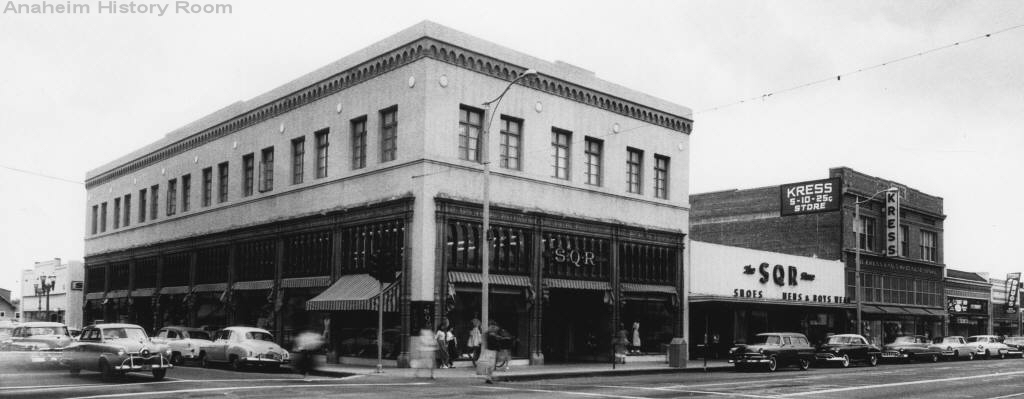
The photo above is a 1955 view of the S.Q.R. Store (1925) at 202 W. Lincoln Ave. It was demolished in 1978 during "Redevelopment Project Alpha." S.H. Kress & Co. is visible on the far right.

Diane continued,...
"My husband and I, lived north of Redevelopment, on North Philadelphia St., and I represented the Anaheim Historical Society on the Project Area Committee. ...I  met a fellow who lived on Broadway, in Redevelopment. He and I printed and distributed flyers throughout the neighborhoods.  The next Tuesday night 68 mad people turned up at the P.A.C. meeting! Of course [the committee leadership] cancelled the meeting and, by the time we met two weeks later, had developed a plan to divide the neighborhoods into five sections. That's called Divide and Conquer -- I think it was invented by the Romans.

"Four  of the neighborhoods worked with the city and were saved, including the 50's neighborhood between the railroad tracks and East Street. However, the people in the 72-house Kroeger-Melrose neighborhood did not like the city officials and would not go to meetings. Then someone got a notice that the bank would not okay their refinancing because they were going to be demolished!"
 
[Ed: The photo above shows the Martenet Hardware Store, at 323 W. Center St. in 1979 -- the year it was demolished.]

But not everyone was an impediment to preservation. The dozen or so original members of the Anaheim Historical Society put up a good fight, and according to Diann,...
"The staff in the State Office really wanted to help preservationists. During the 22 years I worked with them they stood up for historic preservation time after time and rescued me more than a few times.

"Aaron Gallup worked with me on the National Register application on that 72-house neighborhood, including the layout. The process included a visit by a member of the State Historic Preservation Commission.  Aaron was driving, with the Commissioner in the front seat. Aaron cut across the front yard of one house, so the Commissioner would not see an ugly carbuncle of an addition on the roof of one of the houses.

"At the Commission hearing, Anaheim officials were told that they ought to be ashamed of themselves for wanting to destroy the neighborhood. A reporter from the local newspaper wrote a true account of the proceedings and was promptly fired. I really felt bad about that but he said it was okay. Six meetings later,  I was voted off of the P. A.C right in front of my face. I was proud of myself for not bursting into tears. Oddly, most of the members did not get what they wanted from the city."
Efforts at preservation were not a total loss, as the Kraemer Building, the Carnegie Library, Pearson Park, and many square miles of charming historic neighborhoods are still standing. But Downtown Anaheim is still essentially M.I.A., a fact that has served as an object lesson for other cities.

Diann went on to work for preservation in other places, beginning with French Park in Santa Ana. She writes,...

"We moved [away] from Anaheim in 1986, because we found an Italianate house in Santa Ana that was going to be torn down if no one agreed to take it the next day. We agreed and moved the house three times before it was put on our lot in the French Park Historic District. The people that bought our house, in Anaheim (the Olesons) banded together with  the Torgersons, the Hortons, the Caldwells and others. They  took over the fight and were able to do some great things. They continued with the neighborhood work and were responsible for a lot of the restoration of Kroeger-Melrose District.

"We lived in and were active in Santa Ana for 11 years before moving to Illinois in 1999...

"I don't regret our time in Anaheim. It was really a special time and I knew so many wonderful people in Anaheim as well as in several other cities. It was the beginning of my interest in historic houses. Times were so different! Most people didn't even understand what a Craftsman house was or its significance.

"I guess I would do it all over again, but be a lot wiser and a lot more politically savvy."

Wednesday, March 07, 2012

Placentia, Fullerton, Santa Ana, and Olive

 Today's photos are really just one photo with some detail shots cropped out of it. The image shows the Placentia Orange Growers Association packing house (surprisingly located in Fullerton) in 1894. The fruit worked its way down the line largely through gravity, with sorting and culling done as it rolled its way toward the folks actually packing the fruit. Additional power for this set-up was provided "by a man pumping a pair of bicycle pedals."
 So what's the girl thinking in the photo below? "The boss's son has never packed an orange in his life. But once he finds out a photographer's here,..."

Notice squares of tissue paper in which each orange would be wrapped. Notice also that the shipping crates look a bit flimsier than the field boxes (stenciled "Placentia O G" in the back of the photo). The flexibility of the shipping crates allowed them to be stuffed until they bulged a bit, keeping the fruit from knocking around in transit.
 On March 22nd, the Placentia Library District will hold the premier of a new historical documentary DVD, entitled, Placentia: A Pleasant Place, at 7pm, in the Placentia Library Meeting Room, 411 E. Chapman Ave. If you plan to attend, call (714) 528-1906, ext. 200 to RSVP before March 17th.
The Heritage Museum of Orange County (the Kellogg House people) will host "Create A Bit of History: Art & Artifacts," on March 10th, 10am to 5pm, at 3101 W. Harvard St., in Santa Ana. Local artists will sell their work and local historical organizations will have booths out with wares of their own. Plus, you'll also get the chance to see some of the interesting artifacts that have been tucked away in the museum's collection but seldom (if ever) displayed. Admission is free. Tours of the Kellogg House and the museum's collection are $5.

Speaking of events, I hope to see at least some of you at Thursday (tomorrow) night's Orange County Historical Society meeting. I'm looking forward to Daralee's presentation on the Town of Olive.

Tuesday, March 06, 2012

The Fullerton That Ate Orange County

I saw this promotional map in the background of an otherwise fairly unexciting photo and had to blow it up and check out the details. I've seen some pretty exaggerated maps in my day, but this one takes the cake. Look at the SIZE of Fullerton! It stretches from the desert to the sea (apologies to the late Jerry Dunphy) and from Newport Harbor to Long Beach Harbor! In fact, Fullerton seems to fill the entire county north and west of the Irvine Ranch,... and then some. Does anyone have an actual copy of this map they can scan, so we can see more details?

Sunday, March 04, 2012

The Fox Theater and the end of Downtown Anaheim

 Today's photos come from reader Dave Mason and show the demolition of Anaheim's Fox Theater "around 1979." It stood on the north side of W. Lincoln Ave., near Lemon Street, in the area that was Downtown Anaheim before the bulldozers arrived. The theater was opened in 1920 as part of the West Coast Theatres chain, and included a backstage area and dressing rooms for vaudeville shows. It initially operated as the California Theatre but soon became the Fox Theater.
A 1978 L.A. Times article about Downtown Anaheim began, "A move to get 24 downtown buildings listed in the National Register of Historical (sic) Places is politically motivated and aimed at hobbling downtown renewal, the Community Redevelopment Commission said... Chairman James Morris said the move to get the buildings listed for historical recognition is contrived solely to jeopardize or halt redevelopment.

Those 24 sites included Martinet Hardware, the SQR Store, the Rosemarie Apartments, the California Building, the Marietta Court  Apartments, the Fox Theater block, Zion Lutheran Church, the Kraemer Garage, the Carnegie Library, the Pickwick Hotel, the Masonic Temple, the Angelina Kraemer Hotel, City Hall, the Samuel Kraemer Building, the German Methodist Church, the Church of His Holy Presence, First Presbyterian Church, the Ferdinand Baxhaus House, the Richard Melrose House, the Union Pacific Depot, and Pearson Park. Essentially, it was the heart of historic Downtown Anaheim.
 In the article, I'm particularly amused (in a "black humor" sort of way) by Morris' indignation that anyone would try to stand in the way of ripping out the heart of their town in order to replace it with soon-to-be-vacant office buildings and a Von's shopping center. It's like a tiger complaining that a mother is trying to prevent a child from becoming a snack. The impertinence! 
 I only wish that Diann Marsh and her band of preservationists had prevailed. In fact, is there anyone today who DOESN'T wish that Downtown Anaheim had been saved? Which would you prefer: A historic downtown like Orange, or the mess that stands on the site of old Downtown Anaheim today?
 Luckily, at least a few token bits of Downtown were saved, including the Carnegie Library (now part of the "Muzeo") and the Kraemer Building. Also, the community's anger over the destruction lead to a movement that lashed out against the bureaucrats with PAC money and lawyers and succeeded in saving some of the city's historic neighborhoods. I know many people who live in those neighborhoods today, and the area is both unique and charming. Unfortunately, so much is already gone forever.
Let Downtown Anaheim's fate be a lesson to other communities that see wholesale destruction of their history as the path to glory. It isn't. You end up trading your soul for a strip mall and your individuality for a Jiffy Lube. And future generations will blame you for ripping their inheritance away from them.
Hopefully, the death of the redevelopment agencies will prevent this from happening again, but I presume it will only be a matter of time before the same old scam artists find a new scam.

Read PART II of this article here.

Saturday, March 03, 2012

The Town of Olive

The history of the town of Olive (now part of northern Orange) will be the topic of the Orange County Historical Society's general meeting this Thursday, March 8. OCHS board member Daralee Ota will discuss the area's early pastoral days; the rancho lifestyle of the Yorbas; the bustling, boomtown era when Olive boasted a lucrative flour mill; the citrus era; and Olive's development into a modern residential community. Daralee's program will be based, in part, on her Web site, Olive Through the Ages. The program will begin at 7:30p.m. at Trinity Episcopal Church, 2400 N. Canal St. (which is actually in Olive), and is free to the public.

The photo at the top of today's post shows the old St. Paul's Lutheran Church (1912) in Olive, which is now part of North Orange Christian Church. The photo below shows the second flour mill at Olive on opening day in 1890.
 In the 1800s, the area below the bend of the Santa Ana River was known by several names, including Yorbas, Santa Ana (before the modern community of Santa Ana was founded), Old Santa Ana, Burruel Point, Olive Ranch, and eventually Olive. Although Olive never became its own city, many still identify themselves as Olive residents.


Daralee launched her Olive website when she found very little information about the community online. Having grown up near the area and wondering about this town that faded away over the decades, Daralee began researching Olive in 2004, amazed to discover its rich and vast history.

A few years ago, she added the "Living Branch" section to her Web site to share even more information about Olive's history, including stories, maps, and images contributed by individuals with a personal interest or connection to Olive. (Submissions of photos and other relevant content are welcomed for possible inclusion in this portion of the Web site.)

All the photos in today's post come from her site. The photo above shows the Olive Heights Citrus Association packing house (1928) as it appeared in 1982. The photo below shows the Schorn House (ca 1889) at Ocean View and Bixby in Olive.
I got a very brief preview of the presentation Daralee has prepared, and it's rather impressive. She should be making documentaries for PBS or something. Anyway, I hope to see you on Thursday.

Friday, March 02, 2012

Cool old stuff sale Saturday at Howe-Waffle house!

Here's what you need to do Saturday: Get over to the historic Howe-Waffle House in Santa Ana, where they'll be holding a really good antiques and architectural salvage sale from 10am to 3:30pm. I was just over there, and there's plenty of treasures, including loads of paper ephemera, furniture, Victoriana, advertising, etc., etc., etc. Some of it comes from the estate of the late Evalene Pulati, who was one of the earliest and most enthusiastic members of the Santa Ana Historical Preservation Society and who once ran her own antique store.

I pulled out a few things for the Orange County Archives, and a couple other things for friends, but there's tons left, and something for every interest. Some gems I noticed but did not buy included an 1850s newspaper from Pennsylvania (which was taking a strong editorial view against slavery), some great sheet music, WWI and WWII ephemera, fruit crate labels, architectural elements from old demolished Santa Ana Buildings, framed artwork, furniture, and more.

The Howe-Waffle House is at the corner of Sycamore and Civic Center Dr. in Downtown Santa Ana. Parking in the lot behind the Old O.C. Courthouse (just across Sycamore) will be free during the sale.