Thursday, June 27, 2019

William O. Hendricks (1927-2019)

I was sorry to hear of the passing of Bill Hendricks on May 18, 2019. He began working for the Sherman Foundation in 1965 and ran the Sherman Library in Corona del Mar until 2013.

We belonged to a number of the same historical and literary organizations, including, Los Compadres Con Libros, which still meets at the Sherman. The Compadres sent out a memorial note to members, which reads, in part,...

"William O. Hendricks was a founder and developer of the Sherman Library as its first Director, serving for forty-eight years. He developed the library around the personal files of Arnold Haskell and Moses Sherman. He personally secured most of its holding and was instrumental in placing the library's focus on the Pacific Southwest. He was active in and a contributor to both the Los Angeles and San diego Corrals of the Westerners and was Sheriff of the Los Angeles Corral in 1981.

"For about thirty years he served as the organizer of the yearly Baja California Symposium meetings that brought together scholars from both sides of the border who were active in studying the history and development of Baja California. He was also a member of the Book Collectors of Southern California and the Zamorano Club. He authored many texts, often related to the history of the Imperial and Mexicali Valleys and to the history of Corona del Mar, in particular."

Tuesday, June 18, 2019

The Chinese in early Orange County

Chinese workers spraying apricot trees for disease near Tustin, around 1900. (Courtesy CSUF Special Collections)
Several Orange County communities once had their own Chinatowns, including Santa Ana, Anaheim, and Orange. They’re long gone but were important to our early development.

In the mid-1800s, China’s crumbling economy, social upheaval, and a series of natural disasters encouraged young men to seek their fortunes overseas. Tens of thousands, especially from the southeastern provinces, traveled to California, where the Gold Rush and railroad work offered opportunity. 
This Santa Ana Chinatown resident worked on the W. W. Johnson ranch. (Courtesy Western Assoc. for the Advancement of Local History)
Some worked the gold fields. Some opened laundries, restaurants and other businesses or found work as servants, cooks or gardeners. Many Chinese immigrants worked as railroad construction laborers and ultimately built a significant percentage of the American railroad system, including the lines through Orange County. Each railroad construction crew included seventy to a hundred Chinese workers who lived in railroad cars.

Other sold vegetables from carts, or went into fishing, factory work, or – most notably – farm work. By 1890, Chinese accounted for 75% of California’s agricultural work force.

"Before 1887, there were forty to fifty 'Celestials' on the Irvine Ranch all the time," writes historian Stephen Gould. "Each group of workers had a foreman who was Chinese also. The Ranchers paid the foreman, who, in turn, paid his fellow workers. He was usually more proficient in English than the others but worked in the fields just like the rest. As the group's bookkeeper, the foreman used...an abacus."

Throughout Orange County, the Chinese planted and worked in the orange groves and the vineyards. Many lived in migrant tent camps and other work camps. They introduced celery cultivation here, which became one of our most profitable crops. Chinese laborers also dug many of our early irrigation canals, which fundamentally changed Orange County’s future.
Sanborn Fire Insurance Co. map of Santa Ana's  Chinatown, 1895. (Courtesy Library of  Congress)
The Chinese faced widespread and pervasive discrimination from the moment they arrived in California. And as the late 1800s continued, anti-Chinese sentiment grew even stronger. New laws placed undue tax burdens on Chinese immigrants and prevented them from attending public schools, owning real estate, or holding many jobs. Land owners were forced to replace their Chinese employees with others. Some Chinese laborers returned home, while others sought refuge among the local Chinatowns.

Our Chinatowns were marked by their laundries; large vegetable gardens; and ramshackle wood buildings, including elongated, low-roofed bunkhouses with communal kitchens. With the language barrier and xenophobia afoot, the Chinese seldom entered into matters related to the larger community. Most kept to themselves, sent their earnings to their families in China, and maintained their traditional customs. Those customs – including their baggy silk clothing and shaved heads with braided queues – helped make the immigrants a point of mystery and curiosity to their neighbors.
Well-respected merchant and contractor Man Wo and his family in Anaheim’s Chinatown, around 1892. Usually the women and children remained in China. (Courtesy Anaheim Public Library)
Orange County’s largest Chinatown, in Anaheim, was established in the early 1870s. By 1876, about a sixth of Anaheim's population was Chinese. Chinatown was located along Chartres St., between Lemon and Anaheim Blvd. The site is now under new high-density housing, a segment of Lincoln Ave., and a corner of the Von’s shopping center parking lot. Historian Leo Friis wrote, “Many Chinese engaged in truck farming northeast of Anaheim and their vegetable wagons were a familiar sight. ...Actually, Anaheim was a good place for Chinese to live. Its citizens never carried to extremes the prejudice found in many other towns."
Ah Foo, longtime Anaheim Chinatown resident (Courtesy Anaheim Public Library)
Anaheim's best known Chinese resident, writes Gould, was servant and handyman Ah Foo. "Every Fourth of July he would douse himself with a whole bottle of perfume, dress in his best clothes, stick an American flag in his pants and give Anaheim a one man parade through its city streets. He was followed by a trail of gleeful Anaheim youths. The next day he would deny he ever did such a thing. He would explain, 'He my brother.'"

A very small minority of Orange County’s Chinese were American citizens. Ong Q. "Jimmy Craig" Tow, for instance, was a California native. He grew produce in Westminster to sell in Anaheim and Fullerton and was much in demand as a translator. He later opened a successful imports shop in Santa Ana. During the Spanish-American War, he volunteered for the U.S. Army and was sent to the Philippines. Newspapers claimed he was "the first Chinaman to enlist in the service of the United States." (See Phil Brigandi's article on Ong Q. Tow. https://www.ochistoryland.com/ongqtow)

Prejudice against the Chinese was widespread throughout California, often rooted in the fear of low-wage labor replacing local's jobs. Violence was not uncommon. In 1893, for instance, a dozen white men set fire to the shacks several Chinese farmworkers near Westminster. When the victims ran out of the burning structures, their attackers began blazing away with guns. It seems no one was killed, but most of the Chinese never returned to the camp.
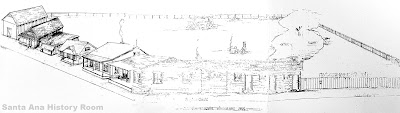
Sketch by memory of Santa Ana's Chinatown by John Galbraith. (Courtesy Santa Ana History Room)
Santa Ana’s Chinatown was a motley set of wood buildings in what’s now primarily a parking lot at 3rd and Bush Streets, behind the old City Hall. It featured shops, residences, and a large communal vegetable garden. At its peak, Santa Ana’s Chinese population numbered around 800, not all of whom (as historian Manny Escamilla recently discovered) lived in Chinatown. Caucasian Santa Anans described Chinatown as unsightly and odiferous – the latter probably attributable to overcrowded, unsanitary conditions; incense; and unfamiliar spices and foods.
Imaginative drawing of Orange's Chinatown from memory by Al Eisenbraun in 1985. (Courtesy Phil Brigandi Collection)
Orange’s Chinatown was on N. Orange St. from the mid-1870s until open cesspools were outlawed “in town” in 1890. It moved to a spot west of Glassell St. along Santiago Creek. (A Union 76 station stands near the spot today.) This collection of rambling buildings and gardens included “a store, a laundry or two and a bunkhouse where most of the men lived,” wrote historian Phil Brigandi, “Out back, chickens wandered around the fenced drying yard for the laundry.” (See https://www.ochistoryland.com/orangechinatown)

Gould wrote that Tustin had a Chinese population of up to 200 or 300 prior to 1890. They were the first in the area to specialize in truck farming and they worked on local ranches. Rather than a Chinatown, "there were numerous little shacks hidden among the tall forests of mustard around Tustin."

"When Chinese New Year rolled around," wrote Gould, "the community was always surprised by the number of Chinese who lived in the area. Every Oriental [sic] made himself known by a great celebration of noisy fireworks. The explosions were far greater than any Fourth of July commemoration of that era."

But ultimately, the Chinese were not able (or in many cases, allowed) to put down roots in California.

With continuing prejudice against the Chinese; with hardly any Chinese women or children; with the men aging, dying, moving, and occasionally returning to China; and with laws stopping further immigration from China, our Chinatowns were headed for extinction.

The Chinese Exclusion Act became law in 1882, prohibiting the immigration of Chinese laborers for a decade. The law was renewed for another decade in 1892. 

In November 1901 the Board of Supervisor of San Francisco called upon Congress to renew the Act which was due to expire on May 5, 1902. To drum up support, they called a convention of supporters from throughout the state. Santa Ana was the only city in Orange County to send delegates. (The County as an entity did not send delegates.) The Santa Ana delegates were Frank Ey (then a City Councilman or Mayor), attorney Victor Montgomery, and newspaper editor Dan M. Baker (representing the Santa Ana Chamber of Commerce).

Ultimately, the Exclusion Act would not only be re-upped but would be made permanent in 1902. This law was only partially repealled in 1943 and not abolished outright until 1952.

Sanborn Fire Insurance Co. map of Anaheim's Chinatown, 1894. (Courtesy Library of  Congress)
Orange County’s Chinese population dwindled to 136 by 1900, to 85 by 1910, and to just 26 by 1920. The final remnants of Orange’s Chinatown were condemned and the last business closed in 1924. After the death of the last (elderly) Chinese man in Anaheim’s Chinatown in 1935, most of the vacant buildings were torn down, with the last one demolished in 1940.
Last of Anaheim Chinatown's buildings, 119 W Chartres. (Courrtesy Anaheim Public Library)
Santa Ana’s Chinatown died more dramatically. The city fathers had long been unhappy with Chinatown’s presence. Their chance to do something about it came in 1906, when a case of leprosy was discovered in what was already a greatly diminished Chinatown. The remaining residents were removed and quarantined, the buildings were condemned as a health hazard, and on May 26, 1906 the city marshal burned down Chinatown in front of a celebratory audience of more than 1,000 locals. Most Chinese left Santa Ana after the fire. Those remaining were relocated to a spot along the Santa Ana River, where some stayed and grew vegetables. The last to leave “China Gardens” along the river, was Lee You, who returned to China in 1923.
Chinese liquor jug (1880-1910) recently unearthed at site of Anaheim's Chinatown. (Courtesy Ivan Strudwick)
By the time the last of Orange County’s first wave of Chinese immigrants died in the 1930s, immigration laws had relaxed a little, and a handful of new Chinese families were already settling here. Today, Orange County has about 80,000 residents of Chinese descent. Like other Orange Countians, few of them know about the early Chinese pioneers who paved the way.
Grave marker in the Chinese section of the Anaheim Cemetery (southeast corner) (Courtesy Anaheim Public Library)

Monday, June 03, 2019

O.C. History Roundup... the EVENT!

You love O.C. History Roundup the BLOG,... Now come enjoy O.C. History Roundup, the EVENT!

This Saturday, June 8, 2019, from 11 am to 4pm, the Orange County Historical Society (of which I am currently president) will Celebrate its centennial year with an O.C. History Roundup event on the campus of the Heritage Museum of Orange County, 3101 W Harvard St, in Santa Ana. The public (that’s YOU) is welcome to attend this free extravaganza of local history.
The day includes,…
  • A chance to interact with costumed interpreters, reenactors, historical societies, genealogical groups, and other like-minded folk from throughout O.C.
  • Tours of the H. Clay Kellogg House
  • Orange County History talks by Phil Brigandi (The Birth of Orange County), Manny Escamilla (Overlooked Historic Sites in Santa Ana), Michael Melzer (Bouchard the Pirate), and Mark Zambrano (History of Surfing in Huntington Beach)
  • Storyteller Corner (hear about O.C. history in the words of those who actually lived it)
  • Live music, presented by Lilies of the West string band.
  • Open House at the OCHS Archives
  • Silhouette artist Leslie Stone of Artist On The Go
  • Nature tours of “Gospel Swamp” by Orange County naturalists
  • A fully restored 1921 Seagrave fire engine
  • Food trucks
  • Fruit and vegetables from the Museum’s Farm
  • A genuine (simulated) grizzled prospector from Silverado
  • A chance to stroll through one of Orange County's last remaining orange groves
  • …and more!
Click through to our Facebook event page or our to the OCHS website for more information.

Hope to see you Saturday!


Mark of Zorro in Rancho Santa Margarita?

Antonio Banderas as Zorro in 1998.
Lindsey J. writes, "I had long wondered where the main road names for Rancho Santa Margarita came from; there is Antonio Parkway, and Avenida De Las Banderas. People jokingly said that these names might have been derived from the actor, Antonio Banderas, but is there any truth to that?”

I’ve heard that tale also. Some locals go so far as to claim that Rancho Mission Viejo honcho (and Antonio Parkway namesake) Tony Moiso himself created that intersection as a joke. I’d love that story to be true, but it's highly unlikely.

Avenida Banderas began as two short segments of road, built in 1987. "Banderas," in Spanish, means "flags" or "bunting," making Avenida de las Banderas the "Avenue of the Flags." This avenida did not intersect with Antonio Parkway until more of Rancho Santa Margarita was developed in about 1989.
The actor Antonio Banderas, who began his career in Spain, didn't become known in the United States until 1992. So neither the street names individually nor the intersection could be a tribute to the actor – Unless maybe Moiso was secretly a big fan of 1980s Spanish cinema.

The greater mystery is the actual source of the “Avenue of the Flags” moniker. A recent drive along the entire length of this thoroughfare revealed not one single flag. Of course, this being South Orange County, flags may well be banned by neighborhood CC&Rs. (Those anxiety-producing bright colors and unseemly snapping in the wind might lower adjacent property values.)

If Mr. Banderas' affiliation with Orange County is minimal, at least Zorro (who Banderas portrayed in two movies) DOES have a big local connection. The character first appeared in a 1919 serialized story by Johnston McCulley in All-Story Weekly magazine, entitled "The Curse of Capistrano," which was set in our lovely Mission town. 

Sunday, May 12, 2019

Mentally Sensitive in Laguna

I was looking at a map of Aliso & Woods Canyon Park in the Laguna Beach area recently and noticed that it included “Mentally Sensitive Trail.” Of course, I immediately wondered how it got its name.

It's no secret that Laguna has its share of folks with a tenuous grip on reality: Artsy types (distinguished from actual artists), cultists, occultists, rich hippies, and people who pay a fortune to balance their homes on the edges of cliffs. But would one celebrate this kind of "mental sensitivity" with the naming of a park trail?

Probably not.
Photo of a newer trail sign, taken by Yelp user "Yvonne N."
Perhaps the trail was named in honor of the snowflakes in our universities, who are so "mentally sensitive" that they are unable to cope with even the micro-ist of "micro-aggressions" and who melt when exposed to opinions different from their own. But again, why would anyone commemorate something so embarrassing?

Actually, it turns out the real answer is slightly less silly, but still kinda weird. 
Detail from OC Parks trail map of Aliso & Woods Canyon Park.
According to OC Parks Resource Specialist Rick Schaffer, the oral tradition is that "it was originally an unauthorized trail with a sign that read, 'Environmentally Sensitive Area'" but that "someone scratched off the 'Environ' letters, leaving 'mentally Sensitive Area'" on the sign. In 2011, this steep trail was developed and made official, but the old name stuck.

Sadly, the creatively vandalized sign is long gone, but a new and official "Mentally Sensitive Trail" sign has replaced it -- which is almost better/funnier.

Rumors circulate that this and other colorful trail names may be changed to new and boring names. Really?!? Why is boring always considered "better" in Orange County these days?

UPDATE, 2-1-2021: Retired OC Parks Ranger Tom Maloney wrote to me with a first-hand account of the Mentally Sensitive saga:

“It was back in the late 1980's and early 1990's… After [we] Park Rangers were chastised for using the negative word ‘no’ in regard to what was not allowed in the park (i.e., no guns, hunting, camping, fires or off trail-usage) we tried an environmentally friendly tactic. We made up some signs to appeal to the ‘good’ folks, mostly from Laguna Beach area to use only official trails, and not to make new trails of their own.

“One such ‘outlaw’ trail went down an incredibly steep ridgeline down into lower Aliso Canyon in an area not open to public use at the time.   

“We placed signs on a sturdy post at the top near Top of the World and at the bottom in Aliso Canyon.  We were attempting to educate the public not to use this and other trails of this type by stating the area/habitat was ‘Environmentally Sensitive.’ And it was. The California Gnatcatcher (bird species) used this as prime nesting habitat. However, use by hikers, mountain bikers and dogs disrupted and disturbed this and other endangered species in the park.

“The local outlaw mountain bike group vandalized these signs, and where they could not tear them out of the ground and hide them, they snapped off the fiberglass signs.  Hence the remaining sign that read ‘...Mentally Sensitive.’

"Obviously being nice did not work."

UPDATE, 11-21-2022: Avid trail runner and former Orange County Register reporter Greg Hardesty informs me that the trail's name has now been changed to Sheep Run Trail. It appears that the rumored threat of boring new names for park trails has come to pass. 

Tuesday, May 07, 2019

Silverado Days

Silverado Canyon. Photo by Clara Mason Fox courtesy O.C. Archives.
I’ve been looking a bit at the story of the brief silver boom that launched Silverado. The canyon had earlier been known as Canada de la Madera (Canyon of the Timber) or simply Madera Canyon. This small silver rush in the Santa Ana Mountains in the late 1870s and early 1880s may not have been that tremendously significant to the development of Orange County, but it has lived for over 140 years as a key element of our folklore and “local color.” The boom itself went bust in 1882 when miners learned the hard truth: The Santa Ana Mountains contain almost any mineral you can name, but not in large enough quantities to make mining profitable.

If the topic interests you, I suggest starting with Phil Brigandi’s recent article about Silverado, which is posted to his O.C. Historyland website. The page also links to a bunch of primary source material from contemporary newspapers, which is pretty remarkable.) But I’ve got some additional information handy, so I might as well share it here.

What follows are some interesting excerpts about Silverado from Jim Sleeper’s A Boys’ Book of Bear Stories (Not For Boys): A Grizzly Introduction to the Santa Ana Mountains and from an article entitled “Silverado Days” by Robert S. Farrar, which appeared in Orange County Illustrated in Feb. 1965. Admittedly, the Illustrated article as highly derivative of pages 49-59 of Terry E. Stephenson’s much superior Shadows of Old Saddleback. But I’m not retyping ten more pages for you.

SLEEPER:

…In the summer of 1877, a chance discovery of silver-bearing ore in Pine Canyon unleashed the greatest mining flurry the Santa Anas have ever known. The strike, and several others that followed within the next four years, changed not only the face but the disposition of the hills…
If repetition of story counts, the Henry Smith and Bill Curry get the credit for touching off Silverado’s explosion. An oft-quoted passage from [Terry E.] Stephenson’s Shadows [of Old Saddleback] has done much to perpetuate their names and what now appears to be a dubious fact of history.

“Thus it was, a quiet canyon with hardly a half-dozen mountain homes in it, when one day in the fall of 1877 Hank Smith and William Curry, both of Santa Ana, hunting in the upper mountains, came upon some rock that looked to them like silver ore. An assay was reported as showing the rock to be a blue and white quartz carrying silver to about $60 a ton. These two men staked a claim that they called the Southern Belle and soon ran in a tunnel some fifty feet.”

Since then, the myths that have turned up regarding Silverado’s first mine would fill a book,... Suffice it to say that the Mexicans prospected Madera Canyon long before any gringo swung a pick there, and records show that the Southern Belle was really discovered on August 12, 1877, by H.C. Purcell and G.F. “Goldie” Slankerd. A week after their discovery, the Santa Rosa Mining District (named for that mountain) was organized.

Though a half dozen claims were staked that summer, the mineral wealth of Pine Canyon was little publicized until almost the end of the year. Even then, there was no rush into the Madera until after the spring rains subsided. Once the human flood tide began, however, every bored farm boy and village slicker who could borrow a shovel and steal the time poured into the hills. Most couldn’t find their way across creek without a compass, and their knowledge about mining ranked right alongside that of a duck. Among those so qualifying was W.F. Heathman, a pioneer Santa Ana resident and for years its city attorney. Recalling the silver stampede of ’78, Heathman wrote:

“…like all other mining excitements, many strove to reach the mountains and stake off a claim, and with others I went also. In a brief period of time there camped on the site of what was known as ‘Silverado’ over six hundred persons intent on making their fortunes . . . I secured a claim which a mining expert declared to be worth one hundred thousand dollars. I fully believed him and wrote to my brother in the east that I had surely made my fortune. The mine petered out and I was sorry I had made the statement.”

At the apex of the excitement, a portly Anaheim product named Pharez Allen Clark, who ran a toy shop and lending library when not hustling real estate, acquired the flat at the end of Madera Canyon. There he platted a townsite which he called “Silverado City.” City proving a bit sanguine, “camp” was generally substituted and describes it much better. Nonetheless, according to H.S. Knapp, four or five hundred prospectors came upon the place and staked half again that many claims.

“…a post office was here established that fall, and in a very short time the new town of Silverado boasted of three hotels, three stores, seven saloons, two blacksmith shops, two meat markets, a select school, and all the other industries of a first-class mining camp. Town lots sold as high as seventy-five dollars each, yet nearly all the dwellings were canvas tents, and the occupants of board shanties were looked upon as ‘bloated aristocracy.”

…One mine was the “Grizzly,” just off Pine Canyon. In August of ’78, the Grizzly was renamed the “Maggie,” for Maggie Gillett, who ran one of Silverado’s meaner hotels. It is not known whether this honor paid off a board bill or was a tribute to Mrs. Gillette’s disposition.
FARRAR:

A mining village sprang up at the fork where Pine Canyon enters the main Canyon. P.A. Clark, a real estate man from Anaheim, laid out the townsite. Appropriately, he named it Silverado, and Canada de la Madera became Silverado Canyon. Population soared … Three stages rain daily from Santa Ana and two from Los Angeles, and seats were at a premium.

The next few years were filled with excitement. J.D. Dunlap, a Deputy United States Marshal sent to arrest a Mexican outlaw hiding in the mountains, never succeeded in apprehending the fugitive but caught the mining fever instead. Dunlap located the mine which has become the most famous in the area, the Blue Light. He put a crew to work, opened up some rich galena ore, and helped to spread the exciting news of silver. Soon a company of eastern financiers formed the New York Mining Company. They located all the property that had not already been staked out, put a large force of men to work driving tunnels and sinking shafts, and spent a sizable fortune on this development.
The Western Zinc Company, composed entirely of French stockholders, began operations in Silverado and installed a quartz mill to handle the ore. In the shadow of the bigger companies were the lone prospectors and “pardners.”

…"'Dad' Justice, a most colorful character filled with the prospector’s perennial optimism, pronounced “a great silver ledge, as great as the richest Virginia City . . . has ever known, lies buried in the Silverado’s ridges awaiting the lucky strike of some miner’s pick."

The lucky strike never came. The Blue Light mine offered the greatest promise. Once the owners believed they had struck the Mother Lode: they pierced the whole side of the canyon with tunnels, in search of the great ledge of ore they knew must be there. But disappointment was their only reward, and the dream of wealth became more and more a myth. . . . By 1883 the last family left, the post office shuttered, and Silverado stood deserted.

Wednesday, May 01, 2019

Jim Sleeper is here to stay

It's been almost seven years since the passing of Orange County historian Jim Sleeper (1927-2012). Since then, his papers have landed at UCI's Special Collections, the Orange County Historical Society has published a volume of his previously uncollected work, a bit of video of him speaking has surfaced, and many rare volumes from his research library are now available at the Orange County Archives. Younger generations of historians continue to reference and be inspired by his work, the public continues to enjoy his books, and the Orange Countiana journal and County Courier newsletter he helped create in the 1970s are still being published. I doubt there will ever be a time when he isn't still a tremendous influence on the study and practice of Orange County history.

I recently came across the following article about Sleeper, written by historian and Jose Antonio Yorba’s great-great-granddaughter, Mildred Yorba MacArthur. It was published in Laguna Federal Savings' Laguna Federal Highlights (Vol. 30, No. 3) in September 1977:

Jim Sleeper: An Orange County Original
 by Mildred Yorba MacArthur

The inspiration for this piece is a letter received from historian Jim Sleeper, December 10, 1974, thanking me for some old Orange County mining pictures.

He wrote, “Great pix. Have run down dope on mine (1899) and believe I can identify most of the gents. Will respond more fully when I get a moment. Right now I am stepping around like a blind dog in a meat house. In the meantime, get off of your big fat Spanish veranda and get something into print.”

Well Jim, this is it!

He hasn’t been around long enough to take himself or anyone else seriously, for he was born April 16, 1927, at Santa Ana, the son of Boyd Sleeper and Italia Perrine Sleeper. He’s a third generation Orange Countian, the grandson of “Big” Jim Sleeper, who was an early sheriff and later the county assessor for 34 years. He says, “When it comes to local pride, I’m not just provincial, I’m downright bigoted.” Whatever it is, he hues to well-documented facts, which he records with comic overtones and the end result is delightful reading. He is the past president of the Orange County Historical Society, lecturer, speaker, and listener.

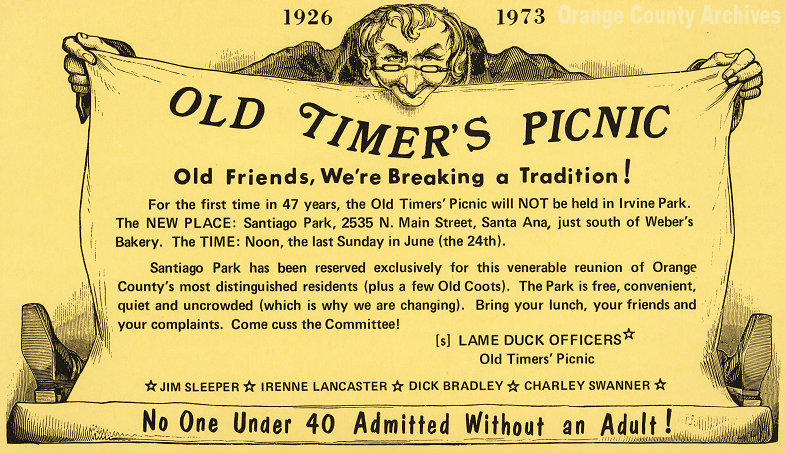
At any meeting he is the quiet one, fondling his pipe, taking in that which he thinks is important and only voicing an opinion when called upon. At the ripe old age of 46 he became the founder-president of the Old Timers’ Annual Picnic. Only sudden death can keep a member from missing one of these events, held in late June, rain or shine, at Santiago Park on North Main Street in Santa Ana. That day Jim becomes host and president.
For several years, Jim was staff historian for the Irvine Company. He wrote and edited their San Joaquin Gazette, starting with a Christmas edition in 1966. It took his readers on a 130-mile stagecoach trip from San Diego to Los Angeles, which included “43 miles of bladder-busting road,” with stops and pictures of Anaheim, Tustin, Santa Ana and San Juan Capistrano in the fifties and sixties. This issue and all others that followed were instant collectors’ items, as are all his writings.
Jim Sleeper’s other accomplishments include his Orange County Almanacs, replete with a hole plugged in the left hand corner of their bright orange covers, through which a cord could be run, for hanging purposes, for easy reading in primitive locations.

Never has so much been crammed into so little space, for Jim is the master of the footnote. It is positively unsafe to skip even one line of the fine print, for you may unearth your own family skeleton in some remote corner. Don’t be afraid to resort to the use of a magnifying glass, for the rewards are great. He also includes pictures of old and young people, places and things. His tables of contents include such gems as, “Tried and True Health Remedies; Rainfall Records; Handy Argument Settlers; Wild Animal Log Book; Official City Flowers; Bumper Crop Reports; and Pithy Political Promulgations.” There are also some puzzles and his favorite recipe for orange spice cake.

The space usually reserved for fillers by other authors is used by Jim to record his own musings, such as, “Ecology boils down to whether someone is going to build a house blocking your view; Justice is when your side wins; He who cuts his own firewood is twice warmed;” and to farmers, “Don’t plant your land. Wait for a developer to make an offer, then haggle like hell.”

Jim’s full-length book, Turn the Rascals Out, published in 1973, is advertised as the story of Orange County’s Fighting Editor, Dan M. Baker, but in it he follows his man from one end of the U.S. to the other and his stormy publishing activities in Orange and Los Angeles Counties. It is a scholarly piece of writing, replete with indexes, annotations, and a fat bibliography, but it is never dull. The book is dedicated to the late John “Sky” Dunlap, a gentleman-journalist who assisted and encouraged so may writers on their way up.

Jim is not a selfish historian, for if he comes across an old clipping or a quote, he’ll pass it along. Recently, he sent Miss Lorna Mills a faded clip, dated August 10, 1900, from the Santa Ana Weekly Blade. It was about her Uncle Fred B. Mills, who lived on a ranch at Ocean View, now Huntington Beach. While digging for a water well he discovered bitumen at a depth of 125 feet. He was sure there was coal thereabouts and his neighbors were heating and lighting their homes from their own gas wells nearby. However, Lorna’s Uncle Fred preferred to go on raising celery which was bringing a fine profit,” without the element of uncertainty incident to mining ventures and oil drilling propositions.” Then came the Huntington Beach boom! Lorna’s uncle and her beloved Dad, the late James H. Mills had other distractions, as Jim Sleeper reports on page 54 of his 2nd Almanac, under the title “Ducks.” “Firing only a single barrel, Fred managed to down 35 wild ducks. The following day he added 32 more sprig in the same fashion.”

The best way to explain Jim Sleeper’s sense of humor is to refer to page 4 of his 2nd Almanac, where Mrs. Calvin Lambert of Tustin wrote, “I enjoyed the Almanac so much and thank you and your wife for getting you to do it. Please write another and tell us her name.” Jim’s answer, immediately below, “Her name is Mrs. Sleeper.”

I ran that one down in the fine print, where he hides that which he prizes most, and it said, “Her name is Nola and she is a school marm.” The Sleepers have a rustic retreat in the mountain area of Holy Jim Canyon and a home in Tustin, where Jim answers the phone.

Monday, March 04, 2019