Thursday, July 09, 2009

D.F. Spangler's wave motor

The drawing above shows portions of Santa Ana inventor D. F. Spangler's wave motor. It comes from the H. Clay Kellogg collection at the Orange County Archives. Wave motors were sort of a trend near the turn of the century, with many clever tinkerers believing they might be a way to tap into the unlimited energy potential of the ocean's waves and tides. None of these dreams panned out the way they were supposed to, but that didn't keep creative folk like Spangler from trying.
.
From the Los Angeles Times, Feb. 21, 1896:
D. F. Spangler of [Santa Ana] has invented a wave motor that promises to become a "bonanza" to the inventor. Mr. Spangler is just a hard-working blacksmith, but he has ideas that indeed seem to be a benefit to mankind. The motor has been shown to a representative of The Times. It consists of a long lever with a hollow float, and connected with two gear wheels to a large air pump, or air compressor, and the air piped to a large steam boiler, or any strong tank or reservoir, and used the same as steam. The machine is a novel one, and is attracting a great deal of attention now by those who have heard of the use to which it may be put. The machine may now be seen here in Santa Ana at the shop of its inventor."

That shop is seen below, at 3rd St. and Sycamore.
Soon the motor was ready to be tested at the end of the wharf in Newport Beach. On May 1st, the Times reported,
"Messrs. W.S. Bartlett, Benton and Lafayette Flood of Santa Ana and Miss Ross of Fairview will stand by the inventor in the experiment, and if it proves a success the motors will them be manufactured on a larger scale. It will cost perhaps $1000, or slightly more, to put in the machinery for this first trial, but if the test is successful an arrangement will not doubt be made so that the power of the motor will be used by the Newport Wharf and Lumber Company and the Santa Ana and Newport Railroad Company in the handling of large quantities of freight..."
The motor was started in mid-May, and ran well for several days before an "unusually low tide" broke part of the mechanism, requiring lengthy repairs. After that, little was heard about the motor.
.
For the record, Spangler also had another notable invention. In 1894 he built a boat that was propelled much like a bicycle. It was similar, in fact, to the garishly colored boats that now tool around the lake at Irvine Park. Rather than the sheer joy of paddling about, however, Spangler saw the boat as a way for hunters to approach their game on Newport Bay almost silently.

Wednesday, July 08, 2009

Santiago Peak, Market Basket, and Disneyland

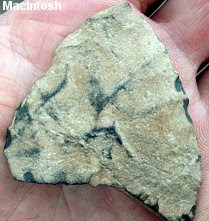
In response to my post about Old Saddleback, Doug MacIntosh sent me this great photo (above) from his trip to the top of Santiago Peak, on July 4, 1977 -- Exactly 32 years before my own trek. He also found a prehistoric biface stone tool that day, at "the edge of the graded road just below the towers... I must have been in third grade." (See photo below.) No doubt, a find like that must have been a factor in nudging him toward his career in archaeology.
Recent Register articles have included historical background on South Coast Plaza, and a story about the defunct Marine Corps Air Stations at El Toro and Tustin (with a related slide-show on their website).
.
In the blogosphere, Pleasant Family Shopping shares an old image of a Market Basket grocery store, and Kevin Kidney tells us things we didn't know about the first year of Disneyland's Main Street U.S.A.

Tuesday, July 07, 2009

Orange County in 1842

The illustrations in today's post are the work of Edward Vischer (1809-1878). He drew them in 1876, based on his memories of visiting what is now Orange County in 1842. Obviously, they aren't perfectly accurate, but how many images of 1840s Orange County are you ever likely to see?
.
Vischer is known for the sketches he made of California in the 1860s and '70s. His most common subjects were the missions and scenes of nature. His early attempts to reproduce his drawings by lithography proved disappointing, which led to his becoming a pioneer in the area of photographically reproduced artwork. He published a number of well-known portfolios, including Pictorial of California Landscape (1870), and Missions of Upper California (1872).
At age nineteen, Vischer emigrated from Germany to Mexico, where he worked as a supercargo -- an officer aboard a merchant ship, charged with the commercial concerns of the voyage. In that capacity, he made many trips up the west coast of America and to Asia.
.
According to Palmquist and Kailbourn in Pioneer Photographers of the Far West, "In September 1842, Vischer sailed from Acapulco on the schooner California on a combination business and pleasure trip to Alta California, where he made a tour of Sausalito, Sonoma, San Rafael, and Monterey... Vischer concluded his circuit of California with visits to Santa Barbara, Los Angeles, and San Diego. Although he apparently did not sketch the missions and pueblos he visited in 1842, in later years he drew many of these scenes from memory."
It was on that 1842 trip that Vischer was introduced to and fell in love with California. But it wasn't until age fifty that Vischer truly devoted himself to sketching and painting. The image below shows Vischer around age 65, in 1874.

Monday, July 06, 2009

Ascending Old Saddleback

A local historian should personally familiarize himself with the key landmarks within his "beat." It's one thing to read about a place, but it's quite another to put boots on the ground. It was in that spirit that my lovely Orange Correspondent and I headed up Old Saddleback on Independence Day. The twin peaks of Santiago (5,687 ft.) and Modjeska (5,496 ft.) are the highest points in the county. Today's first photo, (above), is a view down from Santiago Peak looking toward Modjeska Peak and Long Beach.
.
The Indian people believed that god-in-human-form Chinigchinich lived atop Santiago Peak and looked down over his people. They called the mountain "Kalawpa," meaning "a wooded place." Historian Don Meadows wrote, "In the east was a double-domed mountain called Kalawpa and there, the god said, he would sit in judgment and if any of his subjects failed to obey his teachings he would send down rattlesnakes and grizzly bears to punish the offenders. For centuries Old Saddleback has been held in reverence."
.
Cabrillo undoubtedly noticed Old Saddleback as he sailed past Orange County in 1542.
.
Portola's 1769 overland expedition camped near the mountains on St. Anne's Day, and named the entire range "La Sierra de Santa Ana" -- The Santa Ana Mountains. As they traveled north, they also extended the "Santa Ana" name to a river that seemed to flow out of the mountains.
.
In fact, these mountains, and especially Old Saddleback, have been the iconic backdrop for Orange County's entire rich history. Geographically speaking, it is the elephant in the middle of the room.
We began our trek by driving to the very end of Silverado Canyon Rd, where we stopped at the Ranger Station. The Ranger on duty was effusively helpful, giving us a ton of advice, road maps of the Cleveland National Forest, packets of Tecnu (for poison oak), and a handy guide to identifying and removing various types of ticks. (Luckily, we didn't need the latter two.)
.
From there, we took Maple Springs Rd until we ran out of pavement, and then kept following the dirt road, which eventually merged with Main Divide Rd. The farther up we climbed, the narrower and rockier the road became. The scenery was beautiful, but I was concentrating on my driving too much to appreciate it. I began to wonder if my decidedly non-offroad vehicle was up to the challenge. But then we reached the top of Modjeska Peak. Once we'd gotten that far, how could we not go on to Santiago Peak? I certainly wasn't going to make this trip again.
The image above is a panoramic view (badly cobbled together) from the top of Santiago Peak. The image below is a similar panorama from the top of Modjeska Peak. (Click on them to embigulate.) In spite of the haze, the view from each of the peaks was amazing. We could see five counties: Everything from Downtown Los Angeles to Mt. Palomar, and from Catalina to March Air Force Base and points east. For more photos, see my photostream on Flickr.
I'm a flatlander from the flatest and possibly best-paved part of Orange County, so this was a new experience for me. The drive up involved white knuckles, but by the drive down I was getting used to it. Still, I warn my fellow city slickers to think twice before tackling Old Saddleback. Nature -- in the form of nasty critters, poisonous and prickly plants, and boulder-shedding cliffs -- makes it very clear that she doesn't want you up there. When Chinigchinich went looking for a place to separate himself from humans, he chose wisely.

Saturday, July 04, 2009

4th of July, Irvine Park and Downtown Orange

Here are three Independence Day photos from the collection of the Orange Public Library. The first (above) shows the Hardy family's Fourth of July picnic at Orange County Park (now Irvine Park) in 1900.
This next photo shows the Guzman family on July 4, 1925. I wouldn't be surprised if this was also taken at Orange County Park -- a popular place to spend the holiday.
And finally, we have an image from Independence Day 1888 of the Plaza in Downtown Orange (a year from the creation of Orange County). Note the parade approaching in the distance and the fact that the original fountain was still in the center of the Plaza.

Friday, July 03, 2009

4th of July, Huntington Beach & the USS Juneau

Here's the crew of the U.S.S. Juneau marching in the 1951 Huntington Beach Fourth of July Parade. The Juneau (CL/CLAA-119) was an Atlanta-class light cruiser, commissioned in 1946. It was nicknamed "The Galloping Ghost of the Korean Coast" and received five battle stars for service in the Korean War. In May 1951, the ship returned from Korea to Long Beach for an overhaul. After a brief period on the Pacific Coast and Hawaii, the ship returned to Korea to conduct strikes along the coast. It was decommissioned in 1955.
.
In researching the Juneau, I discovered the image below, which was taken on July 1, 1951; just a few days before the parade seen above. Notice that the whole crew is out on the deck in their whites. I also discovered a short historical document about one of the crewmembers, Vern Meemken, who is more than likely one of the sailors marching in the parade.
The photo below is another scene from the 1951 H.B. 4th of July Parade. This time, it's the local Boy Scouts and Cub Scouts. You can tell it was still very much a hometown parade.
Although this annual event is now one of the largest in the country and is often televised, "people-dumped-onto-a-flatbed-truck" continues to be a popular theme for parade entries. At least they're better than the units where kids (from other cities) walk down the street while someone carries a blaring "boom box" behind them. Oy.
.
However you end up celebrating, have a great Independence Day.

Wednesday, July 01, 2009

Costa Mesa Fish Fry and forthcoming books

The traditional Costa Mesa Fish Fry began in 1946, right after the war. (In earlier years, Costa Mesa had held a Scarecrow Carnival, but somehow that didn't have the same kind of staying power.) The local Lions Club sponsored the first Fish Fry, and has done so ever since. The batter recipe -- which is still used today -- came from Lion and Orange County Supervisor Heinz Kaiser. He is shown above serving fish at the 1947 Fish Fry. (The brown stains on the table indicate freshness.)

[Correction (5-29-2012): I have updated this entry to correct a couple glitches pointed out by Costa Mesa Historical Society maven Mary Ellen Goddard. According to the old Costa Mesa-Newport Harbor Lion's Club website (my original source) the Fish Fry got its start as the Scarecrow Festival, with the fish fry element added in 1945. According to Mary Ellen, that's not true. The articles I drew my information from have since been pulled from the Lions' website, but one can still be found (at least in part), here on the Daily Pilot's website.

Mary Ellen writes, "...There seems to have been no food served at the first two Scarecrow events in 1938 and 1939.  In 1940 and 1941, the American Legion put on a beef barbeque at the Scarecrow Carnival.  There was no fish fried at the Scarecrow Carnival.  The dates of these events were:  June 4, 1938; July 1, 1939; June 1, 1940; and August 30, 1941,... The Fish Fry was decided upon at a meeting of the Lions Club in 1946.  And for most of the time since, it has been a yearly event."

Got that? It's 1946, not 1945. And they didn't fry any fish at the Scarecrow event. I know this seems like awfully small punkin's, but I know how easily a bit of wrong information can be perpetuated ad nauseum on the Interweb, and I hate the idea of being part of that cycle. I honestly thought I was going to the "horse's mouth" for this particular bit of information, but sometimes even the horse is wrong. (And no,... horse was served at neither the Scarecrow Carnival nor the Fish Fry.)]
The image above shows some of the Fish Fry crowd on June 7, 1952. I've included a detail from the same photo below, which should provide you with a better view of the background when you click on it. Note the signs for local businesses like Tewinkle Hardware.
Recently, I’ve mentioned a number of local history books that are in progress or on their way to press. Here are a few more…

Guy Ball is compiling photos for an Arcadia Publishing book about the history of Tustin. The book is due this coming Spring.

Don Ballard is compiling a series of magazine-format follow-ups to his book about the history of the Disneyland Hotel.

Gordon Bricken is working on a follow-up to his Civil War Legacy in Santa Ana, which will discuss the importance of immigrants from the North and South to Orange County in the years after the war.
.
Phil Brigandi is wrapping up work on his history of the Boy Scouts in Orange County.
.
Christopher Merritt’s long-awaited book about the history of Knott’s Berry Farm, Knott's Preserved, is going through its last round of edits and should be out this Fall.

Rob Richardson is working on an Arcadia book entitled Railroads & Depots of Orange County. I’m sure this will be a big seller and provide many images that few of us have seen before.

Tuesday, June 30, 2009

Disneyland, monorails, Fox Fullerton, 1930s, etc.

Here's a view of the snazzy new Disneyland Hotel in Anaheim on June 1, 1956. On the right is the spot where the monorail station would later be built. On the left is the coffee shop that would later be known as the Monorail Cafe. The sign above reads, "Disneyland Hotel Restaurants by Gourmet." I've zoomed in on part of the image below to show off some of the outstanding landscaping, signage, and other Space Age design elements. I'd take this place over Downtown Disney any day!
Today's "Daily Read" in the Register is about the 50th anniversary of the Disneyland Monorail, and features an interview with the monorail's designer, Bob Gurr. It's an interesting article, but take it with a grain of salt. For instance, Walt Disney clearly was not "the most famous guy in America" in 1928 (nor in 1929, nor...) . And the monorail opened in 1959, after a surprisingly short design-build process.
.
The Fox Fullerton Theatre Foundation is asking all its supporters to attend a meeting tomorrow night, concerning the development of the area adjacent to the historic theatre. The meeting will be held Wed., July 1, 6:30pm., in the Venetian Room at Angelo's & Vinci's, 550 N. Harbor Blvd., in Fullerton. The project's history and planning process will be discussed, the developer and architectural team will be introduced, and the community will be able to provide feedback on the initial concept.
.
Phil Brigandi will discuss "The Great Depression in Orange County" at the Anaheim Historical Society's annual banquet on July 11. For more information or to RSVP, contact Cynthia Ward.
.
A bunch of us local history folk celebrated Phil's 50th birthday on Sunday at Disneyland. (See photo below.) Read about it on Cynthia's Anaheim Life blog.