Thursday, August 24, 2023

O.C. Q&A: Huntington Beach Edition

Helme-Worthy House (right) and M.E. Helme Furniture Co. Building (left) prior the construction of The Strand.

Q: What are those old buildings that are now nearly surrounded by The Strand shopping center in Downtown Huntington Beach?

A: Those buildings are still owned and occupied by the descendants of the man who put them there: Matthew E. Helme, a furniture dealer, Socialist, and one of the town's original councilmen. His efforts helped bring paved roads, streetlights, a modern fire department, municipal gas and water systems, and cityhood to Huntington Beach. His house, at 6th and Walnut, was originally built at 5th St. and Euclid in Santa Ana around 1880. He used mules to roll the house on logs to its current location in 1903. The following year, he built the M.E. Helme Furniture Co. building behind the house. In a city that's bulldozed most of its history, it's heartwarming to know these buildings are now on the National Register of Historic Places and are currently (if slowly) being restored.

Q: Why do locals call Golden West College "UBL?"

A: Until about 15 years ago, there was a large discount furniture store between the college and Edinger Avenue. "UBL" stands for "University Behind Levitz." Plenty of other institutions of higher learning have similarly cheeky nicknames. Santa Ana College is "UCSB:" the "University of California at Seventeenth and Bristol." And some say "UCI" stands for "Under Construction Indefinitely." Yours truly transferred from Tangerine Tech (Orange Coast College) to Cal State Disneyland (CSU Fullerton). 

Q: The Huntington Beach 4th of July Parade is great, but the crowds can be terrible. How do we solve this?

A:  We could take a tip from the Huntington Beach Fish Parade of 1926. The brainchild of City Councilman E. B. Stevens, this fishing-themed parade wound 85 miles through the county, reaching La Habra, Olive (the north end of Orange), and even over the county line into Norwalk.  The parade's bathing beauties, bigwigs, and bands -- all piled into open-topped vehicles -- were undoubtedly frazzled by the end of the day. But there were plenty of good seats available along the route. 

Friday, June 30, 2023

Unusual names from Orange County (and environs)

Ulysses Goates, Knott's Berry Farm employee, 1950s.
Twenty years ago, I started keeping a list of some of the curious, colorful or unusual names I stumble across in directories, newspapers, etc, while researching Orange County history (or while out in the world doing other things). Doing so has been purely for my own amusement, but I figure I might as well share a few of them here...

  • Rev. Brazillian Silkwood (1852-1932. Garden Grove resident.)
  • W. H. Tinklepaugh (Robbed the Fox Fullerton Theatre in 1929. Pleaded not guilty by reason of insanity)
  • Eltha Mustard, Geneva Mustard, and Biney Mustard (Family lived in Santa Ana, 1930s-'40s)
  • Carbon Petroleum Dubbs (Lived on Easter Hill, North Tustin)
  • Girtha Edith Ostrander (Mother of Sondra Myracle of Orange)
  • Euphrates Hare (Westminster pioneer)
  • Thelma Blackbeard (Lived in Newport Heights)
  • Gertie Gurney (Property owner in La Habra)
  • Winefred Yingling (1852-1933. Santa Ana painter.)
  • Frank M. Cobbledick (Had a ball bearing factory in California in 1929)
  • Noah Counts (La Habra resident)
  • Beaver Goodykoontz (WWI veteran from Villa Park area)
  • Ulysses S. Lemon (Longtime local newspaper publisher. Died in Fullerton in 1929)
  • Floddie Moan (Los Angeles resident and sister of Melchi W. Hart and Stella Organ)
  • Stella Organ (Daughter of Santa Ana's Harris Hart)
  • Dummer Kiah Trask (Lived 1860-1914. Trask Avenue is named for him.) 
  • Seblewogel Zedingel (Name appeared on wall of donors or doctors at nearby hospital) 
  • Lunetta Bowser (1853-1932. Villa Park resident)
  • Cozy Stovall (1872-1931. Anaheim resident)
  • Fani Y. Arriola (Name appeared on wall of donors or doctors at nearby hospital) 
  • Melvin C. Roach (Married in O.C. around 1928)
  • Rev. Myrna C. Cronic (Preached in Anaheim in 1939)
  • Dick Biggins (Acting Clerk of West Orange County Municipal Court, 1981)
  • Stephen A. Rumps (O.C. Sheriff's Deputy until Jan. 1983)
  • Farnum Phipps 
  • Irene Virus (Lived in Garden Grove in 1981)
  • Monteith Snedegar (Owned property in the Carlton area)
  • Minnie Clynick (Santa Ana resident, circa 1930s-1960s)
  • Sterling J. Fogg (Sold real estate here around 2000. A great name that should be a character in a novel.)
  • Delbert & Dimple Kerley (married couple, lived in Santa Ana in 1930s)
  • Enola Chowder (member of the Slab City Loners on Wheels Club)
  • Thomas Twaddle (San Bernardino resident, as of 1890)
  • Floma Sloop (Filed deed of trust in 1935)
  • Noah Cheatum (Contractor working on San Clemente in 1962)
  • Susan Toothaker (1843-1931. Orange resident)
  • Joseph T. Bubonic (Real estate transactions in O.C. circa 2019)
  • Cletus Wilfong (Garden Grove resident)
  • Fanny Sparks (Phil Brigandi observed, "That's one of the side effects of Olestra.")

Tuesday, May 09, 2023

Furniture from the Trabuco Adobe

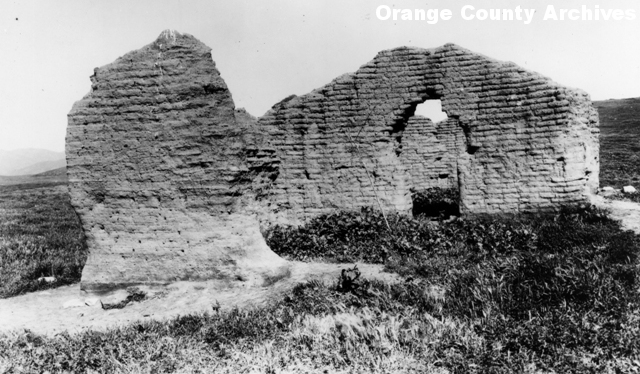
Trabuco Adobe ruins, circa 1930s. Now inside the boundaries of O'Neill Park.

People often come to me with "old stuff." When I can't immediately tell if I'm being offered trash or treasure, I tend to grab the item in question and figure it out later. Over the years, I've saved some important things that way. But sometimes the answers don't come easily. Here's a case where a group of artifacts which finally proved to be a mixed bag of relatively significant items mixed with one particular artifact that may yet prove to be downright amazing. Or not.

In 2019, archaeologist Holly "Sonny" (Windolph) Shelton of Grand Junction, Colorado contacted Mission San Juan Capistrano with an offer to donate four pieces of furniture which had been removed from the historic Trabuco Adobe about a century earlier. This adobe had been an estancia for the Mission and its ruins, located on the Rancho Santa Margarita side of O'Neil Park, are a reminder of what was perhaps the earliest "permanent" building in Orange County outside of San Juan Capistrano. Theoretically, this furniture could have dated back as early as the Mission Era. And even if it wasn't that early, it's association with the Trabuco Adobe alone made the furniture historically interesting.

The Mission turned down Shelton's offer. So on August 28, 2021, Shelton emailed the same offer to the Historical Parks division of OC Parks: 

She wrote, “During the late 1930s or 1940s my grandfather, Leo Windolph of San Juan Capistrano, purchased a parcel of land in Trabuco Canyon, in an area now encompassed by O'Neill Regional Park. Several deteriorating adobe structures were situated on the property.”
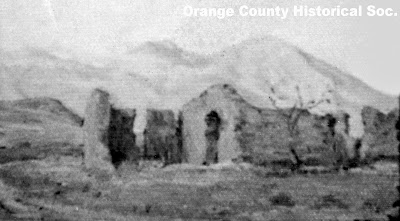
Painting of Trabuco Adobe ruins, circa 1920s by Anne Robinson

The only adobe structure there at that time was the Trabuco Adobe. And indeed, further research has shown that her family was farming that part of the Plano Trabuco (where the adobe is located) in the early 20th Century. 

The adobe, Shelton continued, “had previously been used by Mission San Juan Capistrano . . . and still held a number of mission-related antiquities such as ornate candlesticks, Santos, and other items. In addition, there were several pieces of furniture, all constructed by hand of wood and wrought iron . . .  Mr. Windolph felt these articles belonged to the Church and contacted a Father at the Mission who did come and took all but the furniture back to San Juan Capistrano Mission.” [See entry re Windolph, in Talbert's Historical Volume & Reference Works, Vol. 3, pg 687]

Here, the family lore becomes a little hazy, but none of the important information conflicts with the known historical facts about the furniture itself. Some details, however, are missing from the story. 

For instance, a key turning point seems to have come when the roof was torn off the Trabuco Adobe in the early 1920s to provide tile for Fr. St. John O’Sullivan’s restoration of the Mission’s Serra Chapel. Either the furniture was removed at that point and put into storage (perhaps in a nearby barn) or it was left, as Shelton suggests, still in situ until the 1930s or 1940s. The degree of weathering on most of the furniture suggests the former. 
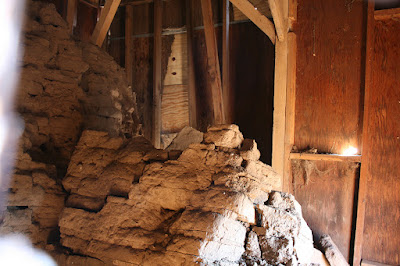
Portion of the Trabuco Adobe ruins, inside a wood shelter, 2012 (Photo by author)

“Eventually, of the aforementioned furniture,” Shelton wrote, “I inherited two high-backed chairs and a large table and bench. . . As I have no heirs or family and feel the items should not remain in Colorado, it is my intention to return them to an entity located as close to their place of origin as soon as possible. As the Mission has declined my offer I am pursuing other alternatives. . .”

“. . . Approximate sizes are: Table 5ft L x 3ft W x 3ft high; bench 5ft L x 1.5ft W x 1.5ft high; chairs 4.5 feet high at back and 2ft wide. Condition: As they are quite old but have been indoors, the wood is slightly weathered but structurally sound, wrought iron in good condition, leather sling seat, and back of chair #1 professionally replaced from a pattern of the original leather which was so old it had begun to crumble. Chair #2 is all wood. The bench has been stained and sealed but is reversible.”
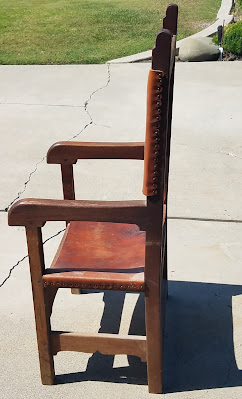
The refinished "Chair #1" (Photo by author)

OC Parks also rejected the offer but kindly passed the email along to the Orange County Archives, which unfortunately is not in the business of accepting such large artifacts. County Archivist Susan Berumen then passed Shelton's email along to me.

I accepted the furniture myself with the idea to study it, pull together as much information as possible about it, and then carefully find an appropriate home (or homes) for it. 

In September 2021, Shelton’s brother, Doug Windolph -- at great inconvenience to himself -- delivered the furniture to me at a predetermined storage site in Orange County. 

Six-foot table with moving straps still around it. (Photo by author)

Soon it became clear that two of the pieces – the table and the bench -- were definitely not from the Mission Era. Historian Eric Plunkett suggested measuring the furniture, and indeed the table and bench measured neatly in feet and inches rather than Spanish varas and fractions of varas. 

Moreover, the table and bench were carefully crafted to look like mortise and tenon construction but were actually held together with hidden nuts and bolts. And finally, the furniture was not built of woods that were readily available in Early California and the wrought iron supports showed a level of sophistication uncommon on the rugged frontier. The table and bench were likely built as “Mission Revival” pieces circa 1900-1920. They were probably purchased during that time and added to the Trabuco Adobe with an eye toward having it appear “at home” in such a structure. 
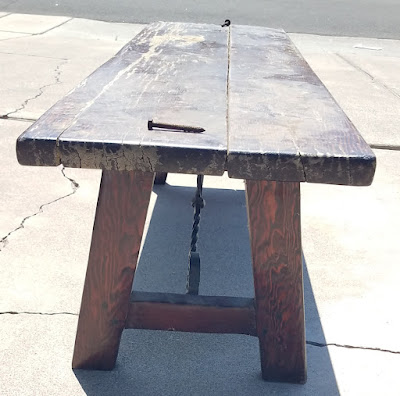
Six-foot long bench. (Photo by author)

The refinished chair with leather sling seat is likely also from the early 20th Century, although it’s harder to tell for certain. It may be early, but the fact that it was refinished makes it difficult to tell a great deal more about it. 

That said, the table, bench and refinished chair’s century-old connection to the Trabuco Adobe make ALL of this furniture historically significant, regardless of its exact age. Very few artifacts from this early estancia survive, from any era. Moreover, they still look – as intended – right at home in an adobe structure and accurately depict the style of furniture one would have seen in Southern California during the Mission Era. Thus, being simultaneously historical artifacts AND historical reproductions, in mid-2022 I offered them to the San Juan Capistrano Historical Society, which graciously accepted. At the time, they were restoring/rebuilding a historic adobe in the Los Rios District as part of their museum and I asked that these pieces be “displayed for educational purposes, and interpreted through signage that reflects the history of the Trabuco Adobe.” 
"Chair #2" (Photo by author)

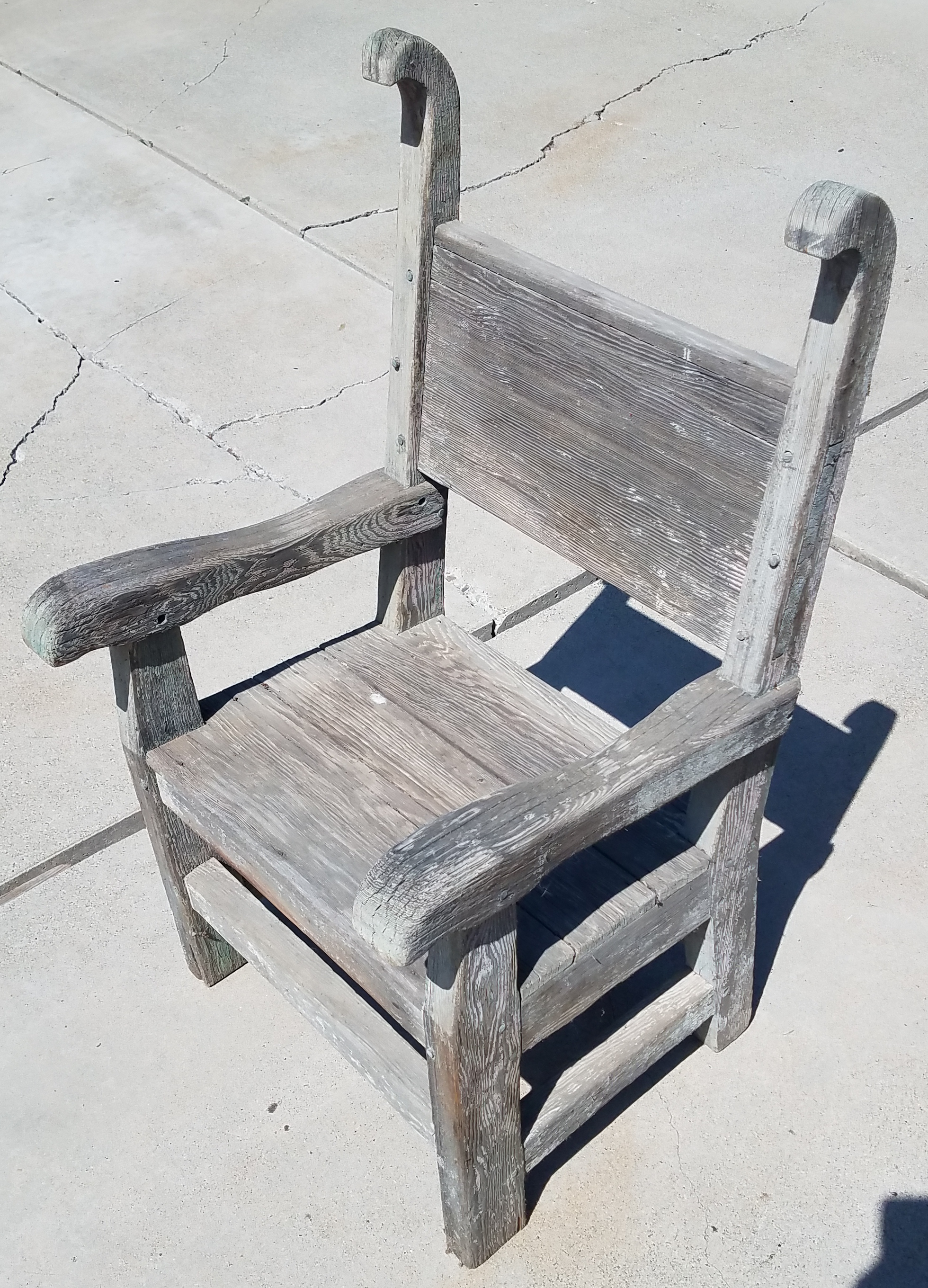
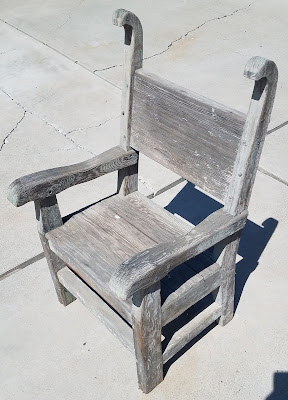
The fourth piece of furniture – still under study and not donated with the rest – is what Shelton identified as Chair #2. This chair is in rougher condition than the rest of the furniture and has clearly had a couple pieces (including the seat) replaced at some point in the past. But this chair bears many indications of being very early. It has traces of paint seemingly consistent with the Spanish/Mexican Colonial era. It features no obvious measurements in feet or inches, but numerous measurements in fractions of varas. 

Also, Chair #2 is made of pine or fir, which would have been the only lumber available locally prior to expanding trade in the 1830s. The construction techniques – aside from the aforementioned replaced pieces and two holes that seem to have been drilled at a later date -- are consistent with the Mission Era as well. (Admittedly, such furniture has often been replicated by others over the generations.) A number of historians have provided their observations regarding the chair so far, including longtime Rancho Los Cerritos curator Steve Iverson, who also happens to be a master woodworker. 

Detail from "Chair #2" (Photo by author)
There is still a hope that a few more experts to weigh in on this chair. To that end, it has been moved to another location in Orange County which not only provides better temperature and humidity conditions for the chair but also provides easier access for said experts to assess the piece. 

Meanwhile, the reappearance of this collection of furniture has led Eric Plunkett to do additional original research into the Trabuco Adobe as well as the story of furniture manufacturing at Mission San Juan Capistrano. Among his earliest findings were the fact that the Trabuco Adobe is older than most thought and that it was used initially for shepherds rather than vaqueros. He has also learned exactly who the master carpenter was at the mission and the names of the neophytes he trained. (See The Trabuco Adobe: The Oldest Adobe Outside of Capistrano in O.C.?

Delivery day! (L to R) Chris Jepsen, Eric Plunkett, Sandra Windolph, Doug Windolph. Sept. 19, 2021

Monday, April 24, 2023

JoAn Burdick Gottlieb (1934-2023)

JoAn Burdick at the Calico Saloon, Knott's Berry Farm, June 1954

My introduction to JoAn Burdick Gottlieb was a single remarkable photograph. 

Soon after I was hired as the Assistant Archivist at the Orange County Archives, in 2003, we became the repository of Knott’s Berry Farm’s historical materials. In trying to identify, date and organize the thousands of photos we pulled from every nook and cranny of the Farm, I needed to identify the places, things, and especially the people depicted therein. 

Naturally, among the photos of Knott’s Ghost Town were countless images of grizzled prospectors, train robbers, square-jawed sheriffs, bartenders, and high-kicking can-can dancers. Almost all of these images made Ghost Town itself the focus of attention. All except for one 1954 photo of a tall beautiful can-can dancer standing atop the bar in the Calico Saloon. That dancer – wearing a snazzier costume than the ones Knott’s usually supplied – was clearly the sole focus of the photo and Ghost Town just happened to be the backdrop. The dancer’s name turned out to be JoAn Burdick. 

Most of the Ghost Town crew from that era were long gone by then, and I didn’t make an effort to track her down. Instead, she found me. 

(L to R) The author with JoAn and her dear friends Kathy and Bill Couture at the Orange County Historical Society, Feb. 7, 2019.
As a local historian who's always looking for contacts and clues, I've joined every Orange County history group I can find on Facebook. One day – several months after finding the can-can photo – I spotted a post from “JoAn Burdick Gottleib” in J’aime Rubio’s Anaheim History group. I can’t remember the subject of the post, but I recognized the name. I contacted JoAn and we talked about her years at Knott’s and many other stories about her life. I liked her immediately. 

If JoAn never told you about the high points of her life, many other tributes since her death have done fair job: Dancing, pageants, parades, Knott’s Berry Farm, Las Vegas, celebrities, her beloved Bernie, her dance and baton twirling school, motherhood, friends, and community volunteer work.  But with all due respect to her many accomplishments, they aren’t the reason her passing generates such an avalanche of fond tributes. 

Why then? 

Because JoAn enthusiastically brought love and a glowing positive attitude to any room she entered. Because she fully immersed herself in being an active part of the community. (Something that her wonderful friends Kathy and Bill Couture helped facilitate in her later years.) And because she was a cheerleader for so many of us – sincerely and effusively telling us we were doing a great job and gushing about our successes to anyone who would listen. And no, I'm not just talking about me. I Everyone needs a JoAn or two in their lives.

Halloween, 2021 at the Anaheim Public Library.

In the years after we met, JoAn and her friends became regulars at meetings of the Orange County Historical Society, where I serve as president and program chair. She was also a regular at the Anaheim Historical Society which had a lot of overlap with another of her favorite community organizations, the Anaheim Halloween Parade. (Causes that are close to my heart as well.) Having played a role in the parade during its halcyon years, in the 2010s she played an even more active role as the parade was revived from the brink of death and once again made a charming and vital part of the community.

JoAn’s passing drew immediate tributes from dozens of individuals on social media, from community organizations, and even the City of Anaheim itself. A memorial I attended turned out to be a semi-secret event because the organizers knew that a publicly-announced memorial would bring out half the city, overwhelm the Anaheim Ebell Clubhouse, and possibly draw unwanted attention from the Fire Marshall. As it was, there were still maybe 175 people there. After a short memorial program and lunch, JoAn’s friends and family – one at a time -- volunteered their memories of her. Altogether, it went on for three hours. It easily could have gone on longer, but I assume the Ebell ladies wanted their hall back eventually.  

I doubt I'll ever light up a room the way JoAn did. And I'll certainly never be able to twirl three batons at once while marching down Broadway. But I hope a little of what made JoAn special has rubbed off on everyone who knew her -- including me.

JoAn speaks at the Orange County Historical Society, 2019. (Photo by author)

Author's note: JoAn passed in January 2023, so this post arrives awfully late. It was written for inclusion in a booklet full of tributes to JoAn being assembled by a mutual friend. Ultimately, that project did not move forward, so -- considering what a fixture JoAn had become in the local history community in recent years -- I thought it appropriate to post it here instead. This little article is in no way intended to serve as a proper obituary, covering the breadth and depth of her life experiences. Rather, it's just a reflection of the JoAn that *I* knew. I will leave other stories to those who know those stories better.

Wednesday, April 12, 2023

A Bit of Hawaii and Financial Skulduggery on Clay Ave.

I stumbled across this row of Hawaiian-themed apartment buildings last week while taking a walk north of Yorktown Ave. and west of Beach Blvd in Huntington Beach. Located at 704-732 Clay Ave between Beach and Florida St. (in Block A of Tract 837) the construction on the buildings was completed in 1965 -- around the peak of the Tiki or Polynesian Pop craze that swept America.

The standout features of these buildings are the multiple variations of the "Dickey Roof" design. This type of roof was introduced in 1926 by Hawaiian architect Charles W. Dickey and was based on the grass roof of King Kamehameha V's Waikiki beach house.

Another telltale sign of the buildings' island inspiration are the remnants of their original subtropical landscaping, including banana trees and bird of paradise plants. 

Developer Eagle Enterprises, Inc., based in Garden Grove, purchased the land from Edgar R. "Ned" Hill & Dora A. Hill of Newport Beach in October 1963. Dora was the first woman to serve as mayor of Newport Beach. Ned had been in the boat building business and was the founder and president of a local bank.

Ribbon cutting for another Eagle Enterprises project, Tustin Acres, April 9, 1964. L to R: Ward Wilsey; Norbert Moffatt, representing Lieut. Governor Glenn M. Anderson; Tustin mayor George Doney; Woodrow Wilsey; Tustin councilman Jerry Mack; Ernest Wilsey (Tustin News photo)

Eagle Enterprises was operated by three brothers: Ward Maurice Wilsey, vice president; P. I. Woodrow Wilsey, advisor; and Ernest Reginald Wilsey, Jr., president. It appears that each owned a 1/3 interest in the business.

Construction on the apartments got underway in 1964, but by June of that year both the Gene Robinson Building Co. and Cal-Western Cabinet Co. (a.k.a. Lawrence E. Green) took out mechanics' liens against Eagle. Then it went from bad to worse. Eagle defaulted on its loans and the property was foreclosed on by the Costa Mesa Savings & Loan Association. Eagle Enterprises went bankrupt in 1965. The Savings & Loan had the work on the buildings completed by contractor Charles R. Swenson, who finished on Aug. 9, 1965.

At the end of 1966 the Savings & Loan -- recently renamed Mariners Savings & Loan Association -- sold the row of Clay Ave. apartment buildings to Donald L. & Carolyn J. Arritt. In 1967, the Arritts in turn deeded half interest in the lots to Howard V. & Waneta M. Mathews. 

But the Wilsey brothers still weren't out of trouble. In 1970, a federal grand jury investigated the Wilseys and the defunct Eagle Enterprises and then idicted Ward and Woodrow for a number of crimes. The charges against Woodrow were more relatively minor (failure to file income taxes) and seem to have been dropped or dealt with through fines. 

However, in 1971 Ward Wilsey was convicted not only of failing to report about $56,000 in income tax, but also filing false statements with federal saving and loan associations during 1963, 1964 and 1965. He'd also diverted corporate funds into his own pockets, billed several federal savings and loans for consulting work he never actually performed, and hid records from IRS agents. "Most of the apartment developments begun by Wilsey were foreclosed by the savings and loan associations involved," recalled The Tustin News (3-18-1972) upon his conviction. He was sentenced to ten months in jail and a $4,000 fine. 

On July 10, 1975, the Arritt and Mathews families sold all the apartment buildings to George M. & Mary E. Heisick. It was the Heisicks, in 1976, who "broke up the set" and began to sell of the lots individually to a variety of new owners. From then on, each building would pass through a variety of different owners' hands, independent of the other buildings. 

Did this row of apartment buildings once have additional Polynesian decor and theming? Were there Tikis amidst the landscaping? Did the complex once have a name like "The Aloha Apartments" or "The Hana Kiki?" Did some of the rooves feature outrigger beams which have since been bobbed? Any of these would not be a surprise, but so far no additional information has come to light. If you know more about this intriguing row of buildings, let me know.

Friday, March 31, 2023

Solve the Mystery of Henry Serrano's Door

Do you have information about this door, which was given by Henry Serrano (of the pioneer Serrano family) to a respected historian and archaeologist I'll call "J" sometime around the 1980s? Henry passed away long ago. J probably knows the door's story, but a recent stroke has made communication extremely difficult. J has also moved out of Southern California and took the door along, but would now like to see it returned to Orange County.

The wood door has carvings of initials, horses, other animals, and dates that range from 1885 to 1890. It is delicate with age and use and is held in a custom-built plywood box for protection. The measurements of the door (encased within its protective frame) are 73” tall by 36” wide.

We'd love to see the door displayed at the Serrano Adobe in Lake Forest's Heritage Hill Historical Park, if appropriate. When that possibility was mentioned, J nodded vigorously, indicated that the Serrano Adobe was indeed the right place for the door. But OC Historical Parks (which owns/operates the adobe) quite correctly requires more provenance than simply "this came from someone in the Serrano family" before accepting an artifact. Which means all of us (including, perhaps, you) need to band together to share/research more information about it.

The reason that J got to know and become friends with Henry Serrano is because J assisted (the late) Jim Brock of Archaeological Advisory Group and/or (the late) Mark Roeder, paleontologist, with a site survey that also involved Henry's input.

I'll try to track that property and survey down and perhaps some of the other people involved in it, to see if the door is mentioned. But that may be a long shot. 

I'm hoping some member of the Serrano family, or the Saddleback Area Historical Society. or a random El Toro old-timer, or SOMEONE will step forward and say, "Sure! I remember Uncle Henry telling me about this door and where it came from!" 

As an artifact, it's a wonderful, functional piece of everyday life that's made dramatically more interesting by the folk-art carvings and inscriptions added to it.

So, if you know the story of the door, or part of its story, or if you think you might know who DOES know the story, please drop me a line at CJepsen at socal dot rr dot com or through my Facebook page. We have volunteers ready to bring this great artifact back to Orange County and its rightful home -- but we have to figure out what that rightful home is.

Monday, March 27, 2023

"Only a Nobody Walks in O.C."

Portrait of José Andrés Sepúlveda, circa 1856 by Henri Joseph Penelon (Courtesy Bowers Museum, via Santa Ana Public Library)

The modern observation that “nobody walks in L.A.” (or Orange County) was just as true during the Rancho Era of the 1800s. But back then the preferred mode of travel was the horse. Only the poorest did much more than cross the street on foot. 

“The few who were not good riders were looked upon with a kind of contempt,” wrote noted horseman Don José Sepulveda of the Rancho San Joaquin (which later became the Irvine Ranch). “Their attachment to their steeds was as great as the Arabs, and the greatest token of friendship between one man and another was the present of his best horse.”

Be glad we switched to cars. Imagine what our roads would be like with millions of commuters on horseback.

Friday, March 24, 2023

A Few Notes About the Irvine Bowl, Laguna Beach

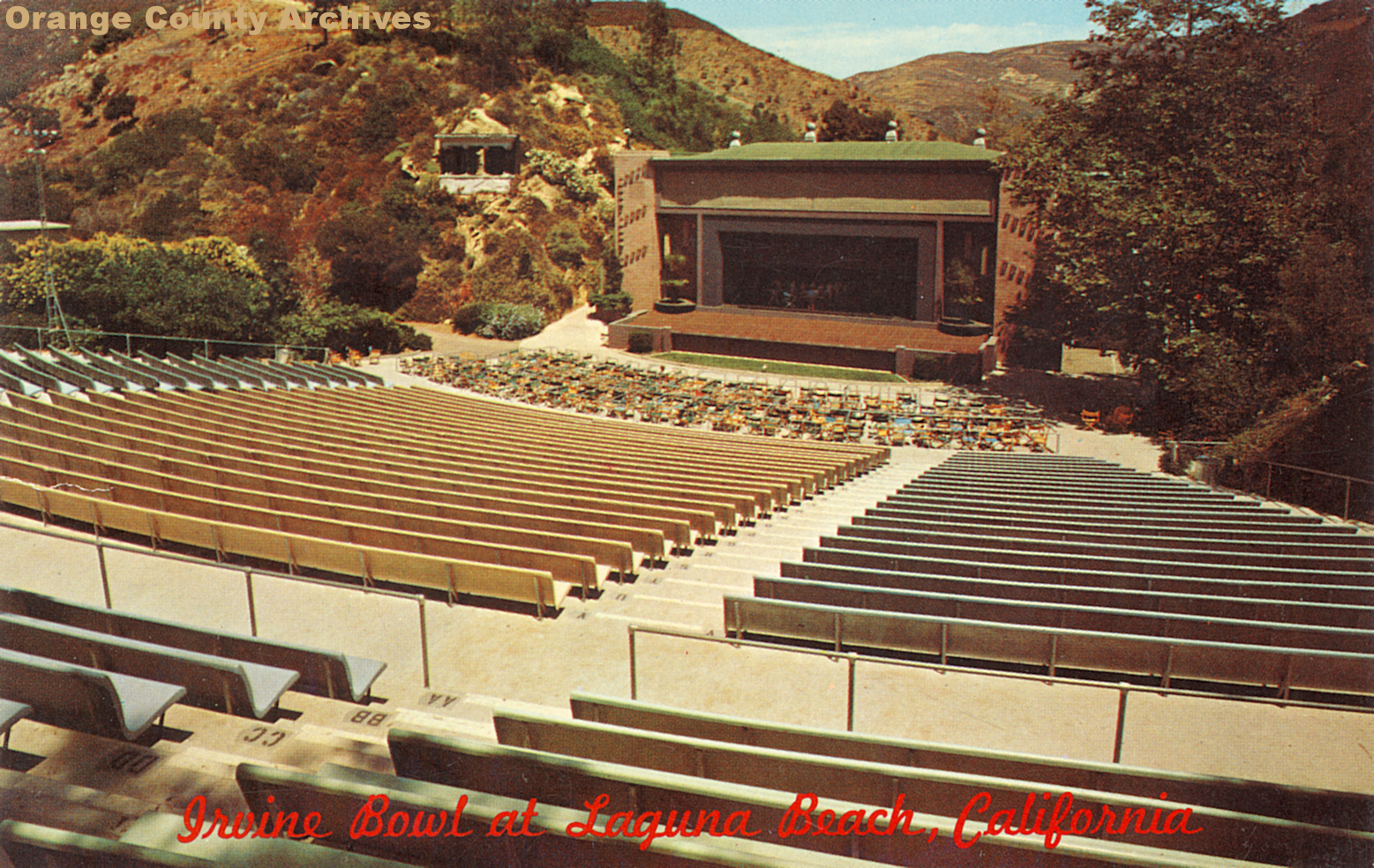
The Irvine Bowl and the adjoining festival grounds weren’t the original home of The Festival of Arts and Pageant of the Masters, but they have served that purpose for generations and are now an important part of the history of Laguna Beach.

Laguna Beach artist John H. Hinchman launched the Festival of Arts in 1932, based in part on South Coast News editor Sumner Crosby’s concept for an “intellectual carnival.”

The hope was to draw tourists already visiting Southern California for the Olympics and support local artists. The first Festival was held on El Paseo Street and for some years the event floated from one available location to another. “Living pictures” made their debut in 1933 as the “Spirit of the Masters Pageant.” The Festival of Arts Association was formed in Sept. 1934 and the first official Pageant of the Masters was presented in 1935. Over time, the event grew in size and popularity and proved itself an excellent way to bring people, money, and positive attention to the little town of Laguna Beach during the cash-strapped years of the Great Depression.

In February of 1940, the Laguna Beach City Council first considered the purchase of land for a new “Laguna Canyon Park” near the mouth of Laguna Canyon. A natural bowl had already been identified as an ideal spot for an amphitheater within the park. In April, the citizens of Laguna Beach voted for a 10-cent tax levy (for each $100 of taxable property) to fund the project.  That summer, attendance at the Festival of the Arts broke records, with standing room only at the Pageant of the Masters. Among the attendees was Mrs. James Irvine.

The City Council was presented with an initial proposed outline of the new park project in March 1941. The plan required the purchase of land from both James Irvine, owner of the vast Irvine Ranch; and Walter E. Pyne, who’d made his fortune in the player piano business before striking it even richer when oil was discovered under this Santa Ana Canyon orange groves. 

Laguna’s initial park plans included restrooms, a road to the bowl area, and the grading and paving of the amphitheater. The Festival Association offered to donate $3,000 toward the project as well as to build the stage and dressing rooms and to provide lighting and insurance. 

In May, the city reached an agreement with Irvine regarding the eighteen acres that were to be acquired from him. Irvine made numerous concessions in order to aid the Festival, including allowing them to use this acreage for years prior to the actual transfer of ownership. 

May 1941 also saw the city purchase land from Pyne and finalize plans for construction.  Grading of the amphitheater began almost immediately thereafter. 

On July 30, 1941, the Festival of the Arts opened with the dedication of the new Irvine Bowl. The Santa Ana Register reported: "Among the special guests to be introduced are Mr. and Mrs. James Irvine, in whose honor the bowl is named. It was through the cooperation of Irvine that the recreation park project was realized." The Bowl, however was not quite ready to be used yet. In fact, it would not be used for its intended purpose until 1946, when the Festival and Pageant returned after a wartime hiatus that lasted from 1942 through 1945.

The Irvine Co. donated the land to the City of Laguna Beach on Dec. 29, 1947, with the conditions that, 1) The City use the property "for the following purposes only, and for no others, to-wit: For the construction, enlargement, improvement, maintenance and operation of the outdoor amphitheater now situated thereon and known as 'Irvine Bowl', for the production and holding of public concerts, theatrical performances, festivals, exhibits, and any and all forms of public entertainment and recreation"; and 2) That if the City ceased to use the property for these purposes or used them for other purposes, that the land would revert to the Irvine Co.

An improved stage for the 2,600 seat amphitheater was constructed in 1953, replacing the original which has been described as “barnlike.” 

Aside from 2020, when they were closed due to COVID-19 fears, the Irvine Bowl and adjoining festival grounds have continued to be an important local hub for the arts in Southern California.