 |
| John and I at the Orange County Historical Society annual dinner, 2012. |
John Wesley Waite passed away on Oct. 14, 2019, leaving many grieving friends, fans, and family – but also leaving a lasting legacy of happiness. John Waite was the Forrest Gump of the theme park business. Kind, friendly and enthusiastic, he was never the top man on any corporate totem pole. But he was integrally involved in an amazing number of historic moments in his field, from the era of unthemed amusement parks, to the early development of Disneyland, to working with innovator Bud Hurlbut at Knott’s Berry Farm, to helping build the foundation for today’s enormous “haunt industry,” and more.
 |
| John with family members, November 1971. |
John was born in Ohio on Feb. 5, 1929 to Nelson and Bertha Waite. He also had an older sister, Helen. The family lived in the West Cleveland community of Lakewood. From an early age, John was interested in entertainment and theater and he especially loved Cleveland’s famous Euclid Beach Park. His family also visited Cedar Point amusement park at least once each summer. While earning his degree in theater at Allegheny College in Meadville, Pennsylvania, John worked summers (from 1947 to 1951) at Euclid Beach Park. There, he mainly worked “on the high rides,” including the famous Flying Turns coaster. He was also fascinated with the workings of the park’s large fun house and dark ride.
 |
| Allegheny College senior John Waite, 1951 |
When John graduated from college with a degree in Theater in 1951 he immediately found himself in boot camp for the U.S. Air Force. It was the Korean War era, and the Texas training base didn’t have enough housing, so trainees had to live in tents. One day, when the heat was especially oppressive, a friend suggested going into the office to apply for Officers Training School. They figured they had no chance of being accepted, but at least they’d get into an air-conditioned office for a little while.
But John was accepted. His service involved classified intelligence activities, and he has always refused to talk about it – even to family.
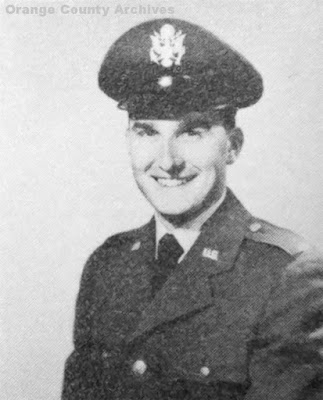 |
| Lt. John Waite at USAF Officers Training School, 1952. |
As Walt Disney’s innovative plans for Disneyland took shape in the early 1950s, Lt. Waite was fascinated. He mailed a concept for a Fantasia-themed ride to Disney for consideration as a Disneyland attraction. His packet was returned unopened with a note stating that Disney did not accept unsolicited proposals.
Once John’s military service came to an end, he drafted a resume, had some professional photos made of himself, drove to Southern California (in an old car his family gave him and dubbed “The Black Mariah,”) and applied for every job he could in the Disney organization.
Someone in Disney’s human resources department saw John’s photo, mistakenly thought they knew him, and gave him a job in the mail room at Walt Disney Studios.
 |
| Caricature of John Waite on a coffee mug, hand-painted by Disney animator "E.C.," circa 1956 |
“I started at Disney Studios in January 1956 and was there for maybe two and a half years,” John told me. “I was in the Traffic Department for the Animation Department, on the second floor of the Animation Building at Disney Studios. So I delivered mail to Walt, Roy, the animators, and all the legends. ‘1E’ – a corridor on the first floor – was on my route, and that’s where WED [the company Walt Disney formed to create Disneyland] was located.
“On my first day, I was told never to talk to Walt unless he spoke to me first. Later that day, while making my rounds with my new mail bag, I saw Walt coming toward me from way down the hall. I was headed for the offices behind him. He was scowling, with one eyebrow raised. I tried to get over to the right as much as I could, to stay out of his way. Boy, was I nervous! We had just come even with each other when he spun on his heel, turned toward me, and with a big smile said, ‘Hello! Who are you?’ Fresh out of the military, I stood at attention with my back against the wall. I answered him, but it was all I could do to keep from saluting. That was the only time I ever exchanged words with Walt Disney. I saw him around, but we never actually spoke again.”
Once inside the company, John continued to submit ideas for new attractions. He later learned that his plan for an alpine Swiss bobsled ride had caused a good deal of consternation, as Disney planners were already secretly at work on the similar Matterhorn ride and couldn’t figure out who’d “leaked” their idea.
 |
| John and his work (like the ghost behind him) was one of the stars of Knott's Haunt Museum. |
“Studio life was so informal,” John said. “We had an hour for lunch. For all that time, I thought [animator and Imagineer] Rolly Crump was a film editor. They’d be out playing football with other employees. A lot of the guys were in really good shape, including Rolly. The Firehouse Five [Dixieland jazz band] – which later became the Firehouse Five Plus Two – would play in a room upstairs. We’d sit there eating our lunch, listening to them. We didn’t realize what a good deal we had.
“Then they started offering classes. Someone would teach Shakespeare or some skill. We formed a theater group and did a show. I was in charge of publicity for the show. We put in on in a film editing room. There were lots of secretaries and execs in the show. I don’t remember it being very good. I don’t know if we only performed it once, or if we did it a couple nights in a row.
“I was the first college grad they hired into the Traffic Department. The mail room was downstairs, but my desk was on the second floor. Stuff to be delivered would be sent up to me by dumbwaiter. Later, they brought me downstairs. The idea of bringing in college grads was that we could learn about all parts of the organization, get to know everyone, and then gradually figure out where we might fit when it came time for promotions.
“Eventually, I ended up in publicity. I had to organize and record the production books and would also send out photo stills for various productions when requested. [Future Disney president] Card Walker was the head of publicity. Hazel Garner was his secretary and we got along really well. It was also during this time that I met wonderful Van France. I just loved that guy. He knew everybody.”
 |
| Just part of the crowd at John's 80th birthday surprise party. |
Van Arsdale France, was an industrial relations guru hired by Disney, who ultimately served in a number of key Disney management positions and who created the company’s employee training program. He made a huge impression on a young John Waite.
“Van’s tie was never straight and his suit always looked like he’d slept in it,” said John. “The execs like Dick Nunis came to Van partly because he knew everyone – Police, fire, city, and so forth – and could solve any problem. When Nunis got a speeding ticket while racing to the hospital for the birth of his child, Van fixed the ticket for him.”
Ultimately, John’s interest in the amusement park business led him to a job working directly for France at Disneyland. John worked in various capacities around Disney, including helping organize the park’s guided tour program and serving as manager of the Holidayland special/corporate events area. These were the formative years, when the Disneyland we know today was still taking shape.
France’s team, said John, “was me and two girls: Ruth Bartelign and Evelyn Huple. Sometimes we’d count state license plates in the parking lots. Or we’d take surveys of guests and offer them gifts of jam or whatever for thank-you gifts.
 |
| Van France in 1964. |
“In the early days of Disneyland there were no costumed characters regularly out socializing with the guests. If people wanted pictures taken with a Disney character, we’d get the call. Many’s the time I’d have to wear that awful Mickey costume from the Ice Capades. All three of us played the characters.”
John did this both inside the park and occasionally at outside events. One of these was the first Disney Night at the Hollywood Bowl in 1958. He said he was essentially blind inside the costume, which was more than a little frightening.
In fact, John’s most significant contribution to Disneyland was probably developing the use of walk-around costumed characters within the park. Walt had wanted to do this from the start, but it had only been done occasionally and haphazardly until John was tasked with the job of figuring out how such a program would work and then developing a training program for those who act the part of various Disney characters. Initially, the area used for training was backstage, between Walt Disney’s apartment and the Jungle Cruise. Today, Disneyland is famous for its well-oiled program of costumed characters meeting and greeting guests – a success that began with John Waite.
Eventually, Van France left for the East Coast to work on a new theme park – Freedomland – for “exiled” Disneyland developer C.V. Wood.
Although sad at the thought of leaving Disneyland, "John wasn't happy when Van left, so he also left and went to work for UCLA's Central Stage Management group, where they handled all the public events on campus," wrote Mark Eades in a 2014 article for the Disneyland Alumni Club. "John worked at UCLA for ten years, but during that time he also worked summers at Disneyland on attractions like the Jungle Cruise, Matterhorn, and even a short stint on the People Mover. He did this until 1969."
John would still return to Disneyland occasionally for odd jobs like helping conduct one day “whole park” surveys. And he remained fascinated with all aspects of the amusement park industry.
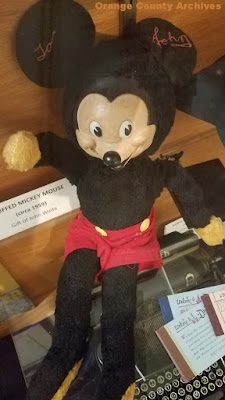 |
| Plush Mickey Mouse given to John as a going-away present by fellow Disneyland employees. |
During the 1960s, John heard about the first flume rides and learned all he could about them.
“As soon as I could, I got myself to Texas to have a look at the first flume ride [“El Aserradero” at Six Flags Over Texas] in person,” John said. “Arrow Development had built several flume rides and I thought that would be a great attraction for Knott’s Berry Farm,”
Still working at USC, John spent weekends and evenings planning his own Old West-themed version of a flume ride and building a large and elaborate model in the basement of a theater on campus. The flume rides built by Arrow had been largely unthemed and were not particularly immersive experiences. John had something better in mind: A “Calico Flume and Mine Ride,” with the ride vehicles traveling up and down rugged hills, through mine buildings, and past scenes of hydraulic mining in early California.
A photographer who often did work at the theater shot photos of the model for John, who included a series of eight-by-ten images in a project presentation binder, along with a description and specifications for the attraction. In 1967, he brought the binder to the Knott family.
 |
Waite's model of his Calico Flume & Mine Ride. Numbers
indicate as follows: 1, Waiting area; 2, Loading area; 3, Lift #1; 4, Ore
crusher (Lift #2); 5, Revolving barrel; 6, Process mill; 7, Lift #3; 8, Slag
pile; 9, Service area.
|
“They told me they were in the food business – jams, jellies and fried chicken,” said John. “They said I should go up the street to talk to the guy who did all the rides for Knott’s Berry Farm.”
So John went less than a mile north to visit Bud Hurlbut at his shop. Hurlbut, it turned out, had actually invented the log flume ride concept and licensed it to Arrow Development for use throughout the country. He needed the licensing money to help fund a new plan of his own.
“Bud said he wanted to show me something, and he took me back and showed me his plans for the Log Ride we know today at Knott’s Berry Farm,” said John.
Hurlbut’s Log Ride actually went through the interior of a mountain and was themed to early logging and lumber operations in early California. But the Old West theme, rugged terrain, scenes of heavy equipment, and even the two-tiered loading area were much like John’s version of the ride.
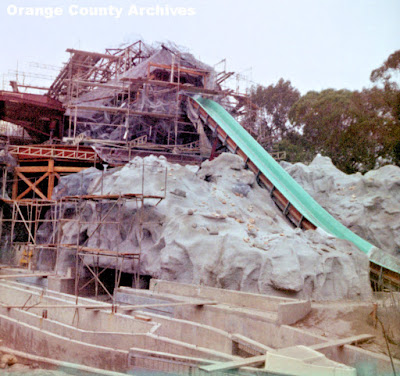 |
| Log Ride under construction at Knott's Berry Farm, April 1969. |
Two men had created extremely similar attractions, independent of one another. But it was Bud who already had the flume ride patent and a long-standing business relationship (on a handshake) with Walter Knott. But Hurlbut was impressed with John’s plans and enthusiasm, and he asked him to come to work for him. Initially, the only position Bud had open was that of part-time ride operator on the Cordelia K steamboat at Knott’s Lagoon. But as the opening of the Log Ride drew closer, John was given a full-time job that more suited his needs. After ten years at UCLA, John quit and began working full time for Hurlbut Amusement Co.
“Bud hired me as one of the three supervisors on his Log Ride which opened July 11, 1969,” John said. “He let me work with the scenery, effects, and lighting in both the Log and [Calico] Mine Rides when he realized I had a theater background.”
As part of the Hurlbut Amusement team, John was also deeply involved in the beginnings of Knott’s Halloween Haunt – an annual event that became a key element of the Knott’s income stream and which has been repeatedly copied throughout the theme park industry.
 |
| John building ghouls for Knott's Halloween Haunt, 1977. |
“In 1973, Bud asked me to attend a meeting at [Knott’s replica of] Independence Hall as the representative for the Hurlbut Company,” John recalled in an interview with
MiceChat.com. “People from the various concessions, food, and merchandise were there. We were told by George Condos of Marketing and Promotions that the Farm was going to do a Halloween Haunt event and they wanted all the departments to come up with ways to support this theme. …[Bud] asked me if I could make the Log and Mine Rides spooky for the event. I told him I was sure we could, but… there was not enough time to build scenery, so I went to all the prop shops in … Hollywood and reserved any spooky props that I could find. …I managed to find two truck loads of figures and props... We hired four to six people to be in the rides [jumping out in costumes and scaring people].
"Of course opening night surprised everyone with the huge crowd that came to this new event. After about two hours on opening night, Bud called a meeting of all the officials that were there that night. He told them that this wouldn’t work unless he had more live people in the rides. When asked how many, Bud said, “thirty-five by tomorrow night.” About six of us went out and bought all the thrift store jackets we could get our hands on and any masks that were still available so we could dress the talent that night. The second year we used a few rented props, but darkened the rides more and added some special effects. Each year Bud and I would discuss my ideas and he would approve or add to the plans for that year. …I had wonderfully talented mechanics and artists that did an amazing job of bringing to life some of the crazy things I would come up with.”
 |
| Haunters in 1980, (L to R) Bill Cook, Hal Lafferty, Jim Beatty, Jon Jolly, and John Waite |
The Haunt now provides Knott’s with much of its income for the year, and its many imitators have been the financial savior of much of the amusement park industry nationwide. In fact, because parental paranoia has greatly stifled trick-or-treating since the 1980s, the haunt trend may also have helped save the very concept of Halloween.
In late 1982, Hurlbut sold his rides at Knott’s to the Knott family and refocused his attention on his own Castle Park in Riverside. John stayed on at Knott’s for two more years as a ride mechanic.
 |
| An exhausted John Waite, leads an orientation and dress rehearsal at the Calico Mine Ride before the 1980 Haunt. |
“Knott’s asked me to do the 1983 Halloween Haunt for the Mine and Log rides,” said John. But soon he had a new job with his old friend Bud. “After retiring from Knott’s, Bud wanted me to sell glow-in-the-dark items at his Castle Park in Riverside. For the next five years I became the “Glowman” at Castle Park on Friday, Saturday, and Sunday nights.”
John also “kept busy over the years volunteering for many groups and causes.” He was, among other things, involved in the Orange County Puppetry Guild and efforts to save and restore the 1925 Fox Fullerton Theatre.
 |
| Castle Park's Glow-Man, John Waite |
In retirement, John moved from his apartment on 9th St. in Buena Park to the Dorado Senior Apartments on Stanton Ave., within easy walking distance of Knott’s Berry Farm. He upgraded his annual Season Pass for Knott’s so that it included free or deeply discounted dining, and he regularly walked over for his meals and to spend time enjoying the park. He attended theme park fan events and, of course, was a regular at Halloween Haunt.
“Spending a Haunt or two with him was definitely a joy,” said historian Eric Lynxwiler, “and getting him on the Mine and Log Ride were adventures in storytelling.”
 |
| At John's 80th birthday surprise party: (L to R): Jim Mayfield, Bud Hurlbut, and unknown |
In retirement, John could also often be found visiting his friends up the street at Hurlbut Amusement.
“The picture I'll always have in my head [of John] is when I'd drop by Bud's shop back in the day and find Bud, John and Lonnie sitting at that big table having lunch and telling tales,” said Ken Stack of Stack’s Liberty Ranch. “They shared such camaraderie and joy.”
In the early 2010s, as interest in the history of Knott’s Berry Farm began to grow, and as the Calico Mine Ride and Log Ride underwent well-publicized rehabilitation, John Waite suddenly found himself in the role of celebrity within the world of theme park fans and professionals. He was called upon for interviews and panel discussions, for special events and social functions.
 |
| John waits to have a book signed by his friends Eric Lynxwiler, Tony Baxter, Steve Knott and Chris Merritt, 2010. |
I met John in April 2010, at the day-long “Knott’s Preserved” historical event, coinciding with the publication of a book of the same title by Chris Merritt and Eric Lynxwiler. Chris and Eric put together the lectures and panels for the day and Phil Brigandi and I did the tours. John was there not only as a font of knowledge and living history, but also – quite clearly – as a fan. When he wasn’t on stage or being interviewed for podcasts, John was going on tours, getting books signed, and joining his fellow theme park enthusiasts on the rides and at Mrs. Knott’s Chicken Dinner Restaurant. He was everywhere that day.
We met again in 2011 at Hurlbut Amusement, about a month after Bud’s death. I was there to begin the process of bringing Bud’s papers to the County Archives, when Chris Merritt and John stopped by. We walked through Bud’s offices together that morning and John shared some memories.
From then on, I started to see John pretty frequently. He came to the Orange County Historical Society’s annual dinner, we hung out together at the official re-opening of the Timber Mountain Log Ride, we occasionally met at Knott’s just to visit and go on rides, we even ended up with a big group at Trader Sam’s Grog Grotto (at Disneyland) a couple times.
 |
| Reopening of the Log Ride, 2013: (L to R) Phil Brigandi, Chris Jepsen, John Waite, Eric Lynxwiler, Ken Stack, Lonnie Loyd. |
But I got to know John a lot better in 2014 when he decided that his own papers and theme park collection should join the Knott’s Berry Farm Collection and the Bud Hurlbut Papers at the Orange County Archives. In a process that went on, sporadically, for over a year, I’d come over to John’s place, we’d go through boxes from his packed walk-in closet, and he’d tell me about each item. It was a much, much longer process than normal for a new accession, but it was, for John, the only way to let go of these materials. A plan for a couple hours of digging and boxing would end up taking all afternoon and evening, and we’d end up finally stopping so we could have a late dinner at John’s favorite coffee shop, Keno’s. There was no way the County was going to pay me for all this time, but I was greatly enjoying the time with John, his stories, and watching him rediscover his own history. (Anyone who works in Archives for any reason
other than a passion for history is nuts. If you’re only looking for a paycheck, you'd far better financially elsewhere.) We took lots of breaks, sitting out on his balcony with cold drinks – with me taking notes while he reminisced. I’m so glad we got to spend that time together.
 |
| Historians (L to R) Ken Stack, Phil Brigandi, Stephanie George and Chris Jepsen at the Ghost Town Grill with John Waite, 2014. (Photo by Dave DeCaro) |
As for the John Waite Collection at the Archives, it is a rich trove of information for future generations of historians or anyone else who wants to delve into this history of amusement and theme parks, the specific projects he worked on, or John Waite himself. Unlike many in the industry, John never became blasé or jaded about his field. Despite being a respected and seasoned professional, he never stopped being the enthusiastic fan who once submitted his own ride ideas to Disney and Knott. As such, he built an impressive collection of theme-park-related publications, which is now well-represented in both the John Waite Collection and in the Archives’ reference library. He also had a selection of internal documents from Disneyland’s early years, which he assumed the Archives wouldn’t be interested in until I convinced him otherwise. (“That doesn’t have anything to do with Knott’s or Bud.”)
But perhaps the greatest jewels of the collection are John’s elaborate plans for the Calico Flume & Mine Ride, and his scrapbooks of behind-the-scenes photos from the early Halloween Haunts. Both show his creativity and passion operating at full-throttle.
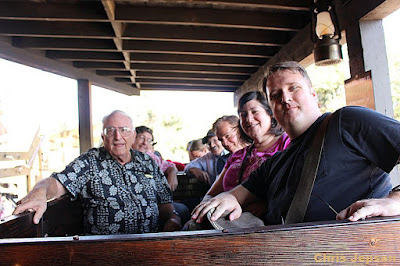 |
| John and I with friends on Knott's Calico Mine Ride, 2014. |
Sadly, I’ve seen less of John in the past few years, although we spoke a couple times on the phone. Finally, attempts to reach him in early 2019 proved fruitless. It turns out his niece had moved him up to Ventura County to live near her.
This month, I learned that John has some pretty serious health problems and that the prognosis isn’t good. Two mutual friends posted this news on Facebook and within minutes John’s niece (whose phone number hadn’t even been posted) was inundated with calls from John’s many friends, inquiring after him. The messages were pulled from Facebook just so the poor woman could get some sleep.
Last night, the word came down that John had passed away the day before. This was followed by a massive outpouring of both grief and warm memories all across social media. John’s kind and generous soul directly impacted the lives of a truly shocking number of people. And in his professional life, the foundations he built will continue to bring joy to countless millions who will never even know his name.
 |
| Bud Hurlbut and John Waite talk shop in front of Hurlbut Amusement Co. |


