The "green fence of death" that stalks so many of our historic buildings, has now gone up around the South Coast Shipyard on the Balboa Peninsula in Newport Beach. I found out about this on a tip from urban archaeologist Sarah Adams, and went over to see for myself.
Most of the buildings on this block appear in 1938 aerial photos, although I don't have a definitive construction date for any of them right now. (During the 1890s it was the site of Horace Salter's feedlot.) The shipyard's main "period of significance," however, was World War II, when the 103,000 square-foot facility was, according to the Los Angeles Times, "among the West Coast's most booming building and repairing shipyards." Then known as South Coast Boat Builders, they won war contracts to build rescue
vessels, convert aging tuna clippers into wooden minesweepers, and outfit other Navy vessels. Some of those ships, like patrol frigates, were surprisingly large for Newport Harbor.
During Orange County's post-war building and development boom,
property values in Newport Harbor skyrocketed, and pricey residential
development replaced industrial. Also, the kinds of large vessels
and working boats the shipyard specialized in were slowly disappearing --
replaced by yachts and sailboats.
In a sign that
residential development was faring far better than ship building,
the South Coast Shipyard was sold to a swimming pool company in the
mid-1960s. But by 1970 (when I suppose every house in Newport already had at least one swimming pool), the shipyard was cut up into smaller properties. There were a lot more spaces than tenants. Cranes and equipment were left to rust, and
the property was soon put up for sale again.
In 1974, the historic shipyard was "renovated and restored" by William Blurock & Partners and became the South Coast Shipyard & Design Center, with a variety of shops selling nautical equipment and decor in addition to the shipyard's usual services.
(The Shipyard was also initially discussed as a potential home
for the Newport Harbor Nautical Museum.)
Over the past three decades, the South Coast Shipyard specialized in restoring vintage watercraft. The adjoining mix of shops became more eclectic as the years went on.
The photo above shows some of those shops, including one with a pretty nice 1930s deco facade, surrounded by green construction fencing. Please note that the Crab Cooker is not fenced and is in no danger. The photo below shows the interior courtyard of the shopping area.
In 2009, the Coastal Commission approved replacing the buildings with a
"mixed-use project ," including a 21-slip marina, a dozen tie-up slips,
27 condos, 246 parking spaces, and 36,000 square feet of office and
retail space. (Yawn!) After several years of a wacky real estate market, I'm not sure if the plan has been modified, but I assume that something very much like the 2009 plan is what will take the place of the South Coast Shipyard.
It's truly a shame that the developer made no attempt at adaptive reuse of the main Shipyard buildings, which played such an important role in history. Certainly, there are some good examples of that kind of "recycling" in Orange County, with a hotel now in the old Irvine bean warehouse, a gourmet food court in the old Anaheim Railroad Depot, CSUF's Art Center in Santa Ana's old Grand Central Market, etc., etc., etc.
In discussing this site a few years ago, a Newport Beach City Councilmember said that it was only feasible to save "super-historic buildings, like the Balboa Pavilion." Sorry, Charlie,... You don't get to invent a new category of "super-historic." Either something is historic or it isn't. And the South Coast Shipyard most certainly is.
Wednesday, July 11, 2012
A call to action: Help save historic Wintersburg
I'm stealing most of the following from the folks at the Historic Wintersburg blog, where you can read more about it...
The Huntington Beach City Council will discuss the potential for preservation of the (now endangered) historic Wintersburg buildings at their meeting on Mon., July 16, 6pm. The folks working to save this site ask you to please send the Council email prior to this meeting (see instructions and details below) and possibly also attend the meeting to show your support for the site.
The meeting will be held in the Council Chambers at City Hall, 2000 Main St. The buildings in the crosshairs include the Furuta family house (1912) and barn (likely predates 1912 home), and the Wintersburg Japanese Presbyterian Mission (1910), manse (1910-1911) and Church (1934). It is the single most important extant Asian American historical site in Orange County. All these buildings are slated for demolition by the current property owner.
A draft Focused Environmental Impact Report (FEIR) is being prepared by the City to analyze the cultural resources of the property per the California Environmental Quality Act (CEQA). However, I'm told the draft FEIR does not include preservation measures, including in situ preservation or relocation of the buildings. Councilwoman Connie Boardman has agendized the "Warner-Nichols" (Wintersburg) project for discussion at the July 16 Council meeting and has asked for a complete CEQA analysis, including historic preservation alternatives.
CEQA requires state and local public agencies identify the environmental impacts of proposed discretionary projects, determine if the impacts will be significant, and identify alternatives and mitigation measures that will substantially reduce or eliminate significant impacts to the environment. Historical resources are considered part of the environment
Write today to prevent the erasure of history. Send an email asking the City Council to:
Instructions:
The Huntington Beach City Council will discuss the potential for preservation of the (now endangered) historic Wintersburg buildings at their meeting on Mon., July 16, 6pm. The folks working to save this site ask you to please send the Council email prior to this meeting (see instructions and details below) and possibly also attend the meeting to show your support for the site.
The meeting will be held in the Council Chambers at City Hall, 2000 Main St. The buildings in the crosshairs include the Furuta family house (1912) and barn (likely predates 1912 home), and the Wintersburg Japanese Presbyterian Mission (1910), manse (1910-1911) and Church (1934). It is the single most important extant Asian American historical site in Orange County. All these buildings are slated for demolition by the current property owner.
A draft Focused Environmental Impact Report (FEIR) is being prepared by the City to analyze the cultural resources of the property per the California Environmental Quality Act (CEQA). However, I'm told the draft FEIR does not include preservation measures, including in situ preservation or relocation of the buildings. Councilwoman Connie Boardman has agendized the "Warner-Nichols" (Wintersburg) project for discussion at the July 16 Council meeting and has asked for a complete CEQA analysis, including historic preservation alternatives.
CEQA requires state and local public agencies identify the environmental impacts of proposed discretionary projects, determine if the impacts will be significant, and identify alternatives and mitigation measures that will substantially reduce or eliminate significant impacts to the environment. Historical resources are considered part of the environment
Write today to prevent the erasure of history. Send an email asking the City Council to:
- Direct a complete CEQA analysis of historic preservation alternatives, including both preservation in situ (onsite) and relocation for preservation
- Make the historic preservation of the century-old "Warner-Nichols" Wintersburg property a priority
- Deny demolition of historically significant buildings located on the Warner-Nichols property, including the Furuta family home and barn, and the Wintersburg Japanese Presbyterian Mission, manse and Church
Instructions:
- Go to http://huntingtonbeachca.gov/HBPublicComments/
- Click on "Make a service request - Agenda & Public Hearing Comments"
- Select request: "Comment"
- Select: "City Council - Agenda & Public Hearing Comments"
- You may attach a letter/document or write in your comments
- Your comments are automatically forwarded to all City Council members, the City Manager's office and the City Clerk's office.
Sunday, July 01, 2012
Newport, San Juan, Dana Pt, Laguna & Anaheim
The photo above shows "Doc, Cornelia and Em" enjoying the Fourth of July, 1938, on Upper Newport Bay. Looks like they didn't have to struggle to find a spot on the shore.
I've been pretty bad about posting in the past couple weeks, so here's at least a few items to get caught up,...
Trabuco Canyon's own Hamilton Oaks Winery is turning the Swanner House in San Juan Capistrano into their tasting room. The Swanner House is on the National Register of Historic Places. At least on paper, this seems like a pretty reasonable "adaptive reuse" of this important structure.
The City of Dana Point will provide the Dana Point Historical Society with a 20' x 40' space at City Hall to use as a historical exhibit space. That's great news for the Society and a great precedent for other cities to follow.
Speaking of Dana Point, a scenic overlook at Heritage Park will be named for historian Doris Walker and will feature a sculpture evoking her work. Some sort of official naming ceremony is tentatively planned for mid-August. I'll post details if I hear more about it.
South County history watchdog/maven Manny Madrano reports that the "Blue Lagoon" community's entrance sign on PCH in Laguna Beach was dismantled and replaced with something much more boring. The sign has long been one of the most interesting and attractive bits of "built environment" along the coast, and it seems senseless to have taken it down. The photo above shows the old sign. Note the blue tile inlay and distinctive font. (Click photo to enlarge.)
This next photo shows the old entrance at night. Unfortunately, it was Christmastime, and the holiday lights detract from the wonderful glowing "torches." In any case, it looks like folks have once again traded attractive, interesting, and distinctive for boring and nondescript. What's wrong with people?
The Anaheim Historical Society has been posting some extra-interesting stuff on their blog lately, including interviews with Diann Marsh and Keith Olesen and a look back at their 35th anniversary year. (I only wonder how much they had to edit Diann and Keith's comments. They both have preservation war stories to tell that would make your hair stand on end.)
I've been pretty bad about posting in the past couple weeks, so here's at least a few items to get caught up,...
Trabuco Canyon's own Hamilton Oaks Winery is turning the Swanner House in San Juan Capistrano into their tasting room. The Swanner House is on the National Register of Historic Places. At least on paper, this seems like a pretty reasonable "adaptive reuse" of this important structure.
The City of Dana Point will provide the Dana Point Historical Society with a 20' x 40' space at City Hall to use as a historical exhibit space. That's great news for the Society and a great precedent for other cities to follow.
Speaking of Dana Point, a scenic overlook at Heritage Park will be named for historian Doris Walker and will feature a sculpture evoking her work. Some sort of official naming ceremony is tentatively planned for mid-August. I'll post details if I hear more about it.
South County history watchdog/maven Manny Madrano reports that the "Blue Lagoon" community's entrance sign on PCH in Laguna Beach was dismantled and replaced with something much more boring. The sign has long been one of the most interesting and attractive bits of "built environment" along the coast, and it seems senseless to have taken it down. The photo above shows the old sign. Note the blue tile inlay and distinctive font. (Click photo to enlarge.)
This next photo shows the old entrance at night. Unfortunately, it was Christmastime, and the holiday lights detract from the wonderful glowing "torches." In any case, it looks like folks have once again traded attractive, interesting, and distinctive for boring and nondescript. What's wrong with people?
The Anaheim Historical Society has been posting some extra-interesting stuff on their blog lately, including interviews with Diann Marsh and Keith Olesen and a look back at their 35th anniversary year. (I only wonder how much they had to edit Diann and Keith's comments. They both have preservation war stories to tell that would make your hair stand on end.)
Tuesday, June 19, 2012
Knott's Berry Farm hootenanny
The 2012 Orange County Historical Society Annual Dinner, held at Mrs. Knott's Chicken Dinner Restaurant this past Friday is the reason I haven't posted much lately. It was a big event, with almost 200 people attending, and it was a lot of work -- but man was it a lot of fun! We started off with tours of the 1920s/30s areas of the park, led by historian Phil Brigandi and third-generation Knott's Berry Farm employee Allen Palovik. When folks came inside, they were greeted with rarely-seen artifacts, courtesy Jeff Shaddic, Knott's head of Park Decor. For instance, in the photo above, Allen is shown with a portrait of Walter Knott painted by Claude Bell. (Bell was famous not only for the life-sized concrete figures that now sit on benches around Knott's, but also for his giant dinosaurs in Cabazon, California.)
All my photos that evening were taken either before the crowd arrived, or after they had mostly dispersed. So I thank Betsy Vigus for the photo above which shows at least one corner of the room mostly full.
Mrs. Knott's chicken and boysenberry pie were even better than I remembered. And then -- after a few great old Knott's movies from the Orange County Archives were shown -- our main program began. Our speaker, Eric Lynxwiler, gave an outstanding talk on the history of Knott's Berry Farm. In about 45 minutes he told the story in a way I hadn't heard before, and he kept the audience in rapt attention. (Please also note Eric's amazing custom western shirt with a boysenberry print and rhinestone boysenberries on the shoulders!)
Everywhere I looked, there were people I wanted to stop and talk with, but there wasn't time! Luckily, I'd already had a couple chances to talk with Diann Marsh during her short Orange County visit. I was very pleased that she was able to attend. Diann did some excellent historical and preservation work in Orange County, and it was a real shame when she moved to Illinois. (Although I know the folks in Illinois feel quite differently.)
It was also nice to see that not ALL the good theme park bloggers were over at the re-opening of Disney's California Adventure. The photo below shows Dave DeCaro of Daveland photographing artist Paul Von Klieben's original working maquette for one of Knott's first attractions: "The Transfiguration of Christ." I was also pleased to meet Mr. "TokyoMagic" of Meet The World.
After his talk, Eric signed and sold copies of his book, Knott's Preserved, which he co-authored with Christopher Merritt.
For those of you who feel bad about having missed the tours, fear not. There's been so much demand, that we're saving the list of people who WANTED to go but signed up too late. I'm not sure when we'll do more tours, exactly, but certainly after the summer and Halloween Haunt crowds have thinned out.
The photo above shows salvaged parts from the "Red Car" trolleys that were once part of the Knott's Beary Tales dark ride. The image below shows a poster from the Bird Cage Theatre in Ghost Town. That was always a family favorite, although I wish they'd changed the shows a bit more often when I was a kid.
The evening really went great as far as I can tell. It's always hard to know how other people see a program like this when you're at the center of the whirlwind. So far, the comments I've heard have been positive. I'd love to hear the good, the bad, and the ugly from folks who were out in the audience. You all seemed to be having a good time, but I like to know if there are things that were especially good (so we can repeat them) or especially not-so-good (so we can avoid them next time).
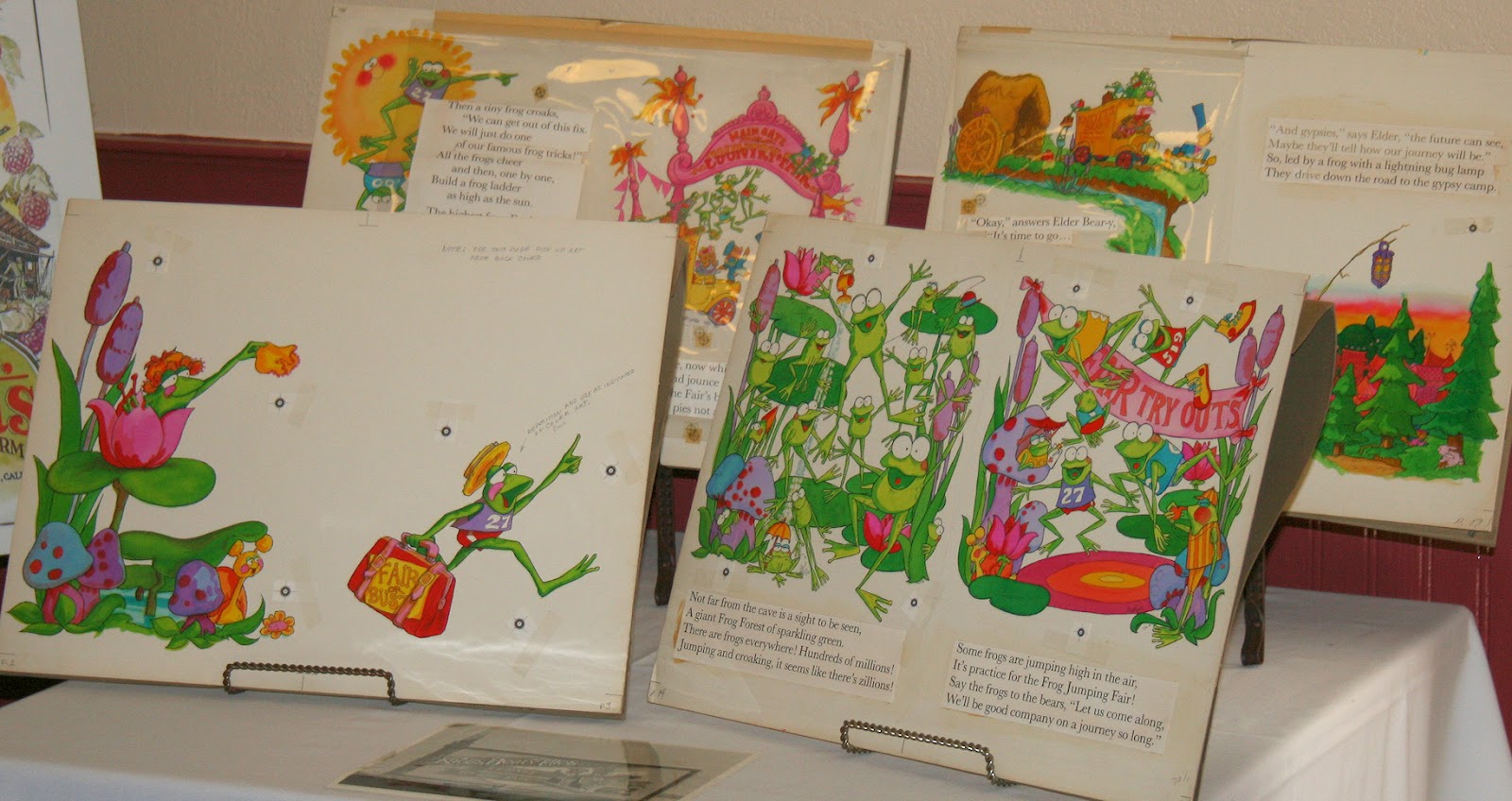
Above is a shot of the original artwork from the old Knott's Beary Tales storybook, which was also on display. (Does anyone have a copy to donate to the Archives?) In the photo below, John Waite -- Bud Hurlbut's right hand man -- and Dana H. show off an amazing photo montage of the Calico Mine Ride's interior, for which Dana recently won an award.
At least some of the many people who put this event together are shown below, standing next to a painting by Paul Von Klieben, which once hung in the Steakhouse at Knott's. (Von Klieben was the artist who designed a good deal of ghost town and did many paintings you would instantly recognize and associate with Knott's.) From left to right are Stephanie George (the event's director, producer, and unseen star), me, Allen Palovik, Phil Brigandi (wearing his dad's old jacket from Bob's Men's Shop), and of course, Eric Lynxwiler. Thanks also to the other OCHS board members who pitched in to help, to Heather Morales and Carolyn Schoff for their help with our raffle, and to Betsy Vigus who attended to so many details I would have forgotten. Special thanks to Helen Myers and her family for all pitching in and helping when we needed it most.
And thanks to everyone who attended. I know *I* had a great time, and I'm looking forward to next year's OCHS programs, events and annual dinner!
All my photos that evening were taken either before the crowd arrived, or after they had mostly dispersed. So I thank Betsy Vigus for the photo above which shows at least one corner of the room mostly full.
Mrs. Knott's chicken and boysenberry pie were even better than I remembered. And then -- after a few great old Knott's movies from the Orange County Archives were shown -- our main program began. Our speaker, Eric Lynxwiler, gave an outstanding talk on the history of Knott's Berry Farm. In about 45 minutes he told the story in a way I hadn't heard before, and he kept the audience in rapt attention. (Please also note Eric's amazing custom western shirt with a boysenberry print and rhinestone boysenberries on the shoulders!)
Everywhere I looked, there were people I wanted to stop and talk with, but there wasn't time! Luckily, I'd already had a couple chances to talk with Diann Marsh during her short Orange County visit. I was very pleased that she was able to attend. Diann did some excellent historical and preservation work in Orange County, and it was a real shame when she moved to Illinois. (Although I know the folks in Illinois feel quite differently.)
It was also nice to see that not ALL the good theme park bloggers were over at the re-opening of Disney's California Adventure. The photo below shows Dave DeCaro of Daveland photographing artist Paul Von Klieben's original working maquette for one of Knott's first attractions: "The Transfiguration of Christ." I was also pleased to meet Mr. "TokyoMagic" of Meet The World.
After his talk, Eric signed and sold copies of his book, Knott's Preserved, which he co-authored with Christopher Merritt.
For those of you who feel bad about having missed the tours, fear not. There's been so much demand, that we're saving the list of people who WANTED to go but signed up too late. I'm not sure when we'll do more tours, exactly, but certainly after the summer and Halloween Haunt crowds have thinned out.
The photo above shows salvaged parts from the "Red Car" trolleys that were once part of the Knott's Beary Tales dark ride. The image below shows a poster from the Bird Cage Theatre in Ghost Town. That was always a family favorite, although I wish they'd changed the shows a bit more often when I was a kid.
The evening really went great as far as I can tell. It's always hard to know how other people see a program like this when you're at the center of the whirlwind. So far, the comments I've heard have been positive. I'd love to hear the good, the bad, and the ugly from folks who were out in the audience. You all seemed to be having a good time, but I like to know if there are things that were especially good (so we can repeat them) or especially not-so-good (so we can avoid them next time).
Above is a shot of the original artwork from the old Knott's Beary Tales storybook, which was also on display. (Does anyone have a copy to donate to the Archives?) In the photo below, John Waite -- Bud Hurlbut's right hand man -- and Dana H. show off an amazing photo montage of the Calico Mine Ride's interior, for which Dana recently won an award.
At least some of the many people who put this event together are shown below, standing next to a painting by Paul Von Klieben, which once hung in the Steakhouse at Knott's. (Von Klieben was the artist who designed a good deal of ghost town and did many paintings you would instantly recognize and associate with Knott's.) From left to right are Stephanie George (the event's director, producer, and unseen star), me, Allen Palovik, Phil Brigandi (wearing his dad's old jacket from Bob's Men's Shop), and of course, Eric Lynxwiler. Thanks also to the other OCHS board members who pitched in to help, to Heather Morales and Carolyn Schoff for their help with our raffle, and to Betsy Vigus who attended to so many details I would have forgotten. Special thanks to Helen Myers and her family for all pitching in and helping when we needed it most.
And thanks to everyone who attended. I know *I* had a great time, and I'm looking forward to next year's OCHS programs, events and annual dinner!
Saturday, June 09, 2012
A day in La Habra
I attended historian Esther Cramer's funeral today in La Habra. It was a very nice service, and the reception provided an opportunity for a lot of old friends to see each other and talk about Esther and all the topics she cared about. Other historical folks in attendance included County Archivist Susan Berumen, noted Orange County historians Phil Brigandi and Diann Marsh, and Esther's daughter, Cindy, who's involved in the O.C. Pioneer Council. Orange County Historical Commissioners in attendance included Steve Adamson, Pamela Harrell, Don Dobmeier, Lynne Yauger, and their longtime OC Parks staff liaison, Griselda Castillo. Also in attendance were former Commissioner Margaret Salisbury, historical exhibits guru Carlota Haider, and members of the La Habra Old Settlers Historical Society. (I'm sure I'm forgetting someone, for which I apologize in advance.)
After the reception, Brigandi and I visited the La Habra Historical Museum -- another product of Esther's hard work and community spirit. The museum had a special exhibit on Esther's life, which I'm sharing a bit of in today's photos. The image above comes from a document produced by Alpha Beta when she ran their Consumer Affairs office.
When you consider all Esther accomplished for local history, it seems like she must have spent every waking moment of her life on historical work. But clearly, it was just one among many facets of her very full life. That just makes her more remarkable in my eyes. You would be astonished to learn just how many of the worthwhile Orange County historical projects from the past 40 years bear her fingerprints.
The display included a number of the books Esther wrote, (shown above), and even some of her baby clothes. (She really did donate all kinds of stuff to the museum, didn't she?)
While we were there, Phil solved a mystery that's been vexing the docents. They had this gizmo (shown below) and had no idea what it was. Phil knew immediately, and soon the whole staff (and a number of others) were gathered around to hear him describe how this "walnut gatherer" was used to pick walnuts off the ground without stooping. It works on very much the same principle as the "shag bags" used to pick up golf balls on driving ranges.
I'll share more about our visit to the museum in a future post. For a new museum, they have a lot going for them. I look forward to seeing them grow and develop in the coming years.
After the reception, Brigandi and I visited the La Habra Historical Museum -- another product of Esther's hard work and community spirit. The museum had a special exhibit on Esther's life, which I'm sharing a bit of in today's photos. The image above comes from a document produced by Alpha Beta when she ran their Consumer Affairs office.
When you consider all Esther accomplished for local history, it seems like she must have spent every waking moment of her life on historical work. But clearly, it was just one among many facets of her very full life. That just makes her more remarkable in my eyes. You would be astonished to learn just how many of the worthwhile Orange County historical projects from the past 40 years bear her fingerprints.
The display included a number of the books Esther wrote, (shown above), and even some of her baby clothes. (She really did donate all kinds of stuff to the museum, didn't she?)
While we were there, Phil solved a mystery that's been vexing the docents. They had this gizmo (shown below) and had no idea what it was. Phil knew immediately, and soon the whole staff (and a number of others) were gathered around to hear him describe how this "walnut gatherer" was used to pick walnuts off the ground without stooping. It works on very much the same principle as the "shag bags" used to pick up golf balls on driving ranges.
I'll share more about our visit to the museum in a future post. For a new museum, they have a lot going for them. I look forward to seeing them grow and develop in the coming years.
Thursday, June 07, 2012
Architectural salvage in Santa Ana
The image above is from the Santa Ana Historical Preservation Society (SAHPS) coloring book, which you can still download from their website. The illustration shown here depicts the old Santa Ana Public Library, which one stood on Sycamore St., just south of the Old Courthouse.
SAHPS is having a two-day sale of architectural salvage items this Friday and Saturday, June 8th & 9th, 10 am to 3 pm. You'll be able to purchase elements from local vintage buildings, circa 1890-1920, and add them to your own home! Talk about recycling!
The sale will be held at All-Aboard Mini Storage, Space 93, 1030 E. 4th St, Santa Ana. Enter using gate code 931030#. Cash and checks only. First come, first served.
Much of this material was recently salvaged from Santa Ana's historic Lacy District, including beautiful hardwood doors, windows, hardware, several amazing pocket doors, as well as swivel doors, a butler's pass through, and two large floor-to-ceiling Craftsman-style built ins.
Questions? Contact Lisa at salvage@sahps.org
SAHPS is having a two-day sale of architectural salvage items this Friday and Saturday, June 8th & 9th, 10 am to 3 pm. You'll be able to purchase elements from local vintage buildings, circa 1890-1920, and add them to your own home! Talk about recycling!
The sale will be held at All-Aboard Mini Storage, Space 93, 1030 E. 4th St, Santa Ana. Enter using gate code 931030#. Cash and checks only. First come, first served.
Much of this material was recently salvaged from Santa Ana's historic Lacy District, including beautiful hardwood doors, windows, hardware, several amazing pocket doors, as well as swivel doors, a butler's pass through, and two large floor-to-ceiling Craftsman-style built ins.
Questions? Contact Lisa at salvage@sahps.org
Ray Bradbury (1920-2012)
It’s a rare thing to meet, let alone have a conversation with your childhood hero. I was lucky enough to have that experience on numerous occasions.
Outside my parents, a few teachers, and a couple mentors – people who I interacted with on a daily basis – Ray Douglas Bradbury influenced me as much as anyone. Ray died Tuesday, June 5, 2012, in Los Angeles.
The San Francisco Chronicle has an outstanding obituary, which I won’t try to top. But I wanted to share a few of my own memories of the man.
Like so many others, I discovered Bradbury’s work when I was in high school. I became an immediate fan for life. Luckily, none of my teachers assigned his books, thereby sparing me the horror of having to analyze all the wonder and joy out of them.
The San Francisco Chronicle has an outstanding obituary, which I won’t try to top. But I wanted to share a few of my own memories of the man.
Like so many others, I discovered Bradbury’s work when I was in high school. I became an immediate fan for life. Luckily, none of my teachers assigned his books, thereby sparing me the horror of having to analyze all the wonder and joy out of them.
Soon, I was buying as many Bradbury books I could, and regularly borrowing out-of-print ones from the library. Then I discovered his more recent first-editions were still affordable, launching a book-collecting addiction that I’ve never been able to shake.
I attended my first Bradbury lecture and book signing at the Costa Mesa Public Library sometime around 1989. I brought a couple books for him to sign, but I also brought a watercolor portrait I’d painted of him, using photos from the Los Angeles Times as reference. Years later, he mentioned to me that the painting was up on the wall of his office at his desert home. That news was one of the greatest honors I've ever received.
Over time, I attended enough of his lectures that I could have done my own “Ray Bradbury Tonight!” performances, the way Hal Holbrook channeled Mark Twain. Not only did his words and philosophy stick with me, but (in retrospect) I was also learning how a good public speaker operates. I suppose most public speakers discover the same tricks eventually. I learned them by watching Ray Bradbury.
While I came to know his style of lecturing pretty well, you never knew what reactions you'd get from him when talking one-on-one. There was almost always passion behind his words. Although he'd fully embraced Southern California as his home, he never adopted the typical L.A. "laid-back" attitude. I remember his strong disappointment with his old friend (Los Angeles mayor) Tom Bradley for his lack of leadership in the face of the 1992 riots following the Rodney King verdict. He wasn't just irritated with Bradley -- he was sad and nearly sputtering with disbelief.
When "virtual reality" was coming to the fore, I remember asking Ray (who'd been the first to dream up the concept in "The Veldt,") what he thought about that technology not just coming to pass, but also being used to develop a computer game based on his Martian Chronicles.
I attended my first Bradbury lecture and book signing at the Costa Mesa Public Library sometime around 1989. I brought a couple books for him to sign, but I also brought a watercolor portrait I’d painted of him, using photos from the Los Angeles Times as reference. Years later, he mentioned to me that the painting was up on the wall of his office at his desert home. That news was one of the greatest honors I've ever received.
Over time, I attended enough of his lectures that I could have done my own “Ray Bradbury Tonight!” performances, the way Hal Holbrook channeled Mark Twain. Not only did his words and philosophy stick with me, but (in retrospect) I was also learning how a good public speaker operates. I suppose most public speakers discover the same tricks eventually. I learned them by watching Ray Bradbury.
While I came to know his style of lecturing pretty well, you never knew what reactions you'd get from him when talking one-on-one. There was almost always passion behind his words. Although he'd fully embraced Southern California as his home, he never adopted the typical L.A. "laid-back" attitude. I remember his strong disappointment with his old friend (Los Angeles mayor) Tom Bradley for his lack of leadership in the face of the 1992 riots following the Rodney King verdict. He wasn't just irritated with Bradley -- he was sad and nearly sputtering with disbelief.
When "virtual reality" was coming to the fore, I remember asking Ray (who'd been the first to dream up the concept in "The Veldt,") what he thought about that technology not just coming to pass, but also being used to develop a computer game based on his Martian Chronicles.
"That's fine," he said. "But they'd better get it right, or I'll hunt them down and kick 'em in the balls!"
Ray, of course, would do no such thing. His demeanor was more like Santa Claus or your favorite eccentric uncle than an internationally celebrated author.
As one of the very first sci-fi fanboys himself, Ray was more than gracious about corresponding and taking time to talk with fans of his work. I don't think it was an "ego thing." I think he genuinely loved people, and author/book events were a great opportunity for him to meet and greet thousands of them.
Ray's connections to Orange County were many -- so many, in fact, that he wrote a lengthy introduction to a book of Orange County photos published by the Chicago Review Press in 1988. He was a regular visitor here, often coming down at no charge to lend support to various Friends of the Library groups and to visit with friends. He also set a number of his stories here, including "The Man in the Rorschach Shirt," which was set on an OCTA bus cruising down PCH in Newport Beach.
In fact, my favorite moment with Ray came at an event held "in his honor" at Muldoon's Pub in Newport Beach. Whoever put the event together clearly wanted to show off by having a world-famous author there as a prop at what turned out to be a local "society" function. But once the accolades were doled out and the magazine photos taken, the socialites and businessmen all turned to each other to schmooze. Ray was left sitting pretty much by himself, so I sat down next to him. He seemed happy to have the company. There was no competition for his time, and we sat and talked about writing and about the future.
What particularly sticks in my head was discussing his short story "The Toynbee Convector," which he admitted held his solution to avoiding all the dystopian futures he'd warned us about in books like Fahrenheit 451. The underlying message of "The Toynbee Convector?" Expecting a great future is the key ingredient that makes it possible for people to build a great future.
I suppose it sounds simple, but framed in his poetic prose, it seems the perfect answer to the politicians and pundits who tell us to lower our expectations and simply accept that things can't be better than they are. The optimism and can-do spirit that put men the moon brought us a technological revolution that even now continues to expand exponentially. Compare that to our national attitude today. (Or, to continue the metaphor, compare it to the manned space program today.) The world needs a few Toynbee Convectors right now. And Lord knows it needs more Ray Bradburys.
Ray, of course, would do no such thing. His demeanor was more like Santa Claus or your favorite eccentric uncle than an internationally celebrated author.
As one of the very first sci-fi fanboys himself, Ray was more than gracious about corresponding and taking time to talk with fans of his work. I don't think it was an "ego thing." I think he genuinely loved people, and author/book events were a great opportunity for him to meet and greet thousands of them.
Ray's connections to Orange County were many -- so many, in fact, that he wrote a lengthy introduction to a book of Orange County photos published by the Chicago Review Press in 1988. He was a regular visitor here, often coming down at no charge to lend support to various Friends of the Library groups and to visit with friends. He also set a number of his stories here, including "The Man in the Rorschach Shirt," which was set on an OCTA bus cruising down PCH in Newport Beach.
In fact, my favorite moment with Ray came at an event held "in his honor" at Muldoon's Pub in Newport Beach. Whoever put the event together clearly wanted to show off by having a world-famous author there as a prop at what turned out to be a local "society" function. But once the accolades were doled out and the magazine photos taken, the socialites and businessmen all turned to each other to schmooze. Ray was left sitting pretty much by himself, so I sat down next to him. He seemed happy to have the company. There was no competition for his time, and we sat and talked about writing and about the future.
What particularly sticks in my head was discussing his short story "The Toynbee Convector," which he admitted held his solution to avoiding all the dystopian futures he'd warned us about in books like Fahrenheit 451. The underlying message of "The Toynbee Convector?" Expecting a great future is the key ingredient that makes it possible for people to build a great future.
I suppose it sounds simple, but framed in his poetic prose, it seems the perfect answer to the politicians and pundits who tell us to lower our expectations and simply accept that things can't be better than they are. The optimism and can-do spirit that put men the moon brought us a technological revolution that even now continues to expand exponentially. Compare that to our national attitude today. (Or, to continue the metaphor, compare it to the manned space program today.) The world needs a few Toynbee Convectors right now. And Lord knows it needs more Ray Bradburys.
Sunday, June 03, 2012
Royal Hawaiian and Don the Beachcomber
For those who wondered what happened to the remains of the Polynesian decor at Laguna Beach's late lamented Royal Hawaiian,... Wonder no more! I had lunch with Art Snyder, owner of Don the Beachcomber's (in Huntington Beach) today, and he told me he purchased the majority of the really nice interior decor pieces when the Royal Hawaiian closed and is starting to put them up around his own restaurant. I can't think of a more perfect home for them! The photo above shows the elaborate outrigger carving by Leroy Schmaltz that once graced the Royal Hawaiian, now hanging over the "second" bar at Don's.
By the way, Don's is hosting an International Tiki Marketplace event (sort of a big tiki swap-meet, shown in the photo below) on the first Sunday of every month, 11am to 4pm. I hadn't attended in many months and was pleasantly surprised to see that it's moved from the front of the restaurant to a larger room in the back. Lots of familiar faces there too, including Bob and Leroy of the magnificent Oceanic Arts, tiki artist Bosko (who it was a pleasure to finally meet in person), Brent Walker (a fellow tiki fan and son of South County historian Doris Walker), and many others. On the stage were musicians from the islands, and a performance by local favorite King Kukulele.
The always-gracious Art Snyder gave me a behind-the-scenes tour of Don's (formerly the old Sam's Seafood), and shared some historical tidbits about the building itself that raised more historical questions than they answered. I've been trying to research and write a solid history of Sam's Seafood for years now, and I think my job just became more difficult. I now have a number of puzzling new leads to follow. When and if they lead somewhere, I'll let you know.
By the way, Don's is hosting an International Tiki Marketplace event (sort of a big tiki swap-meet, shown in the photo below) on the first Sunday of every month, 11am to 4pm. I hadn't attended in many months and was pleasantly surprised to see that it's moved from the front of the restaurant to a larger room in the back. Lots of familiar faces there too, including Bob and Leroy of the magnificent Oceanic Arts, tiki artist Bosko (who it was a pleasure to finally meet in person), Brent Walker (a fellow tiki fan and son of South County historian Doris Walker), and many others. On the stage were musicians from the islands, and a performance by local favorite King Kukulele.
The always-gracious Art Snyder gave me a behind-the-scenes tour of Don's (formerly the old Sam's Seafood), and shared some historical tidbits about the building itself that raised more historical questions than they answered. I've been trying to research and write a solid history of Sam's Seafood for years now, and I think my job just became more difficult. I now have a number of puzzling new leads to follow. When and if they lead somewhere, I'll let you know.
Subscribe to:
Comments (Atom)