Saturday, August 11, 2012

Save what's left of Anaheim's Chinatown

The Chinese began arriving in Anaheim in the early 1870s. By 1876, about a sixth of Anaheim's population was Asian. Most of them lived in what became known as Chinatown -- a segment of Chartres St. that is now under the AT&T building and parking lot on the north side of Lincoln Ave., between Lemon St. and Anaheim Blvd. (The photo above shows a Chinese family on Chartres St. in about 1892.)

During the construction of the AT&T offices and the new Lincoln Ave., workers found Chinese pottery and other artifacts from Chinatown. But those were the bad old days of "Project Alpha," and the builders couldn't be bothered with the state laws that protect archeological sites.  They conveniently called it debris and tossed it aside or took it home.
 
But MOST of the artifacts are still sitting there, sealed up all this time under the parking lot!
Today, the entire property has been sold to developers for a "mixed use" project with stores and apartments. If things aren't handled carefully, there's a significant chance a grading and construction process could damage much of what lies beneath. Members of the local historical community have looked at early drafts of plans for the site, but nobody has seen anything final yet.

I'd suggest that at the very least, there should be archaeologists observing the site during excavation, so they can stop work as things are discovered and document/recover what's there. That's pretty standard practice. (And perhaps some of the archaeologists and environmental engineers who read this blog can tell if I'm right in thinking that CEQA requires at least this much.) 

And ideally, whatever is built on this site would not only blend in architecturally to the surrounding historic neighborhood but would also pay tribute to the areas' early Chinese settlers. Perhaps a decorative arch, a garden, or something could be included to reflect the history of the location.
The image above shows the last building in Anaheim's Chinatown to be demolished. This house, at 119 W. Chartres St., was torn down in 1940.

"Many Chinese engaged in truck farming northeast of Anaheim and their vegetable wagons were a familiar sight," wrote Anaheim historian Leo Friis. "Actually, Anaheim was a good place for Chinese to live. Its citizens never carried to extremes the prejudice found in many other towns."

Millard Sheets' local history mural (detail shown below) at the old Home Savings building in Anaheim depicts Chinese men working in the local vineyards.
Come on, Anaheim! You've done great things in recent decades by channeling your righteous indignation over Downtown's death-by-a-thousand-cuts.  This is a chance to actually right one of those wrongs directly and take back an important piece of your heritage.

Saturday, August 04, 2012

Santa Ana, restaurant opportunities, and genealogy

This is like one of those picture games in (Insipid) Highlights For (Vacuous) Children: Can you find at least four things wrong with this photo of the Old Orange County Courthouse? (And no, the missing cupola and my mediocre photography don't count.) They were shooting episodes of the FX series American Horror Story at the Old Courthouse Friday and today, and a few changes were made to make it more believable as an insane asylum. Now I can truly say I work at the funny farm.
Wanna open a Bob's Big Boy franchise in this still-mostly-in-tact, classic,1960s Armet & Davis-designed Bob's Big Boy building on 17th St. in Santa Ana? It's available, and wouldn't it be great to see it restored with stained glass and its original early California motif? (I wonder what happened to all those big paintings of rancheros and such.) Sadly, the new Bob's that have opened (and in some cases already closed) seem to be missing a lot of the classic elements, including their once excellent "Silver Goblet Milkshakes," vegetable soup with barley, etc. 
With a major wreck on the 55 Freeway yesterday, I took an alternate route to work, which took me past this old cafe at Main and 3rd St. in Santa Ana. Someone has done a nice job of cleaning it up. I only hope that something worthwhile moves in. It would be a great spot for a mini-Ruby's.
Thanks to the Santa Ana Historic Preservation Society for inviting me out to give a historical talk at their big annual gathering last week. The folks working to save the Sexlinger House and orange grove won an award for their preservation efforts, Babe Ruth made a guest appearance, the family of J. Wylie Carlyle were thanked for donating his antique piano to the Howe-Waffle Museum, and Josh "DJ Gummo" McIntosh spun some great records from the 1920s. (Playing Culture Club is not retro. Playing Jack Teagarden IS!) In the photo above, SAPHS President Alison Young discussed upcoming events.

You know, I do try to keep track of the various history-related groups in O.C. and link to all of them in the right-hand column of this blog. But somehow the Orange County Jewish Genealogical Society slipped right past me until now. You're invited to attend their next meeting, at which the topic will be "Hidden Resources at the National Archives," on Aug. 19th, 10:30am-12:30pm at Temple Bat Yahm, 1011 Camelback St., Newport Beach. The speaker will be longtime archivist (and genealogist) Kerry Bartels. For more information, email Sandybee1@Cox.net. The event is open to all at no charge.

Saturday, July 28, 2012

Old O.C. images from Douglas McIntosh

Our friend, Doug McIntosh, is from an old Orange County family, and is always sharing interesting things out of his files. I'm re-posting a few of them here because they're too interesting not to share.

The image above, Doug writes, is a "circa1930s photo of Mr. Mendoza. He was brought to Mission San Juan Capistrano from Jalisco, Mexico by Father Hutchinson to produce souvenir ceramics at the mission. In 1979 archaeologists excavated one of Mr. Mendoza's kilns at the mission. The pottery sherds that were recovered were classified as 'Medoza Ware.' One of his kilns still remains undisturbed at the mission. (Ref: Magalousis & Schiffert 1988:123-132.)"
The pencil drawing above was done by William C. Ulrich in 1930, and depicts the long-since-vanished Laguna Beach Pier. Th undated photo below is marked "Laguna Canyon Big Bend," and comes, Doug says, "from the collection of my great-uncle Herb Straw."
The photo below, also from the Straw family collection, is from about 1899 and shows the grave site of Philander William Straw in Live Oak Canyon. "Next to the grave," Doug writes, "is Herbert Desmond Straw. P.W. Straw was a Civil War veteran who homesteaded land in Live Oak Canyon. A portion of the property he homesteaded is now part of O'Neill Park. His body was later moved to Fairhaven Cemetery in Santa Ana."
Thanks, Doug! You once said I could re-post the photos you share, so I hope you don't mind. These are great images.

My thanks also to the Santa Ana Historical Preservation Society for inviting me to speak at their annual shin-dig this afternoon. It was great to see so many old friends and make a few new ones! The group has lots more upcoming events, so check out their website for details.

Thursday, July 19, 2012

Disneyland - Steps In Time: Casey Jr. Circus Train

When Disneyland opened in Anaheim, 57 years ago this week, a number of things weren't quite ready. One of those was the Casey Jr. Circus Train, in Fantasyland, which opened two weeks later. Even then, the scenery the train passed through wasn't really ready for prime time. Happily, things have improved over the years.

Today's concept/yesterday/today photos show the jaunty depot from this attraction. The 1950s concept art above was done by Disney artist Bruce Bushman. The image immediately below shows the same location in 1955, shortly after the ride opened. And the third photo (way below) shows the depot as it appears today.
Based on scenes in the movie Dumbo (1941), the Casey Jr. Circus Train, like the Storybookland Canal Boats, (which overlaps this ride) takes guests past scenes from various fairy tales that have been animated by Disney. It only lasts four minutes and is one of the few Fantasyland attractions that keeps operating during Disneyland's fireworks shows. Note the old eucalyptus windbreak in the background of the 1955 photo. Those trees still stand today, although they no longer have any orange groves to shelter.

Thursday, July 12, 2012

Avocados, disco, guitars, the Old Courthouse, etc.

Today's post is literally a big "roundup" of a lot of random stuff that's accumulated on my "stuff to blog" list. And what says "random" better than an anthropomorphic avocado with a moustache? The image above is a tin sign that's on display at the La Habra Historical Museum. The sign advertised "Rancho Brands" avocados from United Avocado Growers (formerly the La Habra Heights Avocado Association). How long before this character, (let's call him "Ernesto Avocado,") shows up on a t-shirt at Moonlight Graham?

Two exhibits are opening simultaneously at the Fullerton Museum Center, beginning with an opening reception on July 21, 6-10pm, ($15). The first exhibit is "Lay Down The Boogie: O.C. in the Disco Era."
 The second exhibit is "Lowdown on the Uproar: Leo Fender's Electric Basses." Yes, there will be disco dancing, refreshments, and a curator's talk. The disco exhibit will be open through Sept. 23, 2012. The Fender exhibit will be open through Summer 2014.

The photos above and below come from the Knott's Berry Farm Collection at the Orange County Archives. The one above shows Knott's Cloud 9 Disco and a few of their "Tiffany Dancers," in about 1979. The one below shows guests dancing at Knott's Mardi Gras Madness event in 1976. Can you dig it?
Prefer classic movies to disco? The Santa Ana Historical Preservation Society (SAHPS) will show "Mutiny on the Bounty" (1935) starring Clark Gable and Charles Laughton, along with vintage shorts and cartoons at the historic Howe-Waffle House (1898), 120 Civic Center Dr. West, on July 21, at 7pm. Tickets are $10 at the door and include snacks and drinks. (Park free at the Old Courthouse.) Reservations are a must: movies@sahps.org or 714-547-9645. See my post from 4-28-2007 to see what this version of "Mutiny on the Bounty" has to do with Orange County.

Regulars at the Old Orange County Courthouse will be sad to hear that this was Bich Quach's last week on the staff there. Sounds like she's moving on to pursue an opportunity in the private sector, and I wish her well. Luckily, she and her husband are involved with both the Garden Grove Historical Society and SAHPS, so we haven't seen the last of her. The photo below shows Bich with one of the amazing replica costumes she designed for the Orange County Archives' "On Location: Orange County In Silent Film," exhibit last year.
Speaking of the Old Courthouse, the Mendez v. Westminster exhibit -- originally spearheaded by Greta Nagel of MOTAL (shown below modeling her OC Parks volunteer vest) -- is currently being de-installed from the Courtroom 2 Exhibit Gallery. I believe the next exhibit to go in will be a show of artist/illustrator Sandy Heaton's work. Sandy's done a lot of nice work for the County over the years, and it will fun to see a retrospective.
As it happens, Gonzalo Mendez, Jr. -- a child of one of the plaintiffs in the historic lawsuit -- is a carpenter, and is putting his skills to use helping de-install the exhibit. (The distinguished-looking Mr. Mendez always reminds me a bit of "The Most Interesting Man In The World.") I hear rumors that the Mendez exhibit may soon reappear at the Heritage Museum of Orange County, but I don't have details on that yet.

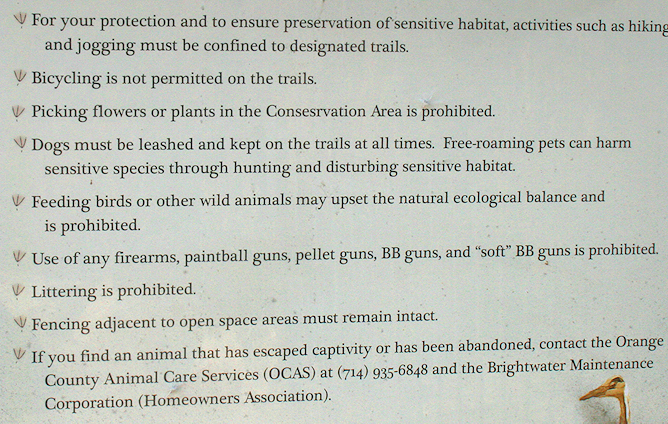
I've been making an effort to explore every accessible inch of all the trails and deer-paths through (and around) the Bolsa Chica wetlands over the last month or so. I've found a lot of interesting things out there, some of which I'll undoubtedly blog about later. For now, I'll just post this photo of a sign located near one of the very "developed" trails:
Oh, SURE! All these things might be harmful to this historically and ecologically important area. But building housing tracts n the middle of it is apparently A-OK. (*Sigh*)

I've been pretty busy lately, which at least partially explains why my blogging has been a bit erratic. I have several speaking engagements coming up, and that always requires some serious prep time. Tomorrow I speak to a group of about 60 park rangers, (always fun people,) on the subject of historical resources and ways to research the stories of their parks. I'll post more about my other programs soon.

Wednesday, July 11, 2012

South Coast Shipyard

The "green fence of death" that stalks so many of our historic buildings, has now gone up around the South Coast Shipyard on the Balboa Peninsula in Newport Beach. I found out about this on a tip from urban archaeologist Sarah Adams, and went over to see for myself.

Most of the buildings on this block appear in 1938 aerial photos, although I don't have a definitive construction date for any of them right now. (During the 1890s it was the site of Horace Salter's feedlot.) The shipyard's main "period of significance," however, was World War II, when the 103,000 square-foot facility was, according to the Los Angeles Times, "among the West Coast's most booming building and repairing shipyards." Then known as South Coast Boat Builders, they won war contracts to build rescue vessels, convert aging tuna clippers into wooden minesweepers, and outfit other Navy vessels. Some of those ships, like patrol frigates, were surprisingly large for Newport Harbor.
During Orange County's post-war building and development boom, property values in Newport Harbor skyrocketed, and pricey residential development replaced industrial. Also, the kinds of large vessels and working boats the shipyard specialized in were slowly disappearing -- replaced by yachts and sailboats.

In a sign that residential development was faring far better than ship building, the South Coast Shipyard was sold to a swimming pool company in the mid-1960s. But by 1970 (when I suppose every house in Newport already had at least one swimming pool), the shipyard was cut up into smaller properties. There were a lot more spaces than tenants. Cranes and equipment were left to rust, and the property was soon put up for sale again.

In 1974, the historic shipyard was "renovated and restored" by William Blurock & Partners and became the South Coast Shipyard & Design Center, with a variety of shops selling nautical equipment and decor in addition to the shipyard's usual services. (The Shipyard was also initially discussed as a potential home for the Newport Harbor Nautical Museum.)

Over the past three decades, the South Coast Shipyard specialized in restoring vintage watercraft. The adjoining mix of shops became more eclectic as the years went on.

The photo above shows some of those shops, including one with a pretty nice 1930s deco facade, surrounded by green construction fencing. Please note that the Crab Cooker is not fenced and is in no danger. The photo below shows the interior courtyard of the shopping area.
In 2009, the Coastal Commission approved replacing the buildings with a "mixed-use project ," including a 21-slip marina, a dozen tie-up slips, 27 condos, 246 parking spaces, and 36,000 square feet of office and retail space. (Yawn!) After several years of a wacky real estate market, I'm not sure if the plan has been modified, but I assume that something very much like the 2009 plan is what will take the place of the South Coast Shipyard.

It's truly a shame that the developer made no attempt at adaptive reuse of the main Shipyard buildings, which played such an important role in history. Certainly, there are some good examples of that kind of "recycling" in Orange County, with a hotel now in the old Irvine bean warehouse, a gourmet food court in the old Anaheim Railroad Depot, CSUF's Art Center in Santa Ana's old Grand Central Market, etc., etc., etc.

In discussing this site a few years ago, a Newport Beach City Councilmember said that it was only feasible to save "super-historic buildings, like the Balboa Pavilion." Sorry, Charlie,... You don't get to invent a new category of "super-historic." Either something is historic or it isn't. And the South Coast Shipyard most certainly is.

A call to action: Help save historic Wintersburg

I'm stealing most of the following from the folks at the Historic Wintersburg blog, where you can read more about it...

The Huntington Beach City Council will discuss the potential for preservation of the (now endangered) historic Wintersburg buildings at their meeting on Mon., July 16, 6pm. The folks working to save this site ask you to please send the Council email prior to this meeting (see instructions and details below) and possibly also attend the meeting to show your support for the site.

The meeting will be held in the Council Chambers at City Hall, 2000 Main St. The buildings in the crosshairs include the Furuta family house (1912) and barn (likely predates 1912 home), and the Wintersburg Japanese Presbyterian Mission (1910), manse (1910-1911) and Church (1934). It is the single most important extant Asian American historical site in Orange County. All these buildings are slated for demolition by the current property owner.

A draft Focused Environmental Impact Report (FEIR) is being prepared by the City to analyze the cultural resources of the property per the California Environmental Quality Act (CEQA). However, I'm told the draft FEIR does not include preservation measures, including in situ preservation or relocation of the buildings.  Councilwoman Connie Boardman has agendized the "Warner-Nichols" (Wintersburg) project for discussion at the July 16 Council meeting and has asked for a complete CEQA analysis, including historic preservation alternatives.

 CEQA requires state and local public agencies identify the environmental impacts of proposed discretionary projects, determine if the impacts will be significant, and identify alternatives and mitigation measures that will substantially reduce or eliminate significant impacts to the environment.  Historical resources are considered part of the environment
  
Write today to prevent the erasure of history. Send an email asking the City Council to:
  • Direct a complete CEQA analysis of historic preservation alternatives, including both preservation in situ (onsite) and relocation for preservation
  • Make the historic preservation of the century-old "Warner-Nichols" Wintersburg property a priority
  • Deny demolition of historically significant buildings  located on the Warner-Nichols property, including the Furuta family home and barn, and the Wintersburg Japanese Presbyterian Mission, manse and Church
Emails should be sent by Saturday, July 14, to the "Huntington Beach City Council," with the subject, "Public Communications for July 16, 2012 Council meeting," and should reference the "Warner-Nichols (Wintersburg)" project.

Instructions:
  • Go to http://huntingtonbeachca.gov/HBPublicComments/
  • Click on "Make a service request - Agenda & Public Hearing Comments"
  • Select request:  "Comment"
  • Select: "City Council - Agenda & Public Hearing Comments"
  • You may attach a letter/document or write in your comments
  • Your comments are automatically forwarded to all City Council members, the City Manager's office and the City Clerk's office.

Sunday, July 01, 2012

Newport, San Juan, Dana Pt, Laguna & Anaheim

 The photo above shows "Doc, Cornelia and Em" enjoying the Fourth of July, 1938, on Upper Newport Bay. Looks like they didn't have to struggle to find a spot on the shore.

I've been pretty bad about posting in the past couple weeks, so here's at least a few items to get caught up,...

Trabuco Canyon's own Hamilton Oaks Winery is turning the Swanner House in San Juan Capistrano into their tasting room. The Swanner House is on the National Register of Historic Places. At least on paper, this seems like a pretty reasonable "adaptive reuse" of this important structure.

The City of Dana Point will provide the Dana Point Historical Society with a 20' x 40' space at City Hall to use as a historical exhibit space. That's great news for the Society and a great precedent for other cities to follow.

Speaking of Dana Point, a scenic overlook at Heritage Park will be named for historian Doris Walker and will feature a sculpture evoking her work. Some sort of official naming ceremony is tentatively planned for mid-August. I'll post details if I hear more about it.


 South County history watchdog/maven Manny Madrano reports that the "Blue Lagoon" community's entrance sign on PCH in Laguna Beach was dismantled and replaced with something much more boring. The sign has long been one of the most interesting and attractive bits of "built environment" along the coast, and it seems senseless to have taken it down. The photo above shows the old sign. Note the blue tile inlay and distinctive font. (Click photo to enlarge.)
This next photo shows the old entrance at night. Unfortunately, it was Christmastime, and the holiday lights detract from the wonderful glowing "torches." In any case, it looks like folks have once again traded attractive, interesting, and distinctive for boring and nondescript. What's wrong with people?
The Anaheim Historical Society has been posting some extra-interesting stuff on their blog lately, including interviews with Diann Marsh and Keith Olesen and a look back at their 35th anniversary year. (I only wonder how much they had to edit Diann and Keith's comments. They both have preservation war stories to tell that would make your hair stand on end.)