Friday, March 30, 2018

F. B. Silverwood and Our State Song (Part 2)

If it says "state song" on the cover, it must be true, right?
[Continued from Part 1]

Even as his marriage fizzled out, F. B. Silverwood was writing and promoting what would eventually become California’s official state song.  He was not the first to write such a number. Many others had already tried and failed to promote their own proposed state songs. In doing so, they paved the way for Silverwood.

For example, "Hail California" (1896) by recent New York transplant Josephine Barrelle Howard Grow (a.k.a. Josephine Gro) sold at least 25,000 copies to public schools before fading into deserved obscurity. Gro simply printed “State Song” under the title on the cover of the sheet music rather than taking steps to obtain official status.

Describing Gro’s song, Ambrose Bierce wrote, "On the music I forgo judgement, lacking the gift and faculty devine of the musician; but the words are about the meanest, mangiest yellow dogs of words that ever scampered ki-yi-ing out of the cerebral kennel to lay waste the night and desolate the day."
Josephine Gro, circa 1895
The lyrics to “Hail California” follow:
O California--Hail to thee!
And to the day that gave thee birth!
With countless mines and fruitful vines,
Thou art a land of wonderous worth;
Thy Native Sons give homage true,
And glory in thy golden frame;
Thy foster children bless thee, too,
And sound they praise with loud acclaim.

(Chorus)
Hail! All hail to California!
Shout from her Sierras to her Golden Gate;
Richest gem in fair Columbia's crown--
Hail to California, the Goden State.

Where once thy deserts lay in waste,
Now, scent of blossoms fills the air,
And fertile plains of golden grains
And groves of vast extent are there.
Since first thy rugged border-land
Gave entrance to the pioneer,
With steady stride and triumph grand,
Hast thou marched on thy proud career.

Oh, El Dorado--treasure land!
Of goodly gifts thou hast a store;
Thy yellow show'rs of fruit and flow'rs
In free profusion round us pour;
Thy flocks graze on a thousand hills,
Thy cattle roam o'er poppied plains,
In every breast a true heart thrills,
And over all contentment reigns.

O, Queen of the Pacific, with
Thy throne upon its golden sands;
Thy ships defy its billows high,
And bear thy wealth to other lands.
Thy South 'neath ever-smiling skies
Is a perennial garden fair--
Caressed by breezes soft, she lies
In luxury beyond compare.

Thy motto, "Watch and Guard," adorned
The banners of thine early days;
Thy record tells 'twas heeded well,
And each, its mandate still obeys.
And should the nation be in need,
Thy sons in all their loyal might,
To its defense will boldly speed,
Beneath Old Glory's colors bright.
Beirce was right about it being “insufferable stuff.” It would be more than a decade before anyone had the guts to broach the topic of a California state song again.
Next time: Westminster and the Land of the Setting Sun

Tuesday, March 27, 2018

F. B. Silverwood and Our State Song (Part 1)

Sheet music cover for I Love You, California, 1913.
You know that antiquated-sounding ode to California used in Jeep TV commercials? That’s a slightly mangled version of our state song: “I Love You California” (1913) – with lyrics written by Silverwood’s clothing store founder, Francis Beatty "Frank" Silverwood (1863–1924), also known as “Daddy” Silverwood.

Most Californians are surprised to learn our state song isn’t "California, Here I Come" (1921) – made popular by Al Jolson, Huell Howser, and your fourth grade teacher.

The intertwined stories of Silverwood and California's adoption of his song are colorful and convoluted to say the least. The tale involves Shriners, a Westminster poet, petty political tomfoolery, failed romances, high fashion, an operatic diva, world travel, legions of poor newsboys, and a place called Happyland.
Francis B. "Daddy" Silverwood
A native of Oakwood, Ontario, Canada, Silverwood first came to the United States in 1877 as a child and sold newspapers for a pittance on the rough-and-tumble streets of New York City. He returned to Canada, but came back to the U.S. at age 18, worked his way across the Pacific Northwest, and eventually arrived in San Francisco around 1886. But he couldn’t find a job there, and he only had $2.50 to his name. So he pawned his watch to pay for steamboat transportation to Eureka, where the Crocker Bros. store had offered him a job selling men’s clothing. It was the start of a career and a lifelong business partnership with fellow clothier George Edward Nagel, and it was also where Silverwood would gain American citizenship in 1892. He worked for Crocker Bros. for five years and rose to the position of manager before leaving to co-found McNamara & Silverwood clothiers with William A. McNamara.
Homeless New York newsboys, late 1800s.
Two years later, in the Spring of 1894, Silverwood left Eureka, with a plan to open his own men’s clothing store in Los Angeles with help from Nagel. First, however, he took a trip to New York and then to see his family in Canada.

Silverwood and Nagel opened their first Silverwood store on May 13, 1894 at 124 South Spring Street in Los Angeles. (Orange Countians may remember some of the chain’s branches, much later, at Anaheim Plaza, La Habra Fashion Square, and Newport's Fashion Island.)
Among the first advertisements for Silverwood's store, from the Los Angeles Herald, May 12, 1894.
"Mr. Silverwood is a big, good hearted, genial whole souled fellow,” wrote the San Bernardino County Sun when a Silverwood store later opened in their city. “Although he weighs 250 pounds, he plays golf, was one of the end men in the Jonathan Club minstrel show, and sees the sunny side of life."

Already, Silverwood was a proud Californian who signed his letters, "Yours to the end of the trail, Daddy."

On Jan. 27, 1897, Silverwood married Miss Marie L. Funk, a 23-year-old Illinois native. Previously, she was a clerk in the Charles A. Lang millinery shop in St. Paul, Minnesota.

The wedding was a simple affair conducted at the bride’s uncle’s home in Los Angeles, and she carried a bouquet of orange blossoms down the aisle. They initially lived in a room in a boarding house on Hill Street until Frank’s business really got rolling. By 1910, things were going so well that the Silverwoods had money for a trip around the world, including stops in Japan, China, and Hawaii. But something may have happened on or around that trip that took the romance out of their marriage.
Mrs. Marie L. Silverwood, 1909
Later that year, Marie took off to Europe with no return trip planned. She only came back to the U.S. when World War I began in earnest, and even then did not return to her husband. In 1915, Frank Silverwood filed for and received a divorce on grounds of desertion.

By then, his life had already taken an interesting new turn.

Next time: Part 2 - Hail, California!

Friday, March 23, 2018

Who was Alton?

James & Hannah Alton with their children (L to R) Cecelia, Leonard, Gertrude, and Loretta Rose (in arms). (Photo courtesy Santa Ana Historical Preservation Soc.)

Fellow history dudes Rob and Cliff sent me a question from the "Growing up in Irvine" Facebook group about the origins of the street name "Alton Avenue" in Irvine. Here's what I found,...

The first segment of Alton was a stretch less than half a mile long called Alton Street in Santa Ana. It extended east from South Main St. In 1945 it was still an unnamed dirt road, or at least the name didn't yet appear on maps. However, the street appeared in the 1952 Rene Atlas of Orange County, as Alton St.

Prominent dairyman James E. Alton and his wife, Hanna Hallicy Alton -- both natives of Parsons, Kansas -- lived and ranched along South Main St. in the Greenville area (below Santa Ana) since at least 1901 when the first of their nine children was born. (James primarily made the newspapers when involved in Knights of Columbus activities or when picked up for public intoxication.) When the Post Office began home delivery, the road to their little farmhouse needed a name, and "Alton" was the obvious choice. 

In 1952, James’ son, Joseph W. Alton, took charge of the business: J. E. Alton & Sons Co. At that point, James and his second wife, Frances, lived at 15032 Alton St., Santa Ana. (Hannah died in 1946.)

Looking east on the original segment of Alton St. near S. Main St., in Santa Ana.

Later, it appears that Alton Street was extended east to Newport Blvd., then southeast into what's now Irvine, and was bisected when that segment of Newport Blvd. became part of the 55 Freeway.

As Irvine was developed and grew in the 1960s, 1970s and even into the 2010s, Alton St. was extended yet further and became Alton Ave. and (east of the 55 Freeway) Alton Parkway. Several more unconnected segments of Alton were also added to the west in South Santa Ana as more land was developed. Today, the western terminus of Alton Ave. is at Susan Street.

Alternately, Alton family lore claims that Alton Parkway in Irvine was not named for their family, but was named for someone else and just happened to line up with the existing Alton Avein Santa Ana. I've yet to find evidence for this idea, but I haven't disproven it either.

Friday, March 09, 2018

OCHistoryland


Longtime local historian Phil Brigandi has built you a new website: OCHistoryland.com. I know just how much he loves computers (and how much they love him back), so you should appreciate this all the more. He jammed all those ones and zeroes into place with his bare hands to create a site that's professional-looking, interesting, and a useful reference. (With Phil's writing, you never have to wonder if the facts are really the facts.)

Phil has already posted some of his old articles, a bunch of new ones, a bit of primary source material, and is working on still more content to be uploaded soon. It's a very welcome addition to the growing family of online O.C. historical resources. The more good local history we can get into the public's hands, the better.

Phil's old website is still online too, at  SoCalHistoryland.mysite.com. It also has a lot of great content, but it was mostly static and in retrospect seemed like a placeholder for the site he's debuting now.


"At its best," Phil writes on the new site's introduction, "local history can help give all of us a sense of connection to the past, a sense of belonging, a sense of place. We are all part of a larger story. If I can help build a growing appreciation of Orange County’s past, my work will be worthwhile."

It is very much worthwhile, my friend!

Wednesday, March 07, 2018

The Orange County Press Club writes again (and again)

Famed local cartoonist Virgil “VIP” Partch serenades Pam Bennett at an Orange County Press Club event, April 1962. Photo courtesy County of Orange.
There is undoubtedly an amazing history to be written of the Orange County Press Club. What follows ain't it. However, these colorful stories about the early incarnations of the Club (and its delightfully goofy mascot) might be considered a little step in the right direction.

Journalists from Orange and Santa Ana gathered on the evening of May 26, 1916, at the James Café in Downtown Santa Ana, to launch the Orange County Press Club. Representatives from newspapers in Anaheim and Fullerton sent letters of support, but were unable to attend the first meeting. Terry E. Stephenson of the Santa Ana Register (also a local historian) acted as temporary chairman and W.O. Hart of the Orange News acted as secretary. Hart pointed out that the organization, "even if formed for social purposes at the outset, eventually [will] result in much good to the newspapers of the county in a business way."

It was decided that not only news writing and editorial staff could join, but also front office staff. The drafting of a constitution and bylaws was left to a committee and were adopted at the Club’s first banquet, a few months later.
The Jewel City Café, Seal Beach, as it appeared in 1922. Photo courtesy SBFoundersDay.wordpress.com.
At that time, the Bayside Land Company still owned much of Seal Beach and was using every trick in the book to draw attention to its young community and to spur further real estate sales. Sensing a good PR opportunity, they graciously played host to that first O.C. Press Club banquet and threw quite a party. The event was held Oct. 7, at Millers Famous Sunset Dollar Dinners in the Jewel City Cafe building in the heart of Seal Beach’s brand new pier-side “Joy Zone.” After a short business meeting, there was dancing, aerial acrobatics by aviator Joe Boquel, and fireworks over the pier. Those arriving early were also welcomed to enjoy the Bayside Land Co. beach resort privileges at no cost, including swimsuits, bathhouse privileges, etc.

Despite the impressive kick-off, the Press Club immediately disappeared. Organizations as obscure as the Santa Ana Typographical Union’ Women’s Auxiliary and the Wrycende Maegdenu continued to run regular announcements of their activities in the local newspapers, but there was no further sign of the Orange County Press Club. It makes one wonder exactly what went on that night in Seal Beach! (Considering the reputations of both journalists and early Seal Beach, it’s hard to imagine.)
Almost exactly a decade later another attempt at starting an Orange County Press Club was made, this time with a bit more success.

At that time, the Orange County Harbor Chamber of Commerce was using every trick in the book to promote a positive outcome for an impending ballot initiative that would provide bond money for the development of Newport Bay into a harbor. Sensing a good PR opportunity, they graciously played host to Orange County’s newspaper publishers, and they threw quite a party. On May 11, 1926, the evening began with a cruise around the bay, followed by a deluxe steak dinner at the Newport Harbor Yacht Club.
Pro-Harbor cartoon by Santa Ana Register cartoonist and local war hero Jack Fisher.
During the meeting, Horace Fine of the Register suggested that an Orange County Press Club be formed. Some of the same personalities that had been part of the original group in 1916 were in attendance and may or may not have spoken out about “history repeating itself.” Just like a decade before, a committee was created to draft a constitution and bylaws and a temporary board was set up to instigate the Club's formation. This time, the group in attendance included reps from newspapers in every corner of the county. Newport News publisher (and local historian) S.A. Meyer was made temporary chairman, and A.V. Douglass of the La Habra Star was elected secretary.

Of the bay tour, the Register reported the newsmen being “deeply impressed with the expanse of water and the possibility of developing, at the bay, a first class pleasure and commercial harbor."
After dinner, in the Yacht Club’s smoke-filled drawing room, it was decided to hold another meeting in early June, and plans were discussed for a county-wide advertising campaign to promote the harbor bonds. Later, the Press Club would issue a resolution supporting the bonds, which were "in every way advantageous to the county." This may not be as bad as it sounds, considering the harbor project already had broad support among the county’s movers and shakers. But the optics were certainly bad.

The second meeting of the 1926 incarnation of the Orange County Press Club was held on the evening of June 8, at the Southern Seas Club in Balboa, at the invitation of Newport Beach mayor Conrad Richter.
Concept art for the Southern Seas Club by architects Allison and Allison.
At that time, the Southern Seas Club was in the middle of a major marketing blitz, trying to sell $600 life memberships to support their plans for an elaborate 10-story beach resort on the Balboa Peninsula. They were using every trick in the book to promote sales. Sensing a good PR opportunity, they graciously played host to the O.C. Press Club’s second meeting on June 8th. Newport Beach mayor Conrad Richter coordinated the event.

During this meeting, they decided that the Press Club would be primarily a social group. In keeping with that, their next meeting was a picnic dinner (again with steak!) at Hewes Park on July 21. From there on, it seems they met every two to four months for evening events at various locations throughout the county.
H.S. Webster, president of the California Publishers Assoc. (L) and D. Eyman Huff (R) at an O.C. Press Club event at Hewes Park, welcoming Senator J.F. Burke (center) as the new publisher of the Register.
Although it lasted longer than the 1916 version of the Club, the 1926 version seems to have eventually evaporated also. The last scant references to it in the local papers appear around 1937. In March 1941, a group of high school newspaper staffers started their own organization, which they also called the Orange County Press Club. Apparently nobody from the former group of professionals bothered to ask that they add the word “Student” to their moniker.
Circa 1940s matchbook cover art for the “Press Club of the Pacific Coast,” (no relation) which was actually a seedy bar on a  seedy part of the State Highway (now the I-5 Freeway).
The Great Depression, World War II, and the beginnings of Orange County’s explosive post-war growth were already history by the time anyone tried forming an Orange County Press Club again. The first meeting of the current incarnation of the club was held in 1953 at the behest of Register city editor Harry Harvey, who hosted the event not in the lap of some eager PR-seeker, but in his own living room.

In a 1986-87 issue of the Club’s Add One newsletter, Tom McCann wrote, “Those in attendance included Gale Ellis of the Garden Grove News, Bob Gettemy of the Los Angeles Times, Phyllis Jackson of the Newport Harbor News-Press, Dale Kroesen of the Cypress-Los Alamitos Enterprise, Beth Kroesen the Buena Park News, and Carmela Clark (Martin) and Carrie Lou Sutherland of the Anaheim Bulletin.

“A second meeting was held April 29, 1954 at Santiago Park in Santa Ana with eight additional journalists attending, including Sky and Velma Dunlap of the Times, and Fred Allen of the Newport Harbor News Press. They drew up a nine-point outline of what the club would be and how it would operate. Finally, on May 27, 1955, the Orange County Press Club held its first official meeting at the seedy Savoy bar (now gone) on Fourth St. in Santa Ana. Bob Gettemy was elected the first president, Fred Allen vice president, and Carmela Martin secretary-treasurer.

“The ‘speaker’ that evening was famed cartoonist Virgil ‘VIP’ Partch, who according to a 1980 retrospective article by Vi Smith, ‘alternately drank and drew original cartoons for those present.’
“Smith also recalled that many publishers were nervous about the new club, fearing the journalists might ‘get together and compare salaries or form a union,… They needn’t have worried. Most of the members were too embarrassed to let anyone know how little they received.”

At that time, Disneyland was just months away from opening, and the success of the theme park was still very much in doubt. Walt Disney, in debt up to his eyeballs, was using every trick in the book to draw attention to his wonderland. Sensing a good PR opportunity, Disney graciously sponsored some of the first O.C. Press Club events at the nearby Disneyland Hotel. Disney Studios also provided the club with its logo/mascot.
The author (left) with Orcop (right) at the Los Angeles Archives Bazaar.
“As the club began to dole out annual press club awards, Disney offered to provide the award plaques,” wrote McCann. “But the plaques seemed sort of naked without some sort of Press Club logo. So the Disney artists created “Orcop” – the cliché-riddled mascot of the group. Initially, the character was nameless. Superior Court Judge Franklin G. West collected name nominations for a couple months, but none were worth putting to a vote. Finally, one submission seemed passable. Since then, both the character and the annual journalism awards have been called Orcop. Orcop first appeared in three-dimensional form as a gold broach with blue sapphire eyes, presented to outgoing president Vi Smith.”

In the decades since, the Orange County Press Club has retained its social aspects, but has seemingly become more professional. Smokers and “Miss Orcop” beauty contests have given way to more opportunities to recognize quality journalism.
Tustin’s Gigi Dahl, named Miss Orcop 1965 by the O.C. Press Club. She appears here with her parents and the Orcop trophies.
The club also expanded to include PR and PIO professionals. This was a bit controversial, but it’s true that many good writers find themselves hopping back and forth between public relations and journalism. (It would be odd kick people out and then reinvite them as they switched back and forth between jobs.) Moreover, with the dwindling number of local news outlets and the current generation’s lack of interest in community organizations, it was probably necessary to admit PR folks just to keep the Club stocked with members.

According to their website, “The Orange County Press Club exists to support, promote, and defend quality journalism in Southern California. We seek to encourage journalists by providing networking opportunities and by hosting regular events with topics of interest to a broad spectrum of journalists.

“Our members include Orange County based publishers, editors, journalists, reporters, broadcasters, public information officers, public relations professionals and journalism students.

“The primary mission of the club is to provide a networking opportunity for those employed by news organizations, magazines and new media in Orange County. The club's goal is to foster relationships among the members of the OC Press, to support those interested in entering the profession, and to recognize excellence in writing and reporting in Orange County.”
2014 Orange County Press Club Awards Banquet. Photo courtesy O.C. Register.
The way the business model for journalism is eroding in this country, one hopes there’s someone left to keep some version of the Press Club afloat in another hundred years.

Friday, March 02, 2018

The Islands of Knott's

Ride concept based on input by Bud Hurlbut.
On my other blog, Tiki Lagoon, I've just posted a two-part article about Knott's Berry Farm's attempts at cashing in on the South Seas/Tiki craze. Proposed elements included an elaborate South Seas Island Boat Ride, which was never realized, and Jungle Island, which would later open with a very different look than originally planned. Part one of the article is posted here. And part two is posted here. If you're interested, go take a look!
The entrance to Jungle Island, circa 1964. Photo courtesy O.C. Archives.

Wednesday, February 21, 2018

The Orange County logo

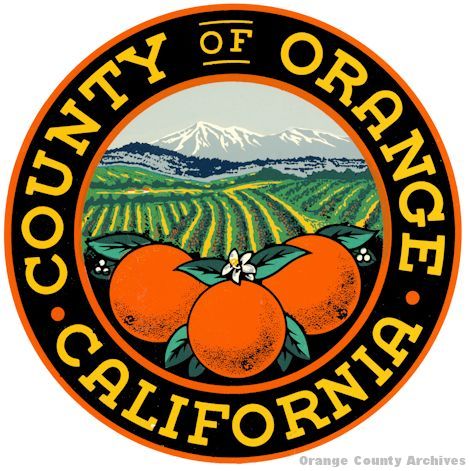
A circa 1960s decal of the Orange County logo.
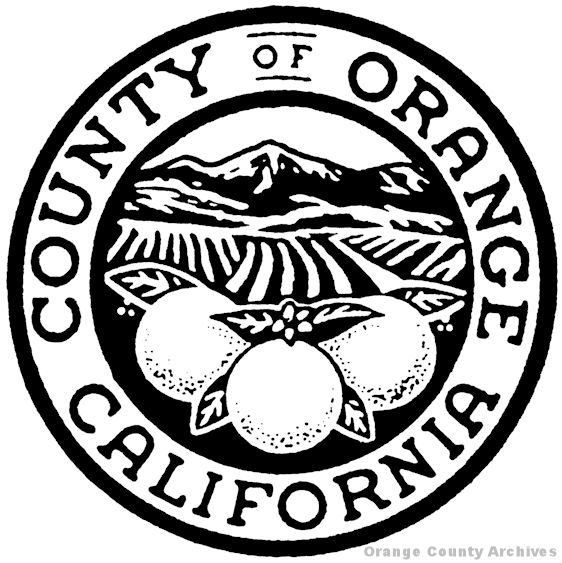
The much-used Orange County logo, with three oranges in the foreground and fields and mountains in the background, is a mystery. It seems I'm asked about its origins every year or two, which usually leads to a long email or phone conversation, or, in one case, to an article in Orange Coast magazine. Usually it's someone in government asking, but queries have also come from my readers and from groups that use some version of the logo in their own emblems. Often, they want to know if it's legal to use it. (I'm not a lawyer, but speaking as a mere mortal I can't see the harm in it. And since it's been used by many groups and individuals for many purposes over many decades, it might be difficult to copyright it at this late date.)

I hope this post will either stave off the next identical round of questioning or (better yet) inspire someone with MORE of the story to come forward.
Taken from a terrible photo of the logo as it appeared on the 1940 book of County Ordinances.
The earliest use of the logo I’m aware of (so far) is on the cover of a 1940 book of County Ordinances. The text in the ring surrounding the artwork reads “County of Orange, California,” in a font that feels very much of the 1930s. In the 1940 version, the central mountain in the background (although possibly backwards) seems to be intended to represent Old Saddleback. This detail is already screwed up by the version featured on the 1948 edition of the same publication. 
The Irvine Company's logo, from (damaged) 1956 letterhead. (Courtesy C. Michael Stockstill) 
As historian Phil Brigandi points out, the logo has design elements reminiscent of the old Irvine Ranch logo (shown above) and the Tustin city seal (shown below). But that may just be a coincidence.
Tustin's City Seal -- Which came first?
Dylan Almendral of the Santa Ana Public Library's History Room makes the excellent point that the county logo also bears some striking similarities to the medal issued to Orange County veterans of World War I.  It certainly could have played a role in inspiring the later design.
"Victory medal" issued to local veterans after World War I.
Although the county logo appears on county government letterhead, publications, vehicles, etc., it has never been officially adopted. It even appears on the center of our county flag, which was officially adopted in 1968.

Jeff Coloman, who has worked at the County's "Fruit Street Yard" since the early 1990s, says the Public Works Dept. guys who affix the logo on county vehicles and other equipment refer to it as "the County pumpkin."

"Even the old-timers, when I arrived here as a kid, always called it 'the County pumpkin," said Coloman. That would suggest that the nickname goes back to at least the 1960s.
1948 version of the "county pumpkin" from the 1948 book of County Ordinances.
The nickname seems like it would be more appropriately applied to the official county seal (shown below), which remains a single orange with three leaves, as approved at the very first Orange County Board of Supervisors meeting on Aug. 5, 1889. (I have yet to see an attractive colorized version of the seal. Most have the orange looking like an angry meatball.)

County seals have legal significance and are distinct from other kinds of logos or emblems.
The venerable Orange County seal -- Still in use where legally required.
Since nobody really owns the Orange County logo, it shows up in the damnedest places. In recent years, I’ve seen our County logo tattooed on the heads of gang members, appropriated as a corporate logo for sandbag manufacturer, carved into wood as the logo for the Orange County Woodcarver's Club, and sold on hats and shirts in the display window of a Santa Ana head shop. It is nothing if not versatile.
The O.C. Fire Authority logo better represents the foothills, but replaces farms with the sea, skyscrapers, and housing tracts.
It's an attractive image when well executed. But it's often "improved" or "streamlined" by ham-fisted would-be artists. Strangely,  one of the places where most versions -- including the original -- miss the mark is in the representation of Old Saddleback. Any Orange Countian knows those twin peaks like the back of their own hand, but these illustrations usually fail to capture their distinctive profile.
A particularly unfortunate version, with doggy-doo-like mountains.
Happily, around 2017 and 2018, I started to notice some of the crummier versions of the logo being replaced with better ones in both government and civilian use. Either my years of kvetching finally had some impact, or perhaps folks just have better design sense these days. Either way, the restoration/improvement of the old logo is welcome. It's pretty attractive when rendered properly.

Update - Aug. 23, 2023: 
In May 2023, the Orange County Board of Supervisors adopted "the Official OC Brand Merchandising and Marketing Plan" which (according to the pitch) would "provide opportunities to pursue merchandising, marketing, sponsorships and revenue partnerships with private sector organizations, businesses, and non-profit organizations to support programs and events administered by the County of Orange, including the Trademark License Agreement with 10th Hole Associates, Inc. which will permit the sale of County branded merchandise at Salt Creek Beach."

Today, I received an email that may reveal the fruit of their efforts. The missive included an attached event poster featuring a new "Official Orange County Brand." 
New "brand" and the event flyer on which it appeared, Aug. 2023.
The email stated that on "August 24th, the [County] CEO’s office will be part of the OC Park’s Summer Concert Series at Salt Creek Beach [in Dana Point] where we’ll be bringing along our latest wave of Official OC Brand merchandise designs, printed on high-quality tees, long sleeves, crewneck sweaters and die-cut stickers." (For what it's worth, the headliner for the concert was Flashback Heart Attack with Tina Tara as the opening act.) 

As far as I can tell, this is the first public unveiling of this new logo, which is strikingly reminiscent of the County Seal from 1889. At this point, the new "brand" just seems to be for merchandise. Is it meant to usurp the roll of the classic 1940s logo? If so, will it succeed? Time will tell.

Update - May 2026: 
The County of Orange's hiring department is now handing out free car air fresheners with a weirdly bastardized interpretation of the County logo. It almost seems like they were told NOT to use the county logo, but wanted to get as close as they could: Mountains in background, green fields in the middle ground and three oranges in the foreground. Is the ersatz-ness intentional, or is this just the historic first "AI slop" version of the County logo? 

Thursday, February 08, 2018

Working as a local historian

Fourth Street, Santa Ana, Decoration Day (Memorial Day), 1891.
A while ago, I got an email from a history student named Tim. He had a series of questions for me about "being a public historian," and I tried to answer them the best I new how. I thought I'd repost my response here in case anyone else is interested in such things.

Tim,

Let me give your questions a shot. I will begin, however, with the caveat that all I can do is answer for myself. People approach this kind of work in many ways, and generally I can only speak for myself and speak from my own philosophy.

- What do public historians do?

I’m not particularly religious, but I think the easiest parallel to what *I* do (and what I think others in this field SHOULD do) is to act as a sort of “history evangelist,” generating and sharing accurate and interesting local history to a population that knows too little about the subject. I say “accurate” because there’s PLENTY of half-baked local history being foisted off on the public in the form of badly research newspaper articles, Wikipedia entries, etc, etc. And I say “interesting” because you have to do your evangelizing in a way that *reaches* people. The best research and most groundbreaking work will be utterly wasted if doesn’t capture the public’s interest. You have to identify the audiences where your work will make the most positive impact and then figure out how best to engage those audiences. When I really got started in earnest in this field in the late 1990s, websites were clearly the way to go, so I built one. Later, blogs were the thing, so I started one. Now social media is the thing, so I’m trying to figure out how best to generate content that will work well on FaceBook (maybe short videos?). Along the way, I’ve done tours, written articles for journals (another smaller audience) and magazines, I’ve lectured extensively (mostly to community groups with an expressed interest in local history, rather than just being cheap entertainment for the Rotary Club), and tried to raise public awareness of local history by working on the board of the Orange County Historical Society.

And when I’ve seen a need, I’ve started non-profit groups specifically with the idea of letting other people run them. Sometimes a community of people who care about preserving local history just haven’t figured out they’re a community yet, and you can do some good just by being the catalyst and bringing the right people together.

So half your goal is generating meaningful, interesting and accurate historical content (and hopefully covering some new ground from time to time), and half is getting it out there into the world where it will do some good. How you choose to accomplish those goals is up to each historian.

Of course, you’ll also need a job that provides you with at least enough money for food and shelter.  Unlike *religious* evangelists, you don’t get to pass around a collection plate. Ideally, the job that pays your bills will dovetail with and compliment your work as a public historian. Here’s where I think I lucked out. I got a job working at the County Archives, where, among other things, I get to help OTHER people use our records to uncover the histories of their families, homes, or communities. In a way, I’m being a bit of a “history enabler,” -- Teaching members of the general public to be their own public historians (albeit with a narrow focus) and also actively helping them with aspects of research that can’t be taught in the short period of time that’s often available for a particular project.

Other public historians find work in museums, libraries, archives, etc.  Others teach. Still others end up in seemingly unrelated fields and do their history work in their spare time.

I think some of our best local historians have been those with a strong background in (and gift for) writing. Journalists and PR people (who usually have training as journalists) often make good public historians. The good ones already know how to dig out the facts, conduct interviews, do research, “get the scoop,” and communicate well in writing. Of course, its not all journalists and PR folks in public history, but there’s certainly a connection or trend there that’s worth noting.

Just roughly, one of the things good public historians do that’s different from other historians is that we tend to focus on the individuals or families or communities rather than on the sort of big, sweeping stuff that’s already been rehashed a million times. The world won’t benefit much from yet ANOTHER historian milking the big picture of the Civil War to try to get something new out of it. The world will benefit even less from an academic historian who wants to revisit the Civil War simply as a means of grinding some modern-day political axe (either their own or their professor’s). But there is value, for instance, in researching and telling the story of a previously ignored person (Civil War vet or not) who changed their community or industry or world in some way.

For example,… I wrote an article about the man who built and ran a hotel that was the hub of Orange County social and business life during the 1960s and 1970s. I wrote about the former Parks Superintendent of Anaheim – a fascinating guy whose gift for hybridizing plants gave us the Boysenberry and who helped Anaheim retain its sense of community at a time when the city was growing by leaps and bounds. I wrote another article about a small group of Los Angelenos who fought to create an all-black beach club at a time when only white people were allowed on most  L.A. beaches. It’s not like writing about Sherman’s March through Georgia or like writing about the Emperors of the Ming Dynasty.  It’s more about acknowledging that the myriad “average Joes” alive in those time periods were ALSO shaping our world and that that understanding society and individuals of all classes and from all angles gives a better picture of reality than once again returning, without a larger context, to the rehashing of generals and emperors.

- What important contributions do they make to their communities?

As America becomes more homogeneous (with an Applebee’s and a Walmart in every town) local history gives people a sense of place, a sense of community, and a certain amount of pride. At one level, people are more desperate than ever to have real-world connections to the place they live. Just one example: When people know the history of their homes – both the architecture and past owners – they tend to take better care of those homes, put more effort into restoring them, and connect with others in the community who are doing the same. This leads to improved neighborhoods, more community involvement, civic pride, more taxes generated for the city because of increased property values, etc. And that’s just one of the more obvious and tangible benefits. Likewise, awareness and appreciated of community history (perpetrated by local historians) led to places like Downtown Orange becoming not only a central part of the community’s identity, but also a thriving economic engine, whereas LACK of awareness and appreciated of community history led to the destruction of Anaheim’s entire historic downtown in the 1980s, leading to vacant lots and a zone of economic malaise that is only recently has started to show signs of turning around. 

Sometimes the historian’s important contribution is simply to debunk earlier legends or poorly-executed history that has placed false narratives in the minds of the public. People can learn from the past to make better decisions for the future, but only if they REALLY understand the past. Sometimes the important thing is to set the record straight because truth is important and should ultimately win out over falsehoods. Not that any historian can be perfect or universally comprehensive, but the goal is always to strive toward a more accurate depiction of the truth.

- What are some ethical issues you face as a historian?

Sometimes it would be very expedient to grossly oversimplify a topic to better please an editor’s length requirements or to make your work more easily digestible. But one must be careful about that. If you can say the same thing in fewer words, that’s probably good. But beware the moment when you find that the only way to turn your 600 word article into a 300 word article is by leaving your readers with an inaccurate (not just incomplete) impression of  your subject.

Also, avoid the allure of getting lazy. It’s true that most people will know almost nothing about your topic and that you could get away with cutting corners, using a Wikipedia entries as though they were valid sources, repeating hearsay, or cribbing from secondary sources you’d don’t entirely trust. No one beyond a few local historians will ever know or notice. But by perpetuating old bad information, you ensure that the next generation will have one more bad source to muddy the water. All you have as a historian is your reputation for accuracy. Once that’s called into question, your entire body of work (sometimes a lifetime’s worth) is thrown into doubt and becomes less valuable.

Another ethical issue is the question of what *kind* of historian you want to be: A hoarder or a sharer. I find that in the long run sharing what I know and what I have access to (for instance, photos or materials in my own files at home) with fellow historians is a big plus. The local history community is a small one, and we all have to stick together and help each other whenever possible. Even if someone is writing on a subject that I ALSO want to write about someday, I prefer to share what I have and know with them. They will undoubtedly take a different angle that I would have, leaving plenty for me to write about. Moreover, they will have added to the current scholarship on the topic at hand, providing me with slightly wider shoulders to stand on when I get around to writing about the same topic. Basically, it’s like we learned in Kindergarten: “Sharing is nice.”

Oh, and whether you’re using photos or information from other sources, always give credit where credit is due.

- What are some professional issues you face as a historian?

Low pay is pretty endemic in the history world. You won’t get rich doing this sort of work, but it makes a difference in the world, you meet a lot of wonderful people, and it beats the hell out of spending your life in one of those “veal fattening pen” cubicles in an office tower somewhere.  You should be a historian only if it brings you a lot of satisfaction and /or joy. If it’s just a paycheck to you, I recommend getting a job at Costco or something instead. (I hear they treat their employees well.)

Another issue is that you’ll undoubtedly spend SOME time working for or with folks who don’t understand what you do. That can cause a certain amount of stress. Many folks in the history world have to *explain* what they do to people who should already know.

- What do you see the role of public historian being?

We’re researchers, educators, and (in our best moments) defenders of our heritage and the truth.

- What was one of the most fulfilling Public History projects you worked on and why?

For me, the most fulfilling parts of my work as an archivist are when I can help someone find the information they need, especially when that information ends up being an interesting story. As a local historian, I suppose I most enjoy tackling a subject that hasn’t been written about before and then watching the story unfold as I do more and more research. The “aha” moment is pretty rewarding, and you get a lot of those.

I’ve also found, much to my surprise, that I greatly enjoy teaching local history through public speaking appearances. Telling stories and getting immediate interactive feedback is, again, extremely rewarding.

- In doing public history, what have you learned about people and interacting with people?

People say they aren’t interested in history, but they lie. Almost everyone is interested in SOME kind of history. To borrow a line from Phil Brigandi: If someone says they don’t like history, ask them what they ARE interested in.  They’ll tell you something like “baseball” and then will begin to tell you about the history of baseball (or whatever their interest might be). The trick is to find out what PARTS of history they ARE interested in. And local history has the advantage of being relatable because it’s all about our own backyards. You may have hated history class is school, but learning stories about your own neighborhood is a whole different thing.

On the issue of interacting with people, I would also say that a healthy dose of extroversion is helpful in this field. You need to be able to cold call people who MIGHT be the descendants of people you’re studying and then engage them in conversations. You need to communicate with librarians and other historians, and students, and the public. If one doesn’t enjoy engaging with people, you might do better as doing something where having a public face isn’t so important.

- How are public historians and academic historians different?

I’m going to make some gross generalizations here because whole books could be written on this subject. And I’ll begin by pointing out that there are lots of exceptions to any rule and there are some EXCELLENT academic historians out there right now. In fact, I can think of a few right here in O.C. that I’m proud to know.

That said, I think academic historians GENERALLY are stuck catering to a comparatively narrow and homogeneous audience: Maybe a handful of professors or peers or perhaps the modest readership of an academic journal. And those academic audiences GENERALLY have certain fad topics or pet issues that must be checked off in order to meet with approval in that particular subculture.

I do try to review academic sources (theses and other academic publications) that pertain to the subjects I’m working on. But more and more I find that such papers from recent decades TEND to be composed of recycled already-known information combined with whatever social or political opinions the student feels the academic faculty is most likely to agree with. This usually makes for a pretty thin gruel. An exception to this is when I need to access data from scientific academic publications, which tend to be more about data and less about proving allegiance to a subculture.

But again, I am speaking here in  very broad generalities.

Another difference I can point out is that academic historians probably generally have better pay, benefits, retirement plans, and built-in prestige (in many circles) than do public historians. So whatever kind of historian you want to be, it probably doesn’t hurt to have a few more letters after your name if possible. (Assuming you can afford the investment.)

- Why did you want to become a public historian?

Like so many of us, I didn’t know I was becoming a public historian. It just sort of happened based on my interests, skill set, and where life led me.

My high school photography teacher gave us an assignment to photograph a series of related things and make a display or mini-exhibit out of the images. It dawned on me that photographing old buildings in Downtown Huntington Beach (my hometown) might be interesting. I was excited to get started and a bit surprised when people started coming out of those buildings, asking what I was doing, and then telling me stories about their homes or family businesses or whatnot. I met a lot of interesting people that way and one introduced me to the City Historian, which was a job I didn’t know existed. The City Historian, Alicia Wentworth, showed me a bunch of the cool stuff in the city’s photo collection, and then hired me as her photographer to go out and expand that collection. (My first paying job.)

Later, in college, I was drawn to an opening as a docent at what’s now the Heritage Museum of Orange County in Santa Ana. Giving tours and sharing history with groups of kids and adults was also very rewarding, but I didn’t ever think of it as a career path.

Later still, I found myself researching and documenting Orange County’s remaining Googie architecture in my free time – simply because the subject interested me. That led to working with Jane Newell at the Anaheim Heritage Center who wanted to build a record of Anaheim’s Googie for the benefit of future researchers. When I found out she’d learned about the subject based on the website I’d been assembling, it was quite a shock. It was the first time I realized that an ordinary guy with a camera, a willingness to do research and a way to communicate with the public could make a real difference! Here was a city project initiated because of something I’d been doing as a hobby! But again, I never saw this as a career – Just as something I did in my spare time.

But some years later, I found myself becoming less and less enamored of the career I HAD chosen – public relations and marketing. Although some clients I’d had were wonderful to work for and with, the lifestyle and the emotional rewards just weren’t there. Then, magically, the new County Archivist (and longtime public historian,) Phil Brigandi, called me out of the blue and offered me a job working for him. He knew I’d been doing this sort of work on my own for years and he needed an Assistant Archivist. Without asking about pay or much of anything else, I said yes! 

I guess if anything convinced me that this was my calling and my career, it was my five years of “apprenticeship” working for Phil. He was an amazing roll model and teacher. He showed me not only how local history works, but also why it’s important, what pitfalls to avoid, and how much can be accomplished. I couldn’t have asked for a better teacher. And I don’t think I could have replicated that kind of education in school. Anyway, it didn’t take long for me to figure out that this was the kind of work I SHOULD have been focused on from the start. I dove in with both feet and never looked back. Or to put it another way, I renounced evil, took my vow of poverty, committed myself to study, and went forth to spread the good word of Orange County history.

I hope this helps, Tim. I’ve probably prattled on for way too long here, but hopefully somewhere amidst all this I’ve also answered your questions. Feel free to get in touch if you have more questions.

All the best,

Chris