Sunday, April 08, 2018

F. B. Silverwood and Our State Song (Part 5)

Silverwood with fishing buddy, author Harold MacGrath, 1914
[Continued from Part 4]

In 1913, California was threatened with yet another state song: "My California," by George Edgar Shinn of Petaluma. Attempts to make it official tanked in the legislature, like its predecessors.

But the popularity of Silverwood’s “I Love You, California” was still growing. In 1915 it served as the official song of both the Panama-Pacific International Exposition in San Francisco and the Panama-California Exposition in San Diego -- events that had far-reaching effects on California. Still, Senator William Scott's 1915 bill to make it the official state song narrowly failed, his fellow legislators deeming the song too "ephemeral" to be dignified with legal recognition. He was just a little ahead of his time.

The song also briefly became a battle cry for reformers seeking improved and better maintained safety signals at railroad crossings. In May 1916, three young girls were blithely singing “I Love You, California,” in the back of their father’s car, headed down Highway 101 through Irvine on their way to see the ruins of Mission San Juan Capistrano. Warning signals failed to operate and the back of the car was hit by a speeding train, killing the children. Horrified members of the public told their state legislators that the “greatest state of all” should provide greater safety measures at rail crossings.
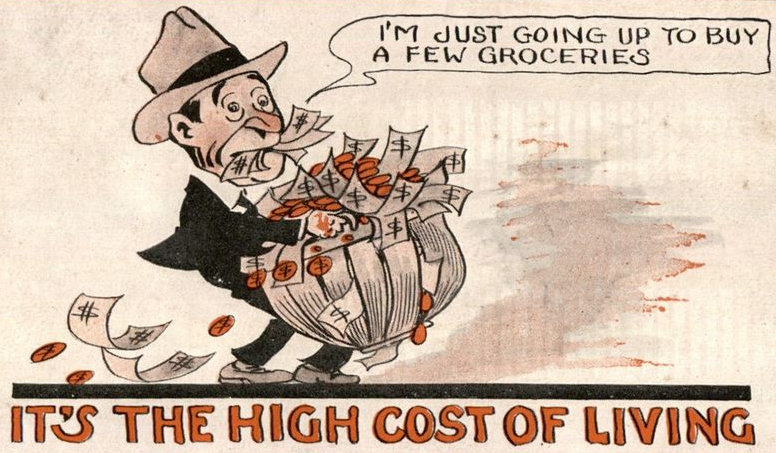
Although "I Love You, California" was again voted down as our state song by the legislature in 1917, it was becoming part of the warp and woof of California. So popular was the tune that it became a template for parodies and satire. In 1920, one Santa Ana resident with the initials H.G.H., modified the lyrics to compliment his letter to the Santa Ana Register's editor, detailing how inflation and the high cost of living had made it too expensive even to buy a sack of lowly potatoes.

I LOVE YOU, O POTATO!

How I love you, you potato!
You're the grandest of them all:
I love you in the winter, summer,
Springtime and the fall;
I love you raised in valley.
And from the mountains I adore;
But H-C [high cost] of living--
I can't buy you any more.

(Chorus)
Where the snow-crowned Sierras
Keep their watch o'er your bloom,
I'd plant you there
In our land fair,
In every bit of room;
And if Nature would give her rarest
It would be Jake to me;
So when I come to die,
I will breathe with a sigh
For you, Sunny California's Spud!


I have loved the sweet potato,
And I love the Irish, too;
I love them fried in butter,
And baked, and in the stew;
I have loved them in the garden.
I have loved them on the vine.
But the Japs have got our nanny now--
The Mrs.'s Goat and mine.

How I love you, you potato!
You are very dear to me,
I love to see you growing
From Stockton to the sea;
I have seen you sacked and rotting,
I have seen you all mildew,
But we have upon the table, now,
A photograph of you.

How I love the dear old Burbanks,
In patches stretching far;
How I loved the Early Roses--
Until they sold at par;
I love you, yes, forever.
But yet it makes me blue;
Your fine when in cold storage,
But you're finer in the stew.


Okay, so the chorus is a clinker. But the author had an intuitive grasp of Yankovic's Third Law: If you take a popular song and change the words to be about food, you've got yourself a hit parody!

[Ed -- I promise, no more wince-inducing lyrics in this series from here on -- Unless you count a short poem, quoted in Part 9, which really isn't half bad.]

Next time: The Newsboy’s Friend

Friday, April 06, 2018

F. B. Silverwood and Our State Song (Part 4)

Sheet music for our state song.
[Continued from Part 3]

Having fully adopted the lifestyle, attitudes, and internal thermostat afforded by the Golden State, Frank Silverwood was none too thrilled when necessity sent him to the east coast on a buying trip in the dead of winter. He found himself eating dinner alone in a New York cafĂ©, homesick for Los Angeles and fed up to the gills with the miserable snow and cold. When the house band began belting out “Maryland, My Maryland,” it was the last straw.

Then and there, Silverwood decided to write a song about his beloved California. On his way home, he wrote the lyrics, into which, as the Los Angeles Times put it, “he poured all the earnest deep-felt love a man can have for his homeland.”  Those lyrics are…

I love you, California, you're the greatest state of all.
I love you in the winter, summer, spring and in the fall.
I love your fertile valleys; your dear mountains I adore.
I love your grand old ocean and I love her rugged shore.


(Chorus)
Where the snow crowned Golden Sierras
Keep their watch o'er the valleys bloom,
It is there I would be in our land by the sea,
Every breeze bearing rich perfume.
It is here nature gives of her rarest. It is Home Sweet Home to me,
And I know when I die I shall breathe my last sigh
For my sunny California.


I love your red-wood forests - love your fields of yellow grain.
I love your summer breezes and I love your winter rain.
I love you, land of flowers; land of honey, fruit and wine.
I love you, California; you have won this heart of mine.

I love your old gray Missions - love your vineyards stretching far.
I love you, California, with your Golden Gate ajar.
I love your purple sun-sets, love your skies of azure blue.
I love you, California; I just can't help loving you.


I love you, Catalina, you are very dear to me.
I love you, Tamalpais, and I love Yosemite.
I love you, Land of Sunshine, Half your beauties are untold.
I loved you in my childhood, and I'll love you when I'm old
.

In addition to scratching an itch, and celebrating a love more permanent than his marriage, Silverwood’s new song also had “a real purpose back of it,” he said. “I was troubled by the sectional strife growing up between northern and southern California and felt that our people must get together some way” and that appealing to “state-love and state pride” might be “the best cement for the broken relations.”
A. F. Frankenstein (not Fronkensteen) in 1908.
Soon after arriving home, Silverwood presented his lyrics to Abraham Franklin Frankenstein, conductor of both the Orpheum Theatre Orchestra and the Al Malaikah Shrine Band. Frankenstein liked what he saw and wrote music to go with the lyrics. The song was copyrighted in 1913.

Silverwood would never make a dime on “I Love You, California.” He and A. F. Frankenstein gave all royalties to the Shriners, initially to finance the Al Malaika (Los Angeles) Shrine delegation’s trip to the 1913 meeting of the Imperial Council in Dallas. Of course, with the song’s unexpected popularity, the Shriners had plenty of royalties to put toward their charity causes as well.

Silverwood later signed over future proceeds to the Shrine charities in his will. Frankenstein’s descendants gave their share of the proceeds to the Crippled Children’s Hospital in San Francisco, and signed over any remaining rights they had to the song to the State of California in 1971.
Mary Garden, looking dyspeptic on the sheet music cover.
In early March 1913, famed soprano Mary Garden was in Los Angeles to perform the lead in the Chicago Grand Opera Company’s production of Nantoma – an opera set in Santa Barbara during the “Days of the Dons.” While in town, she agreed to be the first to perform “I Love You, California” publically, at a Shriner convocation.  The Shriners responded at the end of the song by cheering, jumping up on chairs and waving their fezes. They "rushed to Mary," wrote the Los Angeles Times, "each with a blood-red rose. They wound ribbons around her glistening neck. A basket held in her hands was filled to overflowing with the roses and she was well-nigh choked by the ribbons, but she smiled through it all and waved her ostrich plume fan, and marched around the room at the head of the procession."

Then the Shriners put Garden up on a chair, and marched around her, serenading her, throwing rose petals, and occasionally pausing momentarily for someone to further acclaim the wonders of their guest of honor.

Over the next few days, Garden would sing the song at least twice more: Once at a fireman’s benefit show and then, on March 14, at the end of a performance of Nantoma. The opera, by many accounts, stank. By comparison, Garden’s coda was a breath of fresh air. The audience gave a standing ovation for “I Love You, California,” and called for and received an encore. A group of Shriners in the audience jumped in on the chorus. These performances set the song on the road to widespread national popularity and robust sheet music sales.
Mary Garden as Natoma. Photo courtesy Library of Congress.
Next time: Orange County reacts

Thursday, April 05, 2018

A good old fashioned Orange County snipe hunt!

We've all heard of the snipe hunt: The time-honored camping tradition where a hapless victim is given a bag or pillow case and sent out into the night to crouch among brush and make strange “snipe calls” to lure the wily snipe. Eventually, the poor sap figures out he’s waiting to catch an imaginary animal while everyone else is back at camp laughing their butts off. This hazing tradition goes back at least to the 1840s.

But the truth is, snipe are REAL, they’re a type of bird, and Orange County’s got ‘em! In 1893 – the same year he founded the San Joaquin Gun Club and a few years before founding Bolsa Chica Gun Club, Count Jasco Jaro von Schmidt described our ample snipe supply: "The English snipe … the delight of the gourmand, is found in great numbers all over the artesian belt district of the county. Last season I bagged, near Westminster, seventy-on English snipe in one day.”

The Count was well known for exaggerating his hunting prowess, so take that for what it’s worth. But even bagging a single snipe is no mean feat, as they tend to fly in an erratic corkscrew pattern. An 1888 article about English snipe in Punch magazine stated, "All sportsmen desire to be considered good snipe shots, because he is the hardest bird in the world to hit. I mean to hit with shot fired out of a shotgun. I think a good player could hit one with a base-ball bat, because the bird flies much after the manner of the erratic curved ball of the moderns."
English Snipe lithograph,  Currier & Ives, circa 1871 Courtesy Library of Congress
Further research shows that the English Snipe is also known as Wilson's Snipe or the Jacksnipe. It can still be found among the grassy sand hills of Orange County’s wetlands, albeit in much smaller numbers than in the Count’s day.

“Santa Ana marksman Ed Vaughn made a living shipping [snipe] to San Francisco,” wrote Jim Sleeper in his second Orange County Almanac of Historical Oddities. “One time he asserted, ‘They didn’t want me to [gut] them, as epicures considered the entrails the choicest part of the bird’ – which says a lot about the people of San Francisco.”

Sleeper goes on to point out that Gabe Allen’s place (now Estancia Park in Costa Mesa) was a popular spot for snipe hunting. Why don’t you head up there with a pillow case and a stick some night, and see if you can nab a few? I hear if you crouch in the brush and make a loud “kikery-KEE!” noise over and over again, it really brings ‘em running.
"English Snipe" chromolithograph by A. B. Frost, circa 1895

Tuesday, April 03, 2018

Which flavor of history?

I sometimes find myself having to define the differences between academic historians and public/local historians. It’s not enough to just say, “Academic history is the reason most people say they don’t like history, whereas local history is made up of stories about real people in your own backyard, which is ALWAYS interesting.” Seriously though, the differences between the two approaches are worth thinking about. Shedding at little light on the subject is this article by Prof. Raymond Starr of SDSU, which I stumbled across in an old (March 1983) copy of California Historian. I’ve cherry-picked some excerpts that I found particularly enlightening:

“It is curious that professional academic historians have disdained local history for the last century, because history in America was local history in the beginning. Indeed… even after the emergence of national history as part of the nation-building of the 1830s, local history continued to be more important.
 
“The situation began to change toward the end of the 19th century. Up until that point, history had always been written by amateurs - lawyers, ministers, teachers, retired generals... In the 1870s and 1880s, ‘professional’ history arrived. Coming into American universities from Germany, a new ‘scientific’ history began to dominate. It demanded university training in the new methods of research, analysis of evidence, documentation and writing. Hence departments of history, doctorates in history, and professors of history began to emerge in most American universities. With it came ‘professionalization’ and a professional organization, the American Historical Association, organized in 1884. …That organization and the universities came to be dominated by a very narrow, academic form of history which stressed national and international political, diplomatic, constitutional and military history, and which disdained as antiquarian and narrow, local history.
 
“Not only did the academic historians disdain local history as a field of study, but they also disdained the organizations and institutions of local history - the museum, the local historical society, etc. These matters remained in the hands of amateurs or of what we now call ‘public historians,’ who operated without university affiliation…
 
“That is what is changing today. …Professional historians in the universities have begun to work in local history. …Why have university historians discovered local history? The decline in teaching jobs and enrollments in the last decade has forced colleges to look for courses and programs which appeal to students. One of the phenomenons of the 1960s and 1970s was a great upswing of public interest in local and family history…
 
“…Academic historians are going to have to learn that many people in local history - writers, historical society staffs, museum and historical park staffs, archivists and librarians - are professionals in their own right. They may be different from professors, but they are not necessarily inferior. The emergence of the public history movement shows that some academic historians are capable of bridging the gap between university and public historians. Let us hope this continues and more and more academic historians are able to change their attitudes.
 
“At the same time, the non-academic local historians often show hostility toward university historians. Publications and meetings of archival, museum and preservation organizations ooze hostility toward the professor. These negative reactions come from many sources. One is the natural and understandable reaction to the rejection of local history and local historians by the academicians over the last century. …Archivists, museum staffs, people with historical societies have to come to recognize themselves that they are professionals making unique and absolutely essential contributions to local history.”

Monday, April 02, 2018

F. B. Silverwood and Our State Song (Part 3)

Westminster, 1911: Hub of culture and the arts. (Photo near corner of Westminster Blvd. and Olive St.) Photo courtesy Orange County Archives
[Continued from Part 2]

In 1911, Orange County Assemblyman Clyde Bishop introduced a bill that would have made “California (Land of the Setting Sun)” – a 1907 song with words and music by Mrs. Harriet M. Burlingame of Westminster – our official state song. The effort failed but laid the groundwork for Silverwood’s success soon thereafter.

Burlingame’s lyrics – awkward and hokey, but a marked improvement over Gro’s – went like this:
A song to thee of loyalty. A song of the Golden West;
A land that lies ‘neath sunlit skies,
Beside the Pacific’s breast.

Thy native son and adopted one
From snowy climes agree
That heaven crowned this land renown—
Land by the Western sea.

(Chorus)
California fair, California rare,
all nature sings to thee.
The balmy breeze, the fragrant trees,
the blue of sky and sea.
Mission bells sweet chimes,
as in olden times,
and the mocking birds in the vale,
Let the chorus rise to the sunny skies, Eureka California hail.

Thy hills hold wealth, thy breezes health,
thy valleys fruits and flowers.
Here the orange bright blends golden light
with the poppy pride of ours.
Oh, the lofty heights of Shasta white.
Oh, grand Yosemite.
From south to north thy fame goes forth
from Sierras to the sea.

We lowly bend, for heaven doth blend
with sunshine, shadows cold;
But God's above this land we love,
above the blue and gold.
So here we'll wait 'till the Golden Gate
shall ope when day is done.
Almighty Hand, hold thou our land,
"Land of the Setting Sun."
Assemblyman James W. Hamilton from Petaluma suggested that the work “Eureka” could be mistaken for the town of that name, and humbly recommended replacing the word with “Petaluma.” Legislator E. C. Hinkle of Sacramento objected to the mention of mockingbirds in the song, as he supported a law to legalize extermination of the noisy little bastards.

Milton Schmitt of San Francisco, looking down his nose at both the song and Orange County, recommended the matter be referred to the Committee on Overflow and Swamp Lands. (Schmitt was also among the few California legislators to vote against women’s suffrage that year.) Ultimately, the Speaker could find no committee suited to judge music, and in desperation passed the matter to the Judiciary Committee. The committee reviewed the bill and recommended passage with the proviso that Mr. Bishop sing the ditty, opera-style, on the floor of the Assembly. One member asked, "Wouldn't Bishop look cute in tights?"
O.C. Assemblyman Clyde Bishop promotes “California (Land of the Setting Sun)” in a Los Angeles Times cartoon, Feb. 8, 1911.
Bishop wanted no part of singing and said he might better use his time on the floor to tell the other members to go to hell. He suggested that Judiciary Committee Chairman William Kehoe might want to sing the song in front of the assembled body himself. That offer was also declined, but somehow the Assembly finally approved a slightly modified version of the song none of them were willing to sing.

The State Senate, however, shot it down. There had been harsh criticism of the song not just in Sacramento’s halls of power, but also in the press. "We have no sympathy with [Bishop]," snarked the Pacific Rural Press & California Farmer, "who moved to refer the bill to the Sacramento poundmaster on the ground that it might be doggerel."

Under the headline "Poetry That Snores," the San Francisco Call's Edward Cahill wrote, "In order to stock up with a full line of legislative nincompoopiana, it seems that we are to have a state song imposed on us without our consent, written by the poetess of Gospel Swamp, somewhere in the bogs of Orange County,... The stuff is utterly commonplace and could be written by the yard by any literary blacksmith. If the legislature has nothing better to do than make a laughing stock of California it might better adjourn and go home. As for the state song--forget it."
Capitol Building, Sacramento, 1915. (Photo courtesy California State Archives)
But California would not forget their desire for a state song, and Frank Silverwood would soon play a central role in filling that vacuum.

Next Time: Frank Loves You, California

Sunday, April 01, 2018

April Fool Addendum

April Fool! Some folks were pretty upset about my April 1 post this morning, until they figured out it was satire. The point of the article was that historically important sites are CONSTANTLY being destroyed in Southern California.

Even as we speak, there are very real plans to build large blocks of modern housing in charming little Los Rios – the oldest neighborhood in California. Even now, the remains of the early 1900s Japantown at Wintersburg are slated to be scraped clean and replaced with a Public Storage facility. At this moment, one of the best bits of Googie architecture remaining in O.C. – the Beach-Lin Car Wash – is facing its doom. And by the end of today, the former Sam’s Seafood building (preserved and restored for some years as Don the Beachcomber) will serve its last meal and its last drink. And that’s just the tip of the iceberg.

We SHOULD be outraged, not just when something as OBVIOUS as the Mission is threatened (which it isn’t), but also when OTHER important historic sites are threatened. Righteous indignation and hard work have saved a few important sites in O.C. over the years, including the Old Orange County Courthouse, which was once slated to become a parking lot.

If you’d like to learn more about preservation efforts and REAL threats, follow Preserve O.C. on their Facebook page.


San Juan Mission to Move

After more than two centuries at the same location, Mission San Juan Capistrano is moving to a new location. In early 2017, it was determined that the Mission wasn’t bringing in nearly enough income to warrant the right to occupy ten acres of prime South Orange County real estate. Now plans have been approved to turn the Mission property into a mixed-use development called SWALLOW and to move certain museum elements to a San Clemente shopping center.

“I want to make sure people understand the Mission is just moving, not closing,” said Robin Passerine, Vice President of the development firm SWALLOW Properties, LLP. “A new and improved version will be moving into a great ocean-view commercial space at the Outlets in San Clemente, which opened in 2015. Mission fans are really going to be delighted by what we have in store for them, including interactive exhibits using VR technology. We’re also putting in a bunch of swallows nests along the exterior, with animatronic birds that pop out at intervals – They’re much more reliable than the real ones, which tend to migrate. There will also be plenty of parking for school buses right in front of the gift shop, along with a variety of adjacent dining options.”
Artist's concept of SWALLOW mixed-use development at the Mission site.
 Meanwhile, back at the old Mission site, Passerine said, “We’ll be creating an experience with a mixed-use live/work/play space that will include shops, a gourmet food hall, a boutique hotel, loft condominiums, and even a pocket park on the site of the Serra Chapel. The park will feature themed play equipment, so children will be able to climb over low adobe walls, climb into a caretta, or peek out the entrance of a giant swallows nest.”

Nearby, a restaurant patio built over the Mission cemetery will use Fr. St. John O’Sullivan’s grave marker as a dramatic centerpiece.
Adobe walls come down easily, exposing inferior early construction techniques.
SWALLOW will be LEED-compliant and its design will also use arches, heritage colors, historical signage, and a repeating motif of cliff swallow silhouettes to reflect the site’s rich traditions.

Plans for SWALLOW promise “catalytic activity, vibrant streetscapes, and a tenant mix reflecting the rich history and culture of San Juan Capistrano.”
Parts of the mission's north wing are raized to make way for a parking structure.
It will not be the first move for the Mission.

In 1775, Franciscan missionaries selected a site for Mission San Juan Capistrano about two miles northeast of its current location. Soon thereafter, there was a native uprising in San Diego, and the padres and soldiers were called away to help. Father Serra himself rededicated San Juan Capistrano at its original site, or “MisĂ­on Vieja,” in 1776. A few years later it was moved to a new site that had a better water supply. In 1782, the Serra Chapel – the oldest California building still standing – at its current location in San Juan Capistrano. A large stone church was completed in 1806, but it was destroyed in an 1812 earthquake that also killed 40 Native Americans.
Animatronic swallows will pop in and out of artificial nests at the new San Clemente location.
“That earthquake did a lot of the demolition work for us,” said Passerine. “Why they’ve hung onto a pile of rubble for all these years is unclear. That parcel fronts both Ortega Highway and El Camino Real and is freeway close. It’s terribly under-utilized.”

Local reaction was mixed. “It’s sad to lose an important California landmark that’s central to our community’s history and identity,” said Cliff Bird, who was walking past the Mission on his lunch break.  “But the economy is the economy, and if development brings in more money than a mission, there’s no way to argue against progress. Cash is the only way to measure whether something is successful or has value.”

[UPDATE: Click through to an addendum on this post.]
Juaneño activist Janet Natoma stands between the bell wall and a wrecking ball.

Friday, March 30, 2018

Hurlbut, Knott's. Tiki, OCHS, etc...

On the heels of my two-parter about Bud Hurlbut's unrealized Polynesian boat ride at Knott's, Chris Murray was kind enough to send a long these aerial photos he purchased at Bud's estate sale seven years ago. As he points out, they really show how developed things were on that side of Highway 39.
Speaking of my Tiki Lagoon website, I posted a little tribute to the Sam's Seafood/Don the Beachcomber there a couple days ago. It's so sad to see this O.C. landmark disappear. I'll write a longer piece about it soon.

In other news, the Orange County Historical Society's office and archives will be open tomorrow (Saturday) from 10am to 2pm. Feel free to come by if you have research you'd like to do. We may not have time for idle chatter tomorrow, as there's still a lot of work to do on the collections.

Special thanks to Joan at the Cheney Washington Historical Society for her help with a bedeviling detail or two in researching my ongoing F.B. Silverwood series of articles. Turned out I was barking up the wrong tree, but thanks to her at least I know that now. Also thanks to Stephanie George for assisting me with her mad genealogy skills. (For the two history folk in the world who don't know this yet: The tools of genealogy work equally well in researching long-dead people you're NOT related to!)